
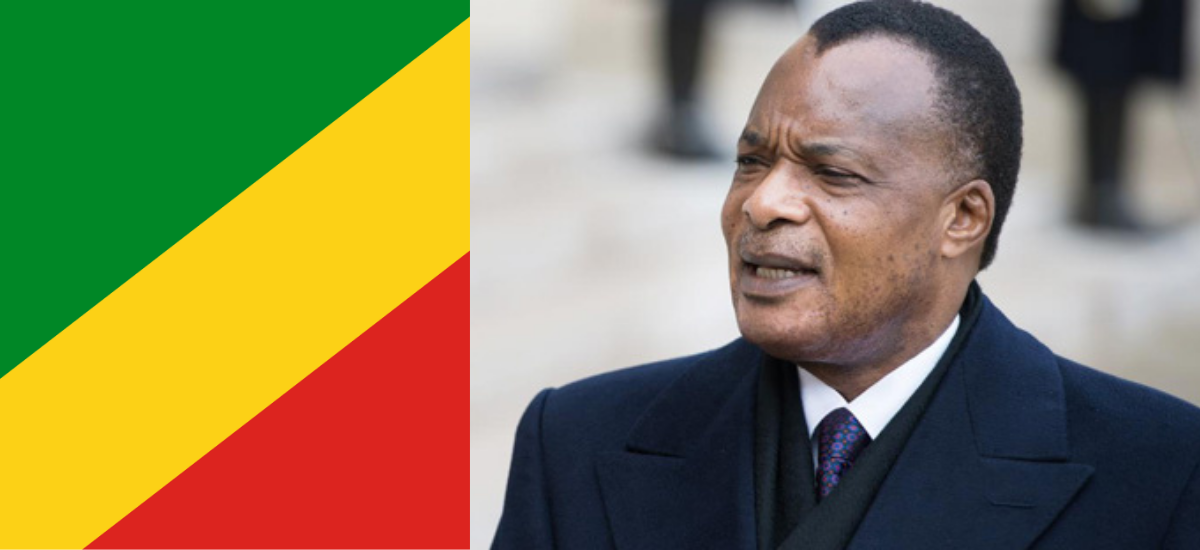
Denis Sassou Nguesso has just won 94.82 percent of the vote in the Republic of Congo’s presidential election, extending his rule to nearly 42 years. He is 82 years old. His nearest challenger received 1.48 percent. The internet was shut down on polling day. The main opposition did not field a candidate. The polling stations in the capital, Brazzaville, were largely empty. The state television announced the results. This is what passes for an election in one of Africa’s most resource-rich, and most misgoverned, countries.
Before going further, one clarification matters. Congo Republic, formally the Republic of the Congo with its capital in Brazzaville, is not the same country as the Democratic Republic of Congo, the vast nation to the east with its capital in Kinshasa. They share a river border and much of the world’s confusion. Congo Republic is the smaller country, home to approximately 6 million people, and is Sub-Saharan Africa’s third-largest oil producer. It is oil-rich, resource-rich, and profoundly poor. It is not, however, the most resource-rich country in the world, that distinction belongs to its neighbour, the DRC. But the paradox of Congo Republic’s situation is stark enough without embellishment. The country pumps 236,000 to 252,000 barrels of oil per day. Oil accounts for roughly 70 percent of exports and 40 percent of GDP. And more than half the population lives below the poverty line.
Who is Sassou Nguesso and how did he get here
Denis Sassou Nguesso was born in 1943 in northern Congo. A former paratrooper colonel, he first came to power in 1979 following a military coup, ruling under a one-party Marxist-Leninist system aligned with the Soviet Union. For thirteen years he governed with complete authority, accumulating personal power and consolidating northern ethnic networks, particularly from his Mbochi group, in the army and state apparatus.
In 1992, as the Cold War ended and international pressure mounted, Congo held its first multiparty elections. Sassou Nguesso lost, becoming the first sitting African president to lose a free election. Pascal Lissouba was inaugurated. It did not last. In 1997, in elections that descended into a four-month civil war, Sassou Nguesso returned to power by force, armed and backed by Angolan troops, with France widely believed to have favoured his return over Lissouba’s. He has not left power since.
From 2002, elections became the mechanism through which he performed legitimacy without risking it. He won in 2002, 2009, 2016, and 2021. In 2015, facing a constitutional barrier: a two-term limit and an age cap of 70 that would have ended his presidency, Sassou Nguesso called a referendum to rewrite the constitution. Security forces dispersed protests with live rounds. The referendum passed. Term limits were abolished. The age cap was removed. He was now free to run indefinitely, and he has.
The 2026 election followed the established template. General Jean-Marie Michel Mokoko, who ran against Sassou Nguesso in 2016 and won an estimated 14 percent, has been in prison since 2016, convicted on weapons charges that his supporters call politically motivated. André Okombi Salissa, another serious rival, has been imprisoned since 2018. The opposition coalition Alliance for Democratic Alternation chose not to field a candidate, citing a lack of electoral transparency. The seven candidates allowed on the ballot by the Constitutional Court were, with one exception, unknown figures. Sassou Nguesso alone was permitted to travel the country during campaigning. His effigies lined the roads of Brazzaville. The internet was cut on polling day. Turnout was reported at 84.65 percent despite visibly empty polling stations. His son Denis-Christel Sassou Nguesso sits in the National Assembly, and many analysts read the 2021 constitutional amendments as preparing a dynastic succession.
What progress has he actually made
The honest answer is: some, but insufficient, and structurally distorted. Congo Republic has built roads, universities, and some infrastructure, primarily concentrated in Sassou Nguesso’s home northern Cuvette region. The country has produced significant oil revenue over four decades. GDP growth was estimated at 2.9 percent in 2025. Congo completed a three-year IMF programme in 2025, its most recent in a series of bailouts stretching back to 2010. The government has made progress diversifying into gas and mining. A pipeline between Pointe-Noire and Brazzaville is under construction with Russian involvement.
But the macro numbers tell a different story. Public debt stands at approximately 94.5 percent of GDP. Debt servicing absorbs more than 60 percent of government revenues. Youth unemployment has fallen from 44 to 39 percent by the government’s own count, which is still catastrophically high. Extreme poverty has risen by over 50 percent despite oil sector growth. The state health system suffers from drug shortages, unpaid workers, and failing infrastructure. The capital lacks reliable electricity and running water for large portions of its population. A young student named Chris Taty told Al Jazeera that he did not vote because “everyone already knows who is going to win. Sometimes we joke that Sassou is our grandfather. He has been ruling for so long that many of us have never known another president.”
What do people really think
In a country where the two most prominent opposition figures have spent a decade in prison, where opposition parties are suspended, where public gatherings are monitored, and where the internet is cut on election day, people think what they think privately. What they say publicly is constrained. A teacher who voted told the Associated Press that Sassou Nguesso would “win with a high score as usual.” The exiled dissident Andrea Ngombet, founder of advocacy group Sassoufit, has described Nguesso’s legacy as “gross underdevelopment and corruption.” Youth unemployment and the visible disconnect between oil revenues and daily living standards produce widespread cynicism. The AU observer mission, led by former Ghanaian President Nana Akufo-Addo, praised the election’s “calm and secure atmosphere.” That is a standard diplomatic formulation.
Is this his last term
Constitutionally, yes. The current constitution, even as amended, limits Sassou Nguesso to three additional five-year terms from 2016, making this final term run until 2031. He told AFP he would not remain “in power forever” and that younger generations would have their turn. He declined to name a successor.
The succession question is the defining political dynamic of his fifth term. Denis-Christel Sassou Nguesso, his son, is a member of parliament and was, until 2021, a powerful figure at the national oil company SNPC, where US prosecutors allege he embezzled millions through shell companies to fund luxury properties and goods in the United States, France, and elsewhere. French investigators have been pursuing various members of the Sassou family for over a decade under the “ill-gotten gains” legal framework, charging multiple family members. In 2019, San Marino authorities seized €19 million allegedly deposited by the president himself. The dynasty is under sustained legal pressure in Western courts even as it tightens its domestic grip.
The Western relationship and what it means
The question of Western influence on Congo Republic is not one of pressure but of complicity. France has been the most consequential external actor. French support, direct and implied, was central to Sassou Nguesso’s 1997 return to power. French oil companies TotalEnergies and Eni have been major players in Congo’s oil sector and have faced Italian and French investigations into their Congolese business dealings. Congo has received four IMF bailouts since the 1980s, with each programme providing international legitimacy and financial oxygen to a regime that systematically undermines the structural conditions for growth. The West has, on balance, prioritised stability, oil access, and counterterrorism partnership in Central Africa over democratic accountability in Brazzaville.
China has replaced some of that dependency. China is Congo Republic’s largest oil export customer, accounting for approximately 24 percent of oil exports. Russia is involved in infrastructure construction and has signed an agreement for a new oil pipeline. Sassou Nguesso has explicitly committed to continuing his partnership with Russia. The geopolitical alignment of Congo Republic’s government is increasingly multipolar, hedging between Western energy investors and Eastern political patrons.
Can he turn around the country
No, and the structural reasons are clear. The resource curse operates through the political economy of patronage: oil revenues flow to a narrow elite connected to the president, creating no incentive to develop the tax base, diversify the economy, or build institutions that would outlast any single government. Sassou Nguesso has had 42 years to build those institutions. What he built instead was a machine for personal and familial enrichment, supported by a security apparatus, an ethnically captured officer class, and international partners who found it more convenient to negotiate with one man than to support the development of Congolese civil society.
The IMF programme completion in 2025 is real. The debt restructuring is real. Gas diversification is real. None of it adds up to transformation. The country has been cycling through IMF programmes and oil booms and debt crises for four decades, and the structural conditions remain: a dominant resource sector, a captured state, absent rule of law, a suppressed opposition, and a population that has internalised the futility of political participation.
What is likely in Sassou Nguesso’s final five years is not transformation but managed succession. The machinery of the state will be deployed to position whoever the ruling party selects as his heir, whether his son or another loyalist, for a post-2031 transition that maintains the fundamental architecture of the current system. That is not turnaround. It is continuation under a different name.
Bigger Picture: The Republic of Congo is not the most resource-rich country in the world. But it is rich enough, in oil, in forests, in mineral potential, that the poverty of its 6 million citizens is a political choice, not an economic inevitability. Denis Sassou Nguesso has governed that choice for nearly half a century. The 94.82 percent result in March 2026 is not a mandate. It is a measurement of how completely one man has eliminated the conditions under which a mandate could be given or withheld. The real question for the next five years is not whether Sassou Nguesso will turn the country around. It is whether the succession he engineers will produce someone willing and able to dismantle the system he spent a lifetime building and whether the international partners who have financed and legitimised that system will finally ask that question of themselves.
Source: The East African / Al Jazeera / Reuters / France 24