
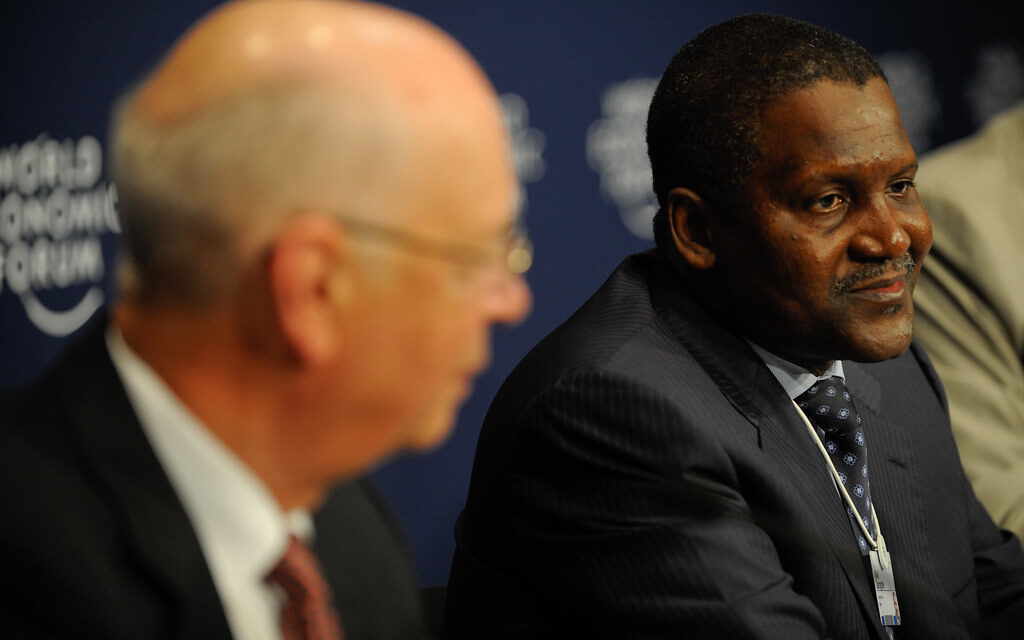
IN SHORT: Aliko Dangote’s net worth reached $35.4 billion on the Bloomberg Billionaires Index in May 2026, up $5.4 billion year to date, as rising global oil prices and the Dangote Refinery’s expanding commercial position combine with the approaching IPO to drive the valuation of his industrial empire to new records. Forbes’ 2026 Africa list, published in March, placed Africa’s 23 billionaires at a combined net worth of $126.7 billion, up 21% from 2025. Nigeria’s four listed billionaires collectively overtook South Africa’s seven for the first time, with combined Nigerian billionaire wealth rising to $47.5 billion against South Africa’s approximately $42 billion.
African billionaire wealth grew 21% in 2026 and Nigeria’s industrialists now collectively outweigh South Africa’s diversified investors for the first time, a shift driven by the Dangote Refinery’s transformation into a globally relevant energy asset, BUA Cement’s 134% share price surge, and the broader recovery of Nigerian corporate valuations from the naira devaluation cycle that compressed them through 2023 and 2024.
The wealth data reflects a specific moment in Nigerian corporate history: the convergence of post-devaluation earnings recovery, rising global commodity prices and the approaching Dangote Refinery IPO, all of which are simultaneously expanding the valuation of Nigeria’s most significant private industrial assets.
- Dangote’s $35.4 billion Bloomberg valuation in May 2026 is built on three converging assets. Dangote Cement, listed on the Nigerian Exchange, has seen its share price surge approximately 69% since March 2025, according to Forbes data. The Dangote Refinery is being valued at $40-50 billion ahead of its IPO, with Dangote’s approximately 90% ownership stake representing the dominant component of his total net worth. And the fertiliser plant at Lekki, Africa’s largest at 3 million tonnes per year capacity, is a separate revenue stream that contributes to group EBITDA. The compound effect of all three assets appreciating simultaneously in 2026 has produced the $5.4 billion year-to-date wealth addition that Bloomberg tracks.
- Abdulsamad Rabiu, founder and chairman of BUA Group, has emerged as the most rapidly wealth-accumulating African billionaire of 2026. BUA Cement’s share price has risen 134% year to date on the Nigerian Exchange, driven by post-naira-devaluation earnings recovery and the same commodity pricing dynamics that are inflating Dangote Cement’s valuation. Rabiu’s net worth reached approximately $10.8 billion in early 2026 on Bloomberg estimates, making him Africa’s fourth-richest person and 337th globally. His BUA model mirrors Dangote’s: import substitution manufacturing at continental scale, primarily serving Nigeria’s enormous domestic cement market.
- Forbes 2026 counts 23 African billionaires with a combined net worth of $126.7 billion. The geographic concentration remains stark: Nigeria and South Africa together account for the majority, with Egypt, Morocco and Algeria providing the next largest contingents. Nigeria’s four listed billionaires overtook South Africa’s seven in combined wealth for the first time in March 2026, reflecting the divergence in corporate earnings trajectories between Nigeria’s recovering industrial sector and South Africa’s more modest 1% GDP growth environment. Notable wealth losers include Morocco’s Anas Sefrioui, whose Addoha Group real estate shares fell more than 30%, reducing his wealth by $300 million.
- The gender gap in African billionaire wealth is absolute: no women appear on either the Forbes or Bloomberg Africa billionaire lists. The Forbes analysis specifically highlighted this as a persistent structural feature of African wealth concentration, reflecting both the historical exclusion of women from large-scale industrial ownership and the sector concentration of African billionaire wealth in mining, cement, oil and telecoms, sectors where women’s representation in founding ownership roles has been minimal.
- The next generation of African billionaires is being built in different sectors. Technology, fintech and digital infrastructure are producing Africa’s fastest-growing private fortunes. The principals of Flutterwave, OPay and Wave are building companies that could produce the continent’s next billionaires. But the current top of the wealth distribution reflects the specific economic history of post-independence Africa: import substitution industrialists who built manufacturing capacity in markets where it was absent at scale and over timelines that required patience that most investors lack.
Bloomberg Billionaires Index placed Dangote at $35.4 billion in May 2026. His wealth has increased $451 million in just the first two weeks of 2026 alone and has continued rising through the year as the refinery’s valuation has escalated with the approaching IPO and rising oil prices.
The Bigger Picture: Nigeria’s billionaires collectively outweighing South Africa’s for the first time is a structural statement about where African wealth creation is happening. South Africa’s billionaires are largely managing inherited positions in mining, luxury goods and financial services built in an earlier economic era. Nigeria’s billionaires are industrialists who built physical infrastructure from scratch in the post-independence period and who are still expanding their empires. The Dangote Refinery IPO, when it completes, will create the most significant new billionaire wealth event in African history: at $50 billion valuation, a 90% founder stake represents $45 billion in a single asset. That number will be visible globally in a way that African industrial wealth has never previously been.
Source: Bloomberg Billionaires Index / Billionaires.Africa / BusinessDay / Forbes Africa, May 2026