
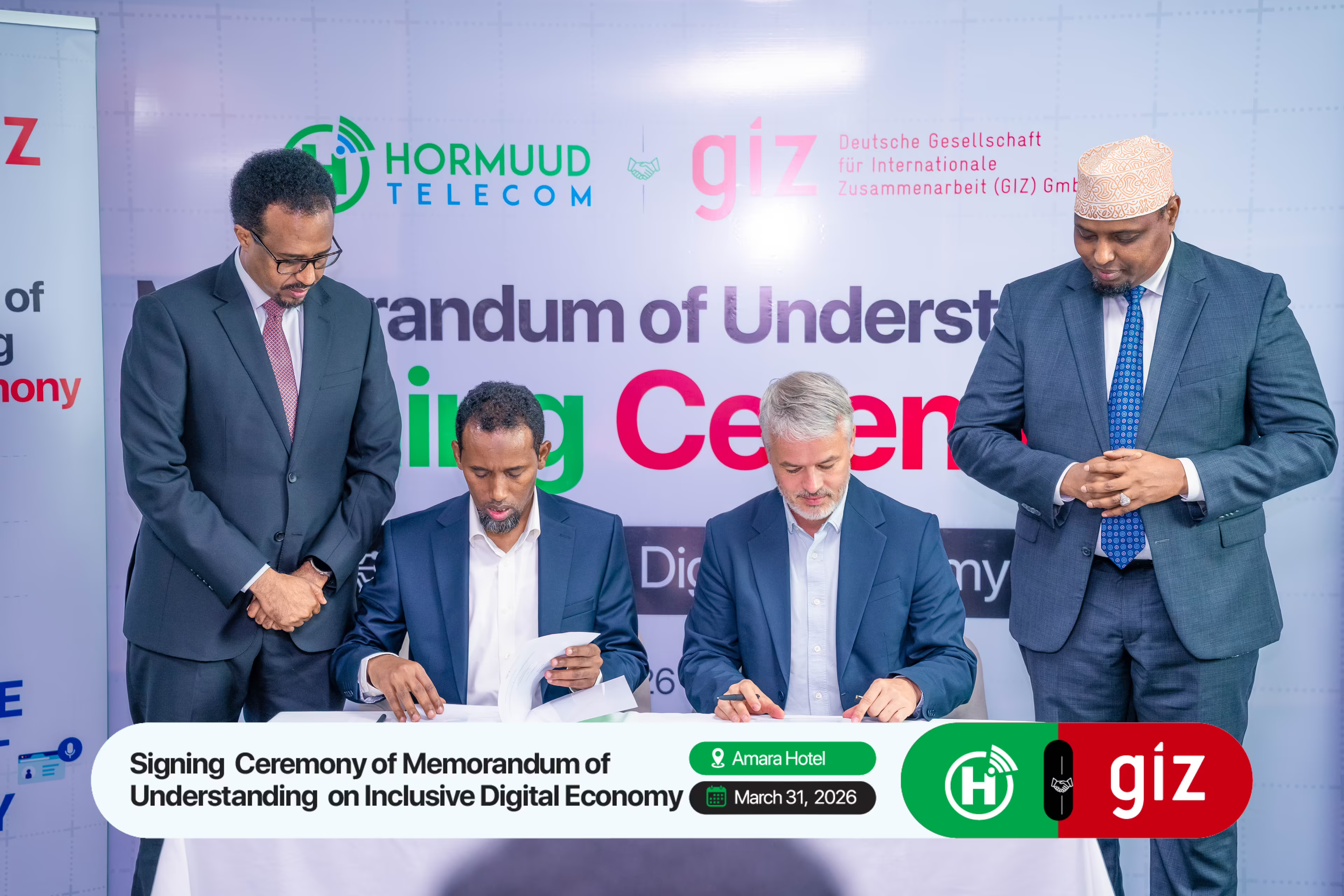
IN SHORT: Somalia’s Hormuud Telecom, the country’s largest telecoms operator, is financing 100,000 smartphones for low-income subscribers through a deposit and instalment model repaid via the company’s EVC Plus mobile money platform. Credit eligibility is assessed using Hormuud’s proprietary telecom-based credit scoring system. The programme is one of the largest device financing initiatives ever attempted in Somalia and uses mobile money infrastructure to extend smartphone ownership to populations with no conventional credit history.
Somalia’s largest telecoms operator is using mobile money data to credit-score and finance 100,000 smartphones for low-income subscribers, deploying a model that has never been attempted at this scale in one of Africa’s most frontier markets and that could fundamentally change how Somalis access the digital economy.
Hormuud Telecom, headquartered in Mogadishu and operating across Somalia’s main urban centres, announced the initiative this week. The programme represents a significant expansion of Hormuud’s role from pure connectivity provider into financial services and device access infrastructure.
- The mechanics are straightforward and powerful. Subscribers pay a small upfront deposit to secure a smartphone. The remaining cost is spread across regular instalments paid through Hormuud’s EVC Plus mobile money platform, Somalia’s most widely used digital payments system. Repayments are automated through EVC Plus, eliminating the collection friction that makes small-ticket consumer finance commercially unviable in markets without conventional banking infrastructure. The phone itself is secured as collateral; non-payment results in the device being locked remotely, giving Hormuud a recovery mechanism that does not require courts or physical collection.
- The credit scoring innovation is the structural breakthrough. Hormuud assesses each applicant’s creditworthiness using their telecom behaviour: airtime top-up frequency, call patterns, EVC Plus transaction history, and account tenure. These indicators are not perfect substitutes for a conventional credit bureau score, but they are far more relevant than a blank file for customers who have never had a bank account. Telecom-based credit scoring has been successfully deployed in Kenya (M-Pesa), Ghana and Tanzania to underpin mobile loans. Hormuud is applying the same model to device finance in one of Africa’s most challenging operating environments.
- Somalia’s digital infrastructure story is one of Africa’s most counterintuitive. Despite decades of conflict and the absence of a functioning central bank for most of the 1990s and 2000s, Somalia developed one of Africa’s earliest and most widely adopted mobile money ecosystems. EVC Plus, launched by Hormuud in 2009, predates M-Pesa’s regional expansion and is the primary payment mechanism for millions of Somalis including diaspora remittances. The country has, in certain respects, leapfrogged conventional banking infrastructure entirely.
- The 100,000 device target is substantial in a country with an estimated population of 17 to 18 million people. Smartphone penetration in Somalia remains low relative to East African peers because devices are unaffordable without financing. A subsidised instalment model backed by mobile money infrastructure removes that barrier for the segment of the population that is bankable through telecom data but cannot access conventional credit. Each device financed is a gateway to the broader digital economy: mobile banking, e-commerce, telemedicine, digital education and diaspora communication all require a smartphone.
- Hormuud’s commercial rationale is clear. Subscribers with smartphones generate more data revenue, use more digital services and represent higher lifetime value than feature phone users. The device financing programme is as much an investment in upgrading its subscriber base as it is a financial inclusion initiative. The commercial and development impact are aligned, which is precisely what makes the model sustainable.
- The broader Somalia context amplifies the significance. President Hassan Sheikh Mohamud’s government has been pursuing governance reforms, fiscal stabilisation and international re-engagement since taking office in May 2022. The IMF has re-engaged with Mogadishu, debt relief has been discussed, and foreign investment interest in Somalia’s offshore oil potential is growing. Hormuud’s device programme is a private sector parallel to that government-level progress: businesses investing at scale in a market they believe is stabilising.
Hormuud Telecom is privately held and does not publish financial results publicly. It is estimated to serve several million subscribers and is widely described as one of the most sophisticated telecom operators in the Horn of Africa relative to its operating environment.
The Bigger Picture: Somalia’s digital economy story does not fit the narrative that is usually applied to the country. The conflict, the governance challenges and the humanitarian situation are real. So is Hormuud’s mobile money ecosystem, which has operated reliably through conditions that would have destroyed a conventional banking system. The 100,000 smartphone financing programme is the next chapter in that story: using the infrastructure that survived Somalia’s hardest decades to give a new generation of Somali consumers access to the digital economy. The model, telecom-based credit scoring driving device finance repaid through mobile money, is replicable. If it works at scale in Somalia, it works almost anywhere.
Source: The Exchange Africa, May 7-8, 2026