
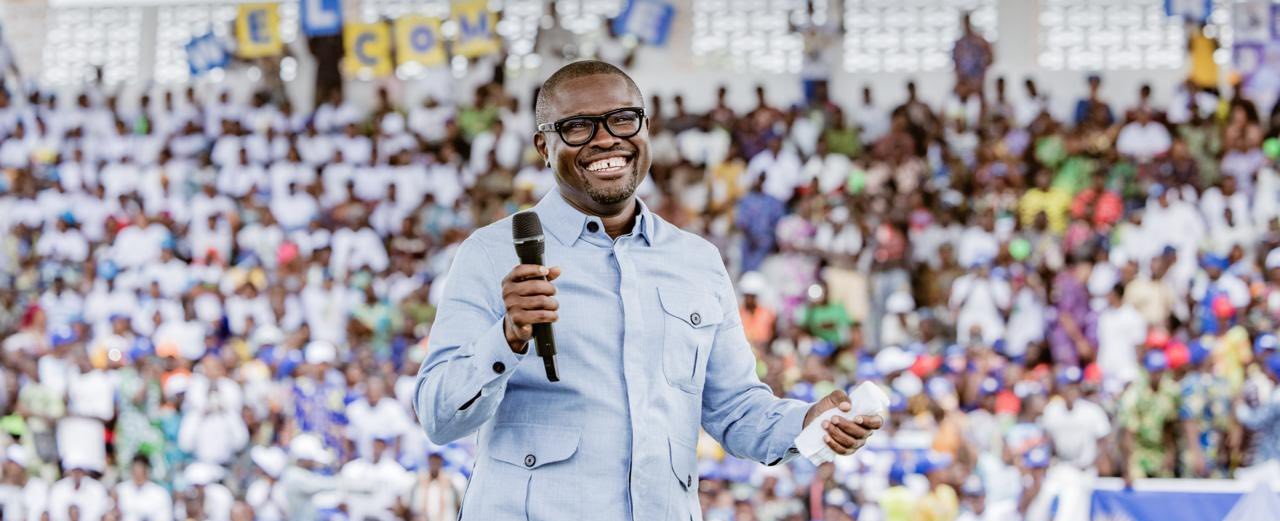
IN SHORT: Benin’s polling stations closed on April 12 after nearly 8 million voters cast ballots in the country’s first presidential succession in a decade. Finance Minister Romuald Wadagni, the endorsed candidate of outgoing President Patrice Talon, is widely expected to have secured victory over the sole opposition candidate Paul Hounkpè. Official results are pending.
Benin completed its April 12 presidential election with close to 8 million eligible voters participating in what is expected to deliver a victory for Romuald Wadagni, the 49-year-old finance minister and anointed successor of President Patrice Talon, who steps down after two terms with a record of 7% GDP growth but a legacy of democratic narrowing that saw all meaningful opposition parties excluded from the ballot and presidential terms extended from five to seven years by constitutional amendment in November 2025.
- Polling closed on April 12 under observation by ECOWAS, the African Union, and the European Union. Results are pending official announcement. Wadagni is widely expected to have won in a first-round result given the absence of credible opposition.
- Wadagni, 49, was Benin’s finance and economy minister for the entirety of Talon’s decade in office. He is campaigning directly on Benin’s economic track record: the IMF recorded 7% GDP growth in 2025, sustained by agriculture, trade, and the Cotonou port expansion that turned Benin into the primary transit hub for landlocked Niger, Burkina Faso, and Mali.
- The sole opposition candidate was Paul Hounkpè of the Cowry Forces for an Emerging Benin. The main opposition figure, Renaud Agbodjo of The Democrats, was barred from running after failing to secure sufficient parliamentary endorsements. The Democrats, which previously held 28 seats in parliament, won 16.14% of the national vote in January 2026 but zero seats after failing to cross the 20% threshold required in every constituency.
- The November 2025 constitutional amendment extended presidential terms from five to seven years, established a partially presidential-appointed senate, and raised the electoral bar for opposition parties. Amnesty International and Human Rights Watch have documented arbitrary detentions and restrictions on public demonstrations under Talon.
- Talon steps down having promised since taking office in 2016 to respect his two-term limit. That promise is being honoured. But analysts at Pangea-Risk described the outcome as “essentially a foregone conclusion,” noting that the process of institutionalising ruling coalition dominance has been systematic and deliberate.
- Benin’s economy grew at an average of approximately 7.5% annually under Talon, driven by agriculture, port-linked trade, and growing links to the wider West African regional market. Wadagni, as the architect of that economic programme, is expected to provide continuity.
- About 2 million Beninese nationals living in Nigeria were among those eligible to vote through designated polling centres in Abuja, Lagos, and Ibadan. A total of 62,679 diaspora voters registered at 112 polling stations in diplomatic missions abroad.
The coexistence of strong economic performance and systematic democratic narrowing is the defining tension in Benin’s political economy. Under Talon, the country achieved a fiscal consolidation that impressed the IMF, expanded infrastructure, and maintained macroeconomic stability during a period when several regional neighbours descended into coup cycles. At the same time, the electoral rules were rewritten in ways that ensured the outcome of this election before a vote was cast. That is not a model that is sustainable indefinitely. The historical pattern across Africa is that concentrated political systems eventually produce either a managed transition or a rupture. What happens in Benin in years five to seven of a Wadagni presidency, under extended term rules with no real opposition, will be worth watching closely.
The Bigger Picture: For investors, Wadagni’s likely victory is the optimal continuity scenario. He is known, experienced, and fiscally orthodox. The Cotonou port expansion is a genuine structural asset for Benin’s long-term trade position, and the country’s role as a transit corridor for the Sahel is growing in commercial importance precisely because those landlocked neighbours are increasingly cut off from their traditional southern routes through Burkina Faso and Mali. Wadagni understands that dynamic. The question for Beninese citizens is whether economic growth distributed unequally and managed through a progressively narrowed political system is a stable equilibrium. History suggests it is not.
Source: AP via Yahoo Finance / AllAfrica