
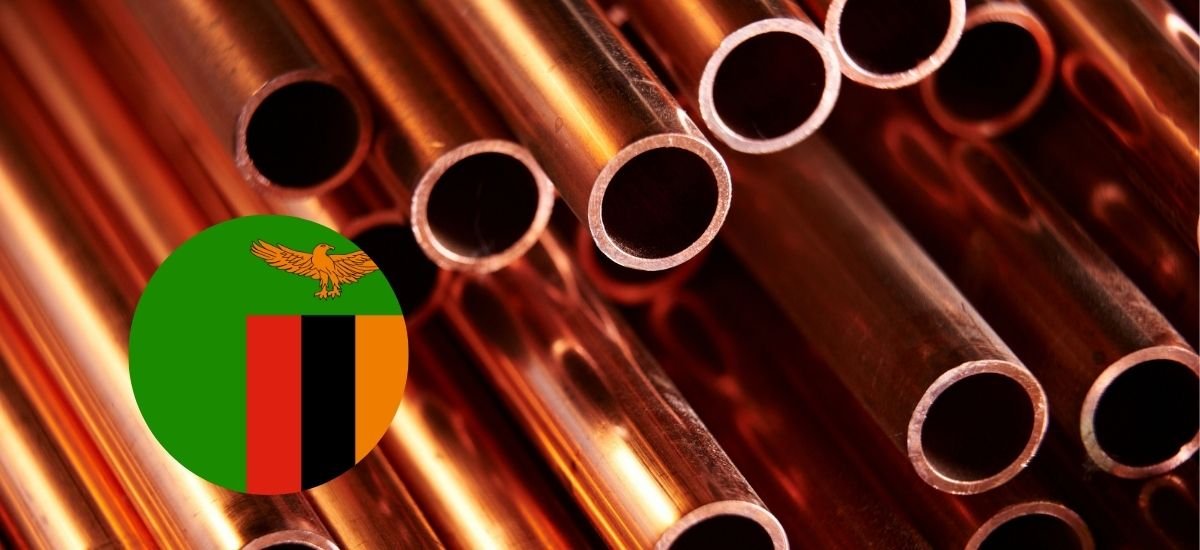
Zambia is courting global investors to help it triple copper output to 3 million tonnes by 2031, positioning itself at the centre of a US-China scramble for the metal that now underpins AI infrastructure, electric vehicles, and the energy transition.
Africa’s second-largest copper producer after the DRC produced 890,346 tonnes last year, missing its 1 million tonne target. Mines Minister Paul Kabuswe confirmed this week that investment talks are underway with partners across multiple countries as Zambia bids to close the gap and then go far beyond it.
- More than $12 billion has flowed into Zambia’s mining sector since 2022, according to President Hakainde Hichilema, who told Mining Indaba delegates: "We have the investors back."
- First Quantum Minerals has completed a $1.25 billion expansion at Kansanshi and Enterprise. Barrick Gold is investing $2 billion to double output at Lumwana and extend mine life. The finance ministry expects output to surpass 1 million tonnes in 2026 and reach 1.2 million tonnes by 2027.
- Vedanta Resources is targeting 300,000 tonnes per year at Konkola Copper Mines (KCM) via a $1 billion investment, and is exploring a US listing for KCM. India has also acquired a 9,000 sq km greenfield copper and cobalt exploration block in Zambia’s northwest.
- Washington launched a $12 billion "Project Vault" initiative this month to secure critical mineral supply chains and reduce dependence on China, with Zambia named as a priority partner. The US Trade and Development Agency previously granted $1.4 million to Metalex Africa for Zambian operations.
- Chinese firms remain deeply entrenched: JCHX Mining operates in-country, and Beijing recently signed a $1.4 billion deal to refurbish the TAZARA railway from Zambia to Dar es Salaam, a direct counter to the US and EU-backed Lobito Corridor route to the Atlantic.
- From January 2026, new Zambian legislation requires mines to source 20% of core goods and 100% of secondary goods from Zambian-owned businesses, rising to 40% for core goods over time.
Copper generates around 70% of Zambia’s export earnings and roughly 15% of GDP. The country is politically stable, English-speaking, and borders eight nations, giving it natural logistics advantages as a regional hub. The risk factors are familiar: electricity reliability remains a constraint, permitting friction can slow ramp-ups, and the country’s infrastructure still depends heavily on which export corridor wins the geopolitical contest. For deeper context on Zambia’s position among Africa’s most attractive mining destinations, see Africaspoint’s ranking of Africa’s top mining countries.
Bigger picture: Zambia is not just a copper producer chasing a production target. It is a geopolitical pivot point. The US, China, India, Canada, the UAE, and the EU are all competing for position in the same Copperbelt, deploying railways, finance, and diplomacy as leverage. The refined copper market is forecast to swing to a 150,000-tonne deficit in 2026, with concentrate supply already tight globally. Every tonne Zambia adds goes directly into a structurally short market. For investors, the combination of committed capex from majors, a government actively rewriting the local sourcing rules, and great-power competition for offtake makes Zambia one of the highest-conviction mining stories on the continent. The 3 million tonne target by 2031 would make Zambia a top-five global producer and fundamentally reshape the global copper supply map.
Source: Times Live / Arab News