
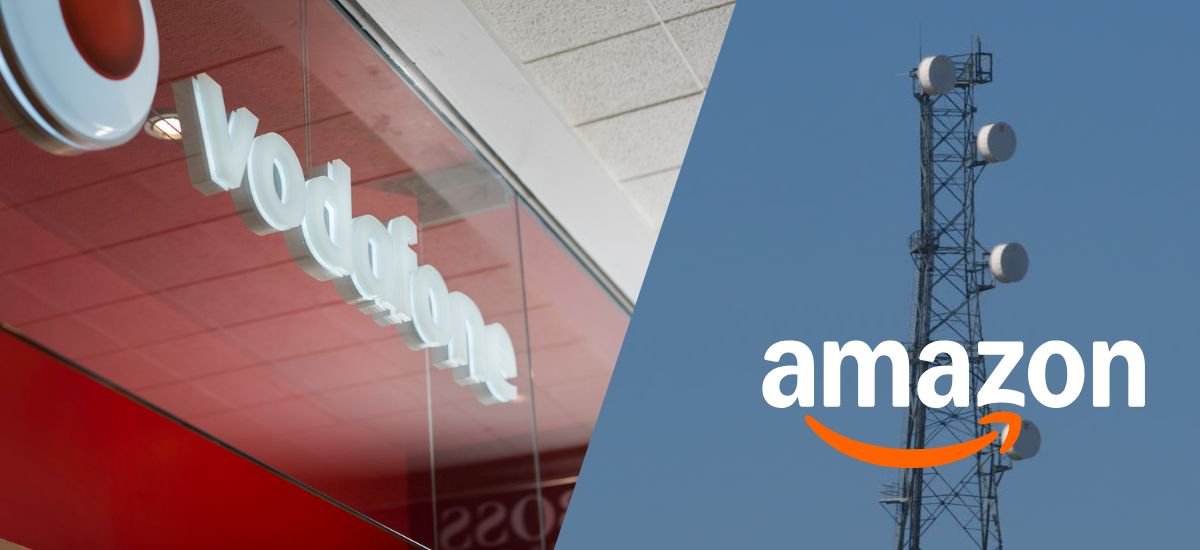
Vodafone and Amazon Leo have signed an agreement to connect remote 4G and 5G mobile masts to their core networks via satellite, eliminating the need for costly fibre backhaul links in hard-to-reach areas. The Africa deployment will run through Vodacom, with the first sites expected online in 2026, and the deal directly supports Vodacom’s Vision 2030 target of reaching 260 million customers across the continent.
- The agreement, announced at Mobile World Congress in Barcelona on March 2, covers the use of Amazon Leo’s low Earth orbit satellite network to provide cell site backhaul at speeds of up to 1 Gbps download and 400 Mbps upload, allowing Vodafone and Vodacom to deploy new base stations in remote areas without laying fibre or fixed wireless links back to the core network
- The rollout sequence starts in Germany and other European markets, with Africa following progressively through Vodacom, which operates across eight African countries including South Africa, Tanzania, Mozambique, the Democratic Republic of Congo, Kenya and Lesotho; the first connected sites are expected in 2026 as Amazon Leo continues expanding its satellite constellation
- Amazon Leo currently has over 200 satellites in orbit with hundreds more built and ready for launch; it began a preview for enterprise customers in November 2025 and is built on a planned initial constellation of more than 3,000 satellites connected to a global network of ground gateway antennas and dedicated fibre
- Vodafone will also use the satellite backhaul to strengthen network resilience for emergency and critical services, providing a failover option when fibre links connecting mobile masts are severed by flooding or other disruptions, a recurring vulnerability in African markets with limited terrestrial infrastructure redundancy
- The deal aligns with Vodacom’s Vision 2030 targets: reaching 260 million customers across Africa, raising smartphone penetration to 75%, and expanding financial services; Vodacom currently provides financial services to around 94 million customers across seven African countries, managing more transactions than any other provider on the continent
- Vodafone Group CEO Margherita Della Valle said the company is looking to space to connect more mobile base stations and strengthen resilience in the most challenging environments; Vodacom Group CEO Shameel Joosub said the partnership enables swift deployment of mobile connectivity in isolated areas across the African continent
- Amazon SVP Panos Panay framed the deal as a step toward connecting millions more people in Europe and Africa, noting that fast and reliable broadband should not depend on where you live and that satellite can now reach communities and emergency networks that traditional infrastructure cannot serve
- The partnership is separate from a second satellite initiative Vodafone is developing with AST SpaceMobile, which targets a direct-to-phone service for consumers, expected to launch by end of 2026; the Amazon Leo agreement focuses specifically on cell site backhaul rather than direct consumer connectivity
- Africa’s mobile data traffic is projected to grow by 40% annually through the decade according to Ericsson’s February 2026 Mobility Report, and internet penetration across the continent reached 38% by 2024 up from 25% in 2019, with satellite backhaul seen as a critical enabler for the next phase of rural and remote coverage expansion
The technical mechanics of the deal matter as much as the headline numbers. Traditional mobile network expansion in rural Africa requires operators to run fibre or microwave links from each remote base station back to the nearest point of presence on the core network, a process that can cost hundreds of thousands of dollars per site and take months or years to execute in difficult terrain. Amazon Leo’s satellite backhaul changes that calculus by giving any base station with a line of sight to the sky a high-speed connection to the core network within weeks of hardware installation. Analysts at Barclays have estimated the approach could improve EBITDA margins by 2 to 3 percentage points in remote operations, and a GSMA benchmark from late February 2026 put the cost reduction versus fibre at up to 76% in rugged terrain. For Vodacom, which serves markets including DRC and Mozambique where road access to remote tower sites is itself a major constraint, the operational significance of removing the fibre backhaul requirement is considerable. The broader satellite backhaul market is projected to reach $20 billion by 2030 according to Markets and Markets, and competitors including Orange and MTN are expected to pursue similar arrangements.
The Bigger Picture: Africa’s connectivity gap is not primarily a spectrum or device problem. The continent has spectrum, handset costs are falling, and consumer demand for data is growing at a rate that exceeds every other region. The constraint is backhaul: getting signals from towers in remote areas back to networks that can carry them onward. Every rural base station that cannot be economically connected to the core network represents a community permanently excluded from 4G and 5G coverage regardless of how much spectrum governments auction or how cheaply smartphones are sold. The Vodafone and Amazon Leo deal directly attacks that constraint for the first time at continental scale. Vodacom’s footprint across eight African countries gives the partnership an immediate addressable market of hundreds of millions of people, and the progressive rollout structure means coverage can extend as Amazon Leo adds satellites rather than waiting for a fully built constellation. The parallel AST SpaceMobile deal for direct-to-phone connectivity adds a second track for reaching people in areas too remote for any tower at all. Together the two partnerships position Vodacom as the African operator with the most credible near-term answer to rural connectivity at scale, arriving precisely when Vodacom’s Vision 2030 targets require a step change in customer reach.
Source: Vodafone Group | Space in Africa