

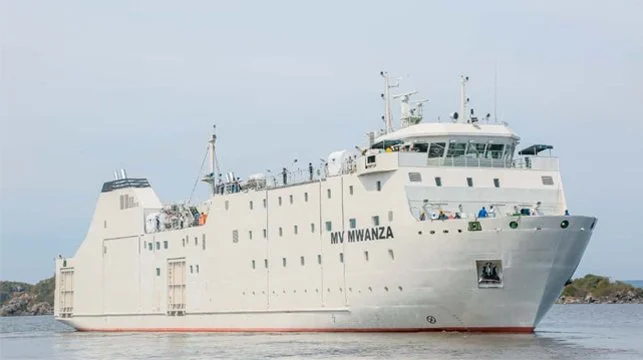
Uganda and Tanzania have jointly launched MV New Mwanza, East Africa’s largest locally built freshwater Roll-on/Roll-off passenger vessel, at the port city of Mwanza in Tanzania, in a $50 million infrastructure milestone designed to cut logistics costs and deepen trade integration across Lake Victoria. The vessel is jointly operated by Tanzania Shipping Agencies Corporation (TASHICO) and Marine Services Company Limited (MSCL).
- MV New Mwanza measures 92.6 metres in length, displaces approximately 3,500 tonnes, and carries up to 1,200 passengers, 400 tonnes of cargo, 20 small vehicles, and 3 large trucks per voyage. Its top speed of 16 knots reduces the Mwanza to Bukoba route from 8 to 10 hours down to approximately 6 to 7 hours.
- The vessel was built locally in Tanzania at an estimated cost of Sh120 billion, equivalent to approximately $50 million, making it a significant domestic shipbuilding achievement for East Africa.
- Routes served include Tanzanian ports Mwanza, Bukoba, and Musoma, Uganda’s Port Bell and Jinja, and Kenya’s Kisumu port, directly linking the three Lake Victoria nations on a single commercial corridor.
- The launch follows Uganda’s 2024 commissioning of MV Mpungu, a 96-metre cargo vessel capable of transporting up to 21 trucks per voyage between Port Bell, Mwanza, and Kisumu. Together the two vessels represent a material upgrade to Lake Victoria’s freight and passenger capacity within 24 months.
- Analysts note that Uganda’s Port Bell and Jinja facilities may require modernisation to handle increased cargo volumes efficiently. Port infrastructure investment will need to pace vessel deployment to unlock the full trade benefit.
Lake Victoria is Africa’s largest freshwater lake, shared by Uganda, Tanzania, and Kenya, and already central to regional fisheries, passenger transport, and cross-border commerce. The EAC’s push to develop maritime trade corridors on the lake is part of a wider strategy to reduce dependence on congested road networks, which currently carry the dominant share of intra-regional freight. For Uganda in particular, which is landlocked and relies heavily on the Northern and Central Corridors for import and export flows, improved lake transport offers a meaningful logistics cost reduction for bulk cargo moving to and from Tanzania’s port of Dar es Salaam via Mwanza.
Bigger Picture: The MV New Mwanza and MV Mpungu together signal that EAC member states are moving from policy commitments on regional integration to physical infrastructure investment. Lake Victoria has historically been underutilised as a commercial corridor relative to its geography and catchment population of over 40 million people across the three littoral states. The $50 million vessel cost, built domestically rather than imported, also demonstrates growing local shipbuilding capacity in the region. For investors tracking East African logistics, port infrastructure at Port Bell, Kisumu, and Mwanza becomes a directly relevant investment and regulatory environment to watch. The constraint is no longer the vessels — it is the port-side handling capacity on the Ugandan and Kenyan shores.
Source: Watchdog Uganda