
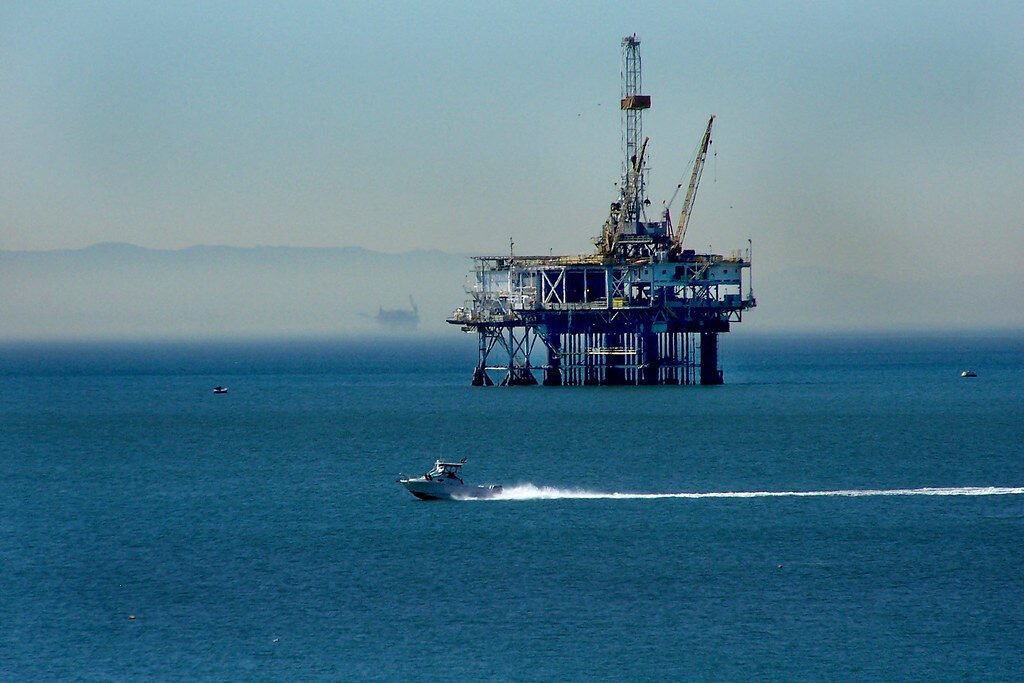
South Africa’s bid to develop its offshore oil and gas resources has spent four years entangled in its own court system, producing a sequence of rulings, appeals, reversals and escalations that has left Shell, TotalEnergies, and the government repeatedly blocked while the Constitutional Court, the country’s apex forum, prepares to issue a judgment that will determine how much of the legal ground activists have won actually holds. The Iran war, which has sent crude above $100 and exposed South Africa’s 75 percent fuel import dependency in the starkest possible terms, has transformed the offshore debate from an energy policy argument into a security crisis.
The litigation runs on two parallel tracks. The first and longer-running battle involves Shell’s Wild Coast seismic survey rights on the Eastern Cape coast, a stretch of Indian Ocean coastline that is the traditional home of the Mpondo people and one of the country’s most ecologically sensitive marine environments. The case began in December 2021 when environmental groups and coastal communities won an urgent interdict halting Shell’s planned seismic survey, arguing that the exploration right granted to Shell and its local partner Impact Africa in 2014 had been renewed without meaningful consultation with affected communities. The Eastern Cape High Court found that argument compelling in September 2022, setting aside the exploration right and its subsequent renewals. Shell appealed.
The Supreme Court of Appeal, ruling in June 2024, upheld the finding that the original exploration right was unlawfully granted but declined to simply set it aside. Instead it suspended the invalidation and permitted Shell to pursue a third renewal application subject to proper consultation, in what environmentalists described as a compromise that rewarded a company for an unlawful process by giving it another chance to fix it. Coastal communities and their legal representatives disagreed and escalated to the Constitutional Court. In September 2025, the country’s apex court heard two days of arguments. The communities argued through advocate Tembeka Ngcukaitobi that the SCA order was incompetent and that a consultation process conducted now could not remedy the violation of communities’ rights at the moment the original decision was made. Shell spent $58 million on its exploration programme and argued that valid steps toward renewal should proceed. A judgment is pending.
The second track concerns Block 5/6/7, a block in the Orange Basin off South Africa’s south-west coast where TotalEnergies and Shell jointly hold rights with state-owned PetroSA. The Western Cape High Court ruled in August 2025 that the environmental authorisation granted to TotalEnergies for offshore drilling in that block was unlawful. Judge Nobahle Mangcu-Lockwood found the environmental impact assessment failed to assess the full socio-economic consequences of a blowout or oil spill on coastal communities, did not evaluate the project’s full lifecycle climate impacts, omitted cross-border consequences for Namibia, and failed to meet requirements under the Integrated Coastal Management Act. The authorisation was set aside and the matter returned to the Department of Minerals and Petroleum for a fresh process. TotalEnergies, Shell and the government appealed, and the State and Shell are now at the Supreme Court of Appeal seeking to widen the grounds of challenge. The Green Connection and Natural Justice are opposing.
TotalEnergies had, even before the August ruling, been signalling its frustration. In October 2025, following months of regulatory delays and the failed authorisation, the company warned it might freeze its South African oil and gas exploration projects entirely, citing what its head of exploration and production called unacceptable approval timelines.
The government’s position throughout has been unambiguous. Mineral Resources Minister Gwede Mantashe told reporters at a recent conference that legal challenges are holding South Africa back from its potential. Petroleum Agency South Africa’s CEO Bongani Sayidini put a number on what is at stake: 27 billion barrels and 60 trillion cubic feet of oil and gas resources. The agency has discovered the Brulpadda and Luiperd fields in Block 11B/12B containing 3.4 trillion cubic feet of gas and 192 million barrels of condensate, though TotalEnergies exited that block in July 2024 citing commercial challenges. In December 2025, PetroSA approved a farm-in giving Shell a 60 percent operating stake in Block 2C in the Orange Basin, signalling that deal-making is continuing alongside litigation.
The legislative response arrived in the Upstream Petroleum Resources Development Act, assented to in 2024 and updated in 2026, which is designed to create a faster exploration and production environment through integrated petroleum rights, new licensing rounds and a clearer framework for state participation. The government has also flagged its intention to establish specialised courts to handle oil and gas disputes, a direct response to the pace at which cases move through the general court system. Both measures signal that Pretoria views the legal backlash as an obstacle to manage rather than a signal to moderate its exploration ambitions.
The Iran war has reframed every one of these arguments. South Africa depends on imports for 75 percent of its petroleum. The Astron Energy refinery in Cape Town is offline for maintenance. Crude oil surged above $100 per barrel following the February 2026 US-Israeli strikes. Jet fuel rose 70 percent in a week. The Department of Mineral and Petroleum Resources has warned of further pump price increases in April. South Africa has formally approached the Dangote Refinery for alternative supply, and the country’s vulnerability to supply disruption through the Strait of Hormuz is now visible to every South African filling a tank. Against that backdrop, Mantashe’s argument that environmentalists are standing between South Africa and energy security has acquired an urgency it lacked in 2021.
The counterargument from communities and environmental groups is not that South Africa should remain energy-poor. It is that exploration rights cannot be granted without meaningful consultation with people whose livelihoods and constitutional rights are directly affected, and that an environmental impact assessment that ignores the consequences of a deepwater blowout on small-scale fishing communities is not a process that deserves the courts’ protection. Advocate Ngcukaitobi framed it at the Constitutional Court as a question of whether a company can cure a constitutionally unlawful process with a later consultation. The communities’ answer is no. The court’s answer will arrive shortly.
Bigger Picture: South Africa is simultaneously running a legal system that takes community rights seriously and an energy ministry that needs offshore production urgently. Those two things are not necessarily incompatible, but they require a consultation and assessment process that is genuinely robust rather than a checklist run in advance of a decision that has already been made. The court record in both the Wild Coast case and the Block 5/6/7 case shows that what failed was not the law, but the implementation of it: Shell and TotalEnergies sought rights through processes that excluded the people most affected and produced assessments that omitted the risks those people face. The Iran war has made the energy security argument more powerful, but it has not changed the legal question the Constitutional Court is being asked to answer. If South Africa wants its offshore resources developed at pace, the fastest route is a process that is done correctly the first time rather than one that generates four more years of appeals.
Source: World Oil / Natural Justice / Energy Capital Power / IOL