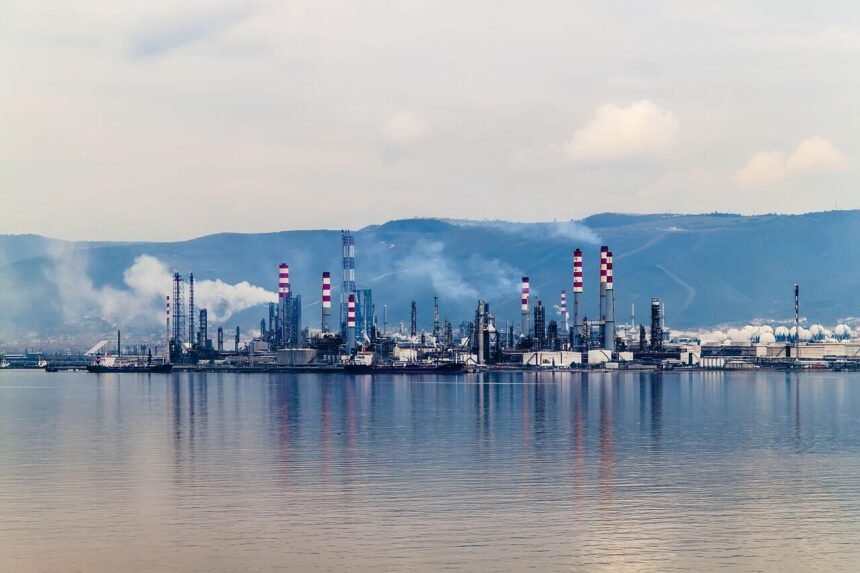

South Africa consumes approximately 612,000 barrels of fuel a day. Its remaining refineries produce less than half of that. Saudi Arabia was its second-biggest oil supplier in 2024. The Glencore-owned Astron Energy refinery in Cape Town is currently offline for maintenance, with production only expected to resume in April. And 75% of the fuel that East and Southern Africa import comes from the Middle East, through the Strait of Hormuz, which is now at the centre of a shooting war between the United States, Israel, and Iran. Against that backdrop, South Africa turning to Aliko Dangote is not a strategic choice. It is an emergency response.
The scale of the disruption is significant. According to Bloomberg, approximately 600,000 barrels a day of refined petroleum products that ordinarily flow from the Middle East to African markets are now at risk. Energy analytics firm Kpler has documented the collapse in shipments: petroleum product loadings fell from 580,000 metric tonnes in January to 183,000 metric tonnes in February, a 68% drop. In March, volumes fell to zero. The entire quarter’s supply buffer has been wiped out in twelve weeks.
South Africa’s exposure is structural, not incidental. The country lost Sapref, its largest refinery, when the plant shut in 2022 and has not restarted despite the government taking ownership in 2023. Engen, BP, and Shell have all exited South African refining in the past decade, unable to justify the investment required to meet cleaner-fuel standards. Sasol’s coal-to-liquids plant in Secunda produces roughly a third of domestic fuel output but cannot be scaled and faces long-term pressure from carbon transition policy. What remains covers less than half of daily demand. The rest is imported, and the import routes now run directly through a conflict zone.
Dangote: Africa’s emergency refiner
The $20 billion Dangote Petroleum Refinery in Lagos’s Lekki Free Zone reached its nameplate capacity of 650,000 barrels per day in early 2026, making it the world’s largest single-train refinery. It now supplies 62% of Nigeria’s domestic fuel demand, the first time in decades that Nigeria has not been a net importer of refined petroleum products. With Nigeria’s own consumption running at approximately 493,000 barrels a day, Dangote has surplus capacity available for export, and the queue is forming fast.
Bloomberg reported this week that South Africa and Kenya are among the countries scrambling to secure supply from Dangote as Middle East shipments tighten. Elitsa Georgieva, executive director at energy consultancy CITAC, was direct: the crisis is exposing how refinery closures and underinvestment have left much of the continent dependent on a single trade route now at the centre of a widening conflict. The Dangote refinery, she said, is a rare bright spot.
The refinery’s managing director David Bird has pledged to prioritise Nigeria’s domestic market. His condition: continued access to Nigerian crude through NNPC at internationally benchmarked prices. With crude prices above $100 a barrel after spiking from the mid-$60 range in the weeks following the US-Israeli strikes on Iran, the refinery’s own economics are under pressure. Crude lands at the Lagos plant at $88 to $91 per barrel after premium and freight. Brent briefly topped $110 before pulling back toward $92 after Trump signalled the war would end soon. The ex-depot price for petrol has been reset twice in two weeks, rising to N1,175 per litre before a partial rollback to N1,075. At Nigerian pumps, prices in some areas have crossed N1,300 per litre, up from N830 just days prior and N195 at the start of 2023.
Export capacity is therefore real but constrained. Dangote cannot run at full export volume while also honouring its commitment to the domestic Nigerian market, especially while feedstock sourcing remains partly dependent on pricier international crude. The refinery currently receives approximately five NNPC crude cargoes per month under the naira-for-crude policy, against the thirteen it needs to sustain full domestic coverage. The gap is made up with US crude, which has comprised as much as a third of total feedstock.
Kenya’s 21-day clock
South Africa is vulnerable. Kenya is in acute danger. The country consumes approximately 100,000 barrels of fuel per day and imports every litre of it. Oil marketing companies are required by regulation to hold 21 days of operational stock, with the countdown beginning the moment an expected cargo fails to arrive. Martin Chomba, chairman of the Petroleum Outlets Association of Kenya, confirmed to Bloomberg that the largest fuel suppliers are already rationing product and that rural distributors are experiencing stock-outs. Kenya’s main fuel supply contracts run with Saudi Aramco, the Emirates National Oil Company, and the Abu Dhabi National Oil Company, all suppliers whose logistics route now passes through the disrupted Strait. Mombasa, where Kenya imports its fuel, was the site of a refinery that shut because it was unprofitable. It has no domestic refining fallback.
Ethiopia has moved further. Prime Minister Abiy Ahmed publicly instructed citizens to curtail fuel use, directing available supplies toward essential services only. The government has not provided a timeline for when normal supply will resume.
The structural lesson South Africa is refusing to learn
South Africa’s fuel vulnerability has been visible for years. The Sapref shutdown was not a surprise. The refinery had been struggling with underinvestment and emission compliance costs for over a decade before the 2022 floods in KwaZulu-Natal provided the final blow. The government’s decision to take ownership of the plant without a credible restart plan has left the country exposed without closing the gap. The Astron Energy Cape Town refinery, the country’s remaining large coastal facility, has capacity of 100,000 barrels a day but is currently offline. Even when running, domestic refining capacity covers less than half of demand.
The country holds approximately 8 million barrels of strategic fuel stocks through the Central Energy Fund. At 612,000 barrels per day of demand, that is roughly 13 days of cover at full consumption. Strip out Sasol’s coal-to-liquids contribution and the arithmetic tightens further. The Iran war has not yet produced shortages at South African forecourts, but the buffer is narrow and the supply lines are disrupted.
As covered in Africaspoint’s earlier analysis of the Iran war’s impact on Africa’s biggest economies, South Africa sits squarely in the loser column of this shock. It is a pure cost importer with no crude production upside, a compromised domestic refining base, and Middle East supply dependence built over two decades of deferred investment decisions.
Bigger Picture: The Iran war has compressed decades of deferred energy policy failure into a single breaking point for southern and eastern Africa. South Africa runs on less than half of its own refining capacity and depends on the Middle East for the rest. That arrangement worked when the world was stable. It does not work now. Dangote’s refinery is the continent’s only meaningful short-term alternative supply source, and it is already prioritising Nigeria. The queue forming at Lagos is a market signal Pretoria cannot afford to ignore a second time: a country of 62 million people with no domestic refining backstop is one sustained disruption away from a fuel crisis that translates directly into food prices, transport costs, and social instability.
Source: Daily Investor / Moneyweb / The Star Kenya / Africa Energy Chamber