
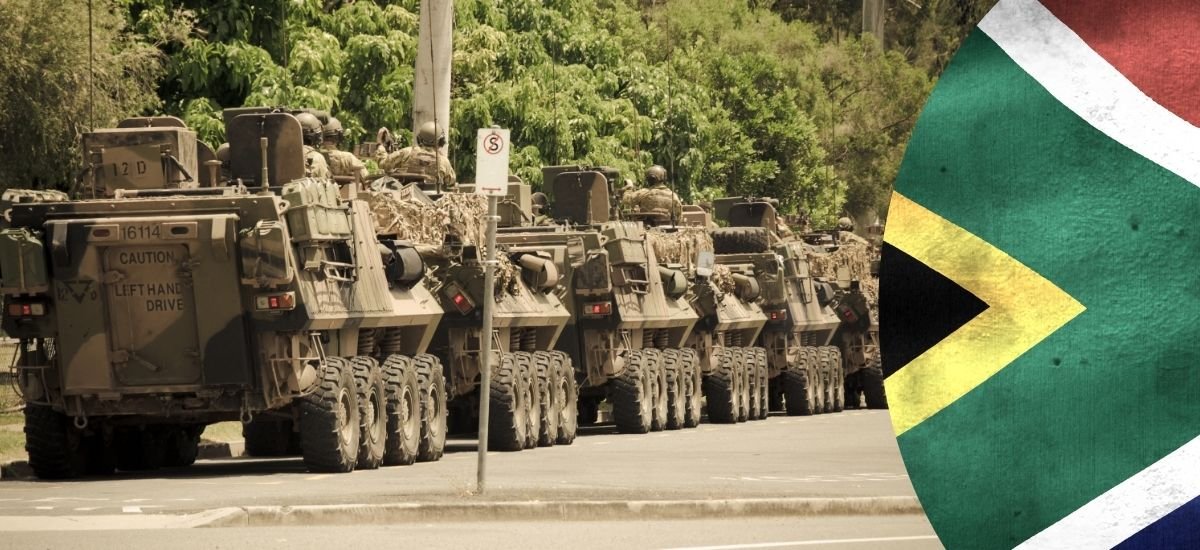
South Africa has deployed the national army to support police in illegal mining operations across Gauteng, with Deputy President Paul Mashatile telling Parliament on March 5 that the state is running intelligence-driven raids, supply chain disruptions, and syndicate arrests under Operation Vala Umgodi. The deployment signals an escalation beyond policing into a full security response. Illegal mining is now formally classified as a transnational organised crime threat.
- Operation Vala Umgodi combines specialised police units, the South African National Defence Force, the Directorate for Priority Crime Investigation (Hawks), the Department of Mineral Resources and Energy, and Home Affairs in coordinated raids targeting the East and West Rand communities of Gugulethu and Sporong in Randfontein.
- The government has secured funding for a 12-dimensional National Illicit Economy Disruption Programme, targeting illegal mining, fuel smuggling, and port-linked illicit trade as the three highest-risk sectors for syndicate activity and revenue loss.
- President Cyril Ramaphosa announced at the State of the Nation Address the recruitment of 5,500 additional police officers and a special task team to investigate criminality involving senior SAPS members, following interim findings of the Madlanga Commission.
- Anti-corruption measures inside SAPS include the Anti-Corruption Task Team established in 2010, technology-driven case management to reduce manual interference, the Anti-Gang Unit, and lifestyle audits with financial disclosure analysis for priority personnel.
The scale of the illegal mining problem in South Africa extends well beyond gold. Illegal miners, widely known as zama zamas, operate in abandoned shafts across Gauteng and the North West, using networks that span multiple countries for labour, financing, and equipment. The state’s previous approach of periodic raids produced limited results because syndicates adapted faster than enforcement did. The shift to intelligence-driven, multi-agency operations with SANDF support represents a structural change in strategy. Whether it holds depends on coordination between departments that have historically struggled to operate as a single unit. South Africa allocated R848 billion over the medium term to security forces, providing the fiscal foundation for this expanded operation.
The Bigger Picture: Illegal mining costs South Africa an estimated R50 billion a year in lost mineral revenues, according to the Minerals Council. For the mining majors and junior operators with assets in Gauteng and surrounding provinces, the deployment of the SANDF is a material development. It reduces the immediate physical security risk to operating mines and signals that the state is willing to commit hard resources rather than issue statements. The 12-dimensional disruption programme, if funded and implemented, would be the most comprehensive illicit economy intervention South Africa has attempted. The test, as always, is execution.
Source: SAnews