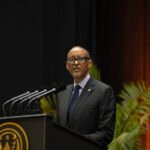

Khalil Halilu, the head of Nigeria’s National Agency for Science and Engineering Infrastructure, has been named Young African Leader of the Year by African Leadership Magazine at its Persons of the Year ceremony in Accra, Ghana, recognised for transforming a largely obscure federal agency into a functioning industrial platform. The award signals growing continental attention to Nigeria’s push to shift from consumer economy to producer economy. Halilu was appointed to lead NASENI in 2023 by President Bola Tinubu.
- Halilu was selected through a two-stage process: shortlisting by the magazine’s editorial board on measurable impact, leadership record, policy influence, and institutional reform, followed by a continent-wide public vote across multiple categories. He secured the highest vote count in his category.
- Under his leadership, NASENI has advanced programmes in clean energy localisation, mechanised agriculture, and coal-to-fertiliser technology for food security, alongside youth innovation initiatives including Innovate Naija, DELT-Her, Shefly, and FutureMakers.
- The agency operates on three principles it labels the 3Cs: Creation, Collaboration, and Commercialisation, a framework designed to move outputs from the lab bench into the market.
- The Accra ceremony drew former Tanzanian President Jakaya Kikwete, Lesotho Prime Minister Samuel Matekane, former Ghanaian President John Kufuor, Angolan Vice President Esperança da Costa, and Sierra Leone’s Minister of Information Sheku Fantamadi Bangura.
NASENI was established in 1992 but spent most of its existence on the margins of Nigerian public life: underfunded, understaffed, and largely invisible to the industries it was meant to serve. Halilu’s appointment marked a deliberate pivot. Tinubu has framed local manufacturing as a strategic necessity as Nigeria seeks to reduce its exposure to import costs and foreign exchange volatility. NASENI’s repositioning, from a research body to an industrial commercialisation platform, is the institutional expression of that policy direction. Whether the 3Cs framework produces durable output at scale is the real test: Nigeria has a long record of promising industrial initiatives that stalled at the prototype stage.
The Bigger Picture: Africa imports more than $600 billion in goods annually, much of it in categories where the continent has the raw materials to manufacture locally. Halilu’s message at the ceremony, that Africa cannot control its future without producing what it consumes, is not new, but the recognition of a working practitioner rather than a policy commentator gives it different weight. If NASENI delivers even a fraction of its clean energy and agricultural technology agenda at commercial scale, it becomes a replicable model for other African countries attempting the same transition from resource extraction to value-added production. That is the bet the continent is watching Nigeria make.
Source: Vanguard