
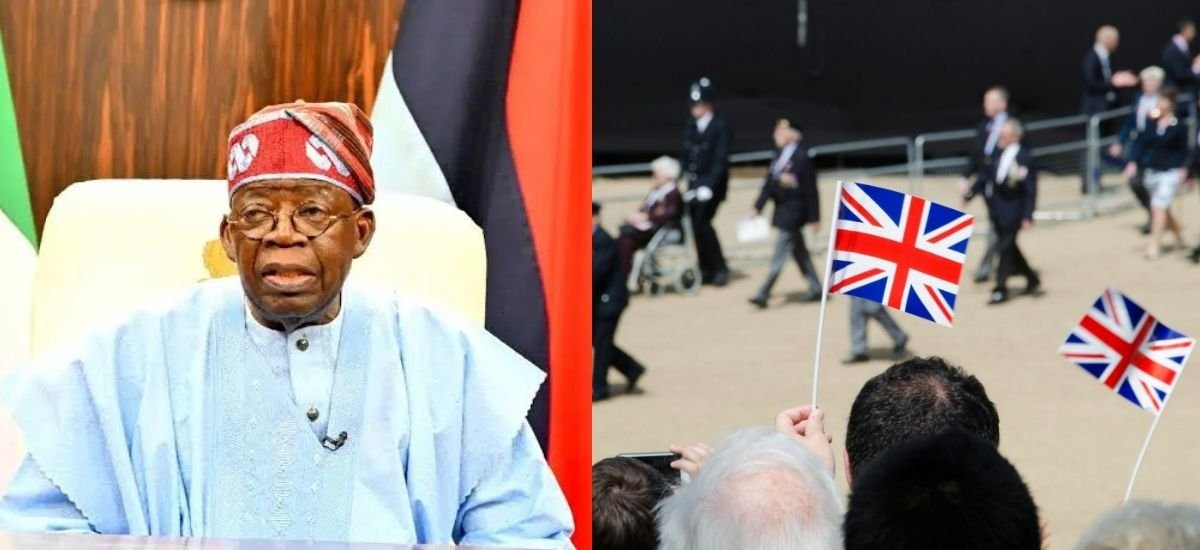
President Bola Tinubu arrived in London on March 17 for a two-day state visit, the first by a Nigerian leader to Britain in 37 years. By the time his plane touched down at Stansted Airport, the commercial machinery had already moved: seven Nigerian banks operating in the UK, a $944 million (£746 million) port financing deal with UK Export Finance confirmed, $127 million (£100 million) in fintech investment pledged, and a $30 million (£24 million) Twinings Ovaltine manufacturing facility opened in Lagos. Nigeria came to Windsor not to receive aid but to close deals.
The visit, which runs March 18 to 19, centres on a reception at Windsor Castle hosted by King Charles III, bilateral talks with Prime Minister Keir Starmer at 10 Downing Street, and the formal signing of memoranda of understanding covering trade, investment, defence cooperation, and cultural exchange. It is the first time a Nigerian president has been received at Windsor by a British monarch.
The headline infrastructure deal is the $944 million (£746 million) financing agreement involving UK Export Finance, the Nigerian Ports Authority, and Nigeria’s Federal Ministry of Finance. The deal funds the refurbishment of the Lagos Port Complex at Apapa Quays and the Tin Can Island Port Complex, the two most critical maritime gateways through which Nigeria’s import-dependent economy runs. Marine Minister Adegboyega Oyetola is expected to sign the agreement during the visit. For a port system largely unreformed for half a century, the deal is significant: Apapa alone accounts for the majority of Nigeria’s container throughput, and its chronic congestion has cost the economy billions annually in logistics inefficiency.
The financial sector activity is equally substantive. Zenith Bank opened a new Manchester branch on March 17, expected to create up to 30 direct jobs in Northwest England, with the bank exploring a 2027 listing on the London Stock Exchange. Fidelity Bank has completed the acquisition and rebranding of Union Bank UK as FidBank UK, with plans to double its 62-person workforce in 2026. FCMB has selected the UK as the first international destination for its new digital cross-border payments platform. Seven Nigerian banks now operate on British soil, collectively supporting over 1,000 jobs. The combined banking footprint positions Lagos and London as the two poles of a deepening Africa-UK financial corridor.
In fintech, LemFi has designated London as its global headquarters with a $127 million (£100 million) five-year investment commitment. Moniepoint is building its London team to 100 employees in 2026 to serve its African user base. Kuda Bank is expanding its UK headquarters as its global growth base. Nigeria’s tech diaspora is the engine behind this expansion: engineers and product managers trained in both systems are building infrastructure that now serves millions of users across Africa from British offices.
Going the other direction, Twinings Ovaltine’s $30 million (£24 million) Lagos manufacturing facility is the company’s first in Africa, generating over 100 direct jobs and positioning Lagos as an export base for West African markets. Wellington College International is set to open a Lagos campus in 2027 for 1,500 students, one of West Africa’s first flagship British curriculum schools. The University of Birmingham and University of Lagos have signed agreements in Applied AI, Digital Communications, and Global Surgery. The London School of Economics has launched a Data Science partnership with Nile University. UK edtech company EStars will deliver digital learning programmes to approximately three million Lagos State students.
The broader framework for all of this is the UK-Nigeria Enhanced Trade and Investment Partnership (ETIP), originally agreed under the previous Conservative government and now being executed under Labour. Bilateral trade stands at an all-time high of $10.2 billion (£8.1 billion) annually. At Monday’s ETIP reception at Kensington Palace, Deputy Prime Minister David Lammy hosted 180 senior representatives from government and industry. Business and Trade Secretary Peter Kyle said the partnership was delivering real outcomes. Both statements are, for once, backed by the numbers.
There is context that the diplomatic communiqués will not volunteer. Tinubu’s domestic economic reform programme, launched in May 2023 with the removal of fuel subsidies and the flotation of the naira, generated significant hardship before stabilising. Inflation surged, purchasing power contracted, and public anger produced large-scale protests in 2024. The reforms are now showing results, with currency stability improving and investor confidence returning, but the political cost was real. The UK state visit is partly a validation exercise: Tinubu returning to London with concrete commercial outcomes that justify the reform pain to a domestic audience still feeling it.
The security dimension is also present. Islamist insurgency in northeast Nigeria, banditry across the northwest, and intercommunal violence in the Middle Belt remain active. Tinubu declared a national security emergency in November 2025 and ordered the recruitment of thousands of additional security personnel. UK-Nigeria defence cooperation, rooted in a 2018 security partnership, includes intelligence sharing and counter-terrorism collaboration. The Downing Street talks are expected to deepen these arrangements.
Bigger Picture: Nigeria has arrived at Windsor as a capital exporter, not a supplicant. Seven Nigerian banks operating in Britain, $127 million in fintech investment pledged for London, and a $10.2 billion bilateral trade relationship at its highest point on record are not the optics of dependency. They are the metrics of a structural shift in how West Africa’s largest economy relates to its former colonial power. The $944 million Lagos port deal is the most consequential single commitment: if it delivers, it begins to address a logistics bottleneck that has suppressed Nigerian trade competitiveness for a generation. The test, as always in Nigeria, is execution. The deals are signed. Whether the cranes arrive at Apapa is a different question.
Source: Daily Trust / UK Government / Al Jazeera