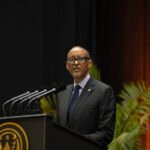

Ghana’s President John Mahama issued a direct challenge to African heads of state at the opening of the African Court on Human and Peoples’ Rights 2026 Judicial Year in Arusha on March 2, becoming the first sitting Ghanaian president to address the court and calling on every AU member that has not yet ratified the court’s protocol to do so immediately. The court marks its 20th anniversary this year.
- Mahama urged all unratified AU member states to sign the AfCHPR Protocol without further delay
- He called on member states to allow individuals and NGOs direct access to bring cases to the court
- He asked all governments to implement the court’s rulings in good faith, warning that rights on paper without enforcement are meaningless
- Mahama described the court as a safeguard against executive overreach, weakening judicial independence and constitutional tensions across the continent
- He warned against looking to the Global North as a democratic model, citing what he called rapidly crumbling judicial independence in Western nations
- Ghana has contributed two presidents to the court: former Chief Justice Sophia Akuffo and current Supreme Court judge Dennis Dominic Adjei
- The ceremony was themed “20 Years of Service in Protecting Human and Peoples’ Rights in Africa”
Mahama grounded his speech in personal history, recounting the detention of his father after the 1966 coup and again in 1974 for advising military ruler General Acheampong. His father later spent 13 years in exile. The President invoked Patrice Lumumba, Thomas Sankara and Nelson Mandela as figures whose suffering the court, had it existed, could have addressed. He framed the court not as a threat to sitting leaders but as a shield against the kind of impunity that destroyed those men and countless unnamed others. The 2026 judicial year opening also formally launched the court’s 20th anniversary commemorations, with Mahama setting a clear target: by the 40th anniversary, the AfCHPR should stand as the leading international judicial body on the continent.
The Bigger Picture: Only 34 of the African Union’s 55 member states have ratified the AfCHPR Protocol, and fewer still have made the separate declaration allowing individuals and NGOs to file cases directly. That gap is the court’s central weakness. A continental human rights court that most of the continent’s governments have not fully committed to is structurally limited in what it can enforce. Mahama’s speech lands at a moment when governance pressures across Africa are intensifying: constitutional term limit manipulations, disputed elections and shrinking civic space have all accelerated since 2020. His message that the Global North’s democratic façade is crumbling is an argument for Africa to build its own credible institutions rather than defer to external frameworks that are themselves under pressure. Whether his peers act on it or treat it as ceremonial oratory is the question that will define whether the court’s next 20 years look different from its first.
Source: Graphic Online / Asaase Radio