
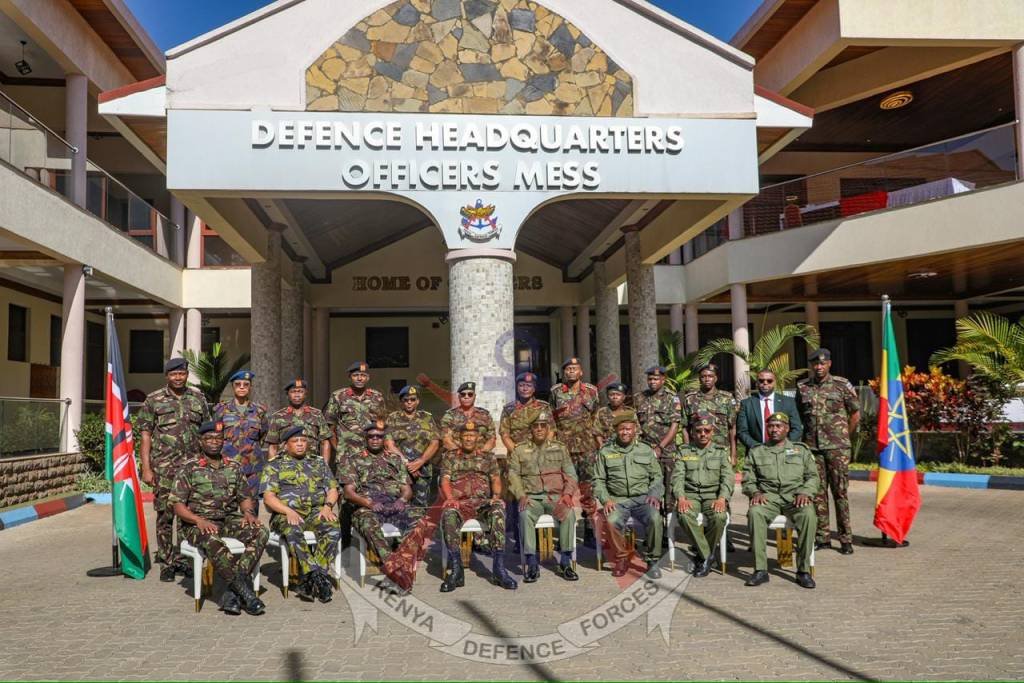
Kenya and Ethiopia have agreed to launch structured joint military operations along the Moyale-Marsabit-Turkana corridor and to protect the LAPSSET infrastructure corridor, deepening a Defence Cooperation Agreement signed in September 2025, as Sudan accuses both countries of supporting the Rapid Support Forces in its civil war. The timing puts East Africa’s two largest economies at the centre of one of the continent’s most volatile geopolitical flashpoints.
- High-level talks between Kenya’s Defence Cabinet Secretary Soipan Tuya and Ethiopia’s Minister of Defence Aisha Mohamed Musa, held on the sidelines of the 130th Battle of Adwa anniversary in Addis Ababa, produced agreement on a phased, practical framework to fast-track the inaugural Joint Defence Committee’s outcomes, shifting cooperation from ad-hoc coordination to an institutionalised structure.
- The Moyale-Marsabit-Turkana corridor is the primary operational focus, a zone stressed by cross-border criminal networks, resource disputes, and clashes between Kenya’s Turkana community and Ethiopia’s Dassanech and Nyangatom communities around the Ilemi Triangle and Lake Turkana.
- Both sides reaffirmed commitment to protecting the LAPSSET Corridor, the Lamu Port-South Sudan-Ethiopia Transport project that represents one of the region’s most strategically significant infrastructure investments, against asymmetric and emerging threats.
- Kenya and Ethiopia also reaffirmed their joint commitment to the African Union Support and Stabilisation Mission in Somalia (AUSSOM), underscoring shared interest in counter-terrorism across the Horn.
- The September 2025 DCA, only the second such pact in the 62-year history of Kenya-Ethiopia relations, covers intelligence sharing, joint exercises, training, defence industry development, counter-terrorism, and border security.
- Sudan’s Ministry of Foreign Affairs accused Ethiopia on March 2 of allowing drones to use its airspace for strikes near Kurmuk in Blue Nile State. Sudan has separately accused Kenya of acting as a conduit for UAE weapons supplied to the RSF. Both Kenya and Ethiopia deny the allegations.
The Sudan accusations carry strategic weight beyond rhetoric. A Reuters investigation published in February 2026 reported that Ethiopia is hosting a training camp for RSF fighters in the remote Benishangul-Gumuz region, financed by the UAE. Ethiopia has not confirmed this. Kenya separately hosted RSF figures in Nairobi in early 2025 for a parallel government charter signing, drawing condemnation from the US, UN, Egypt, Saudi Arabia, Qatar, and Kuwait. Both countries deny formal alignment with the RSF, but their deepening bilateral defence pact signals that Nairobi and Addis Ababa are converging strategically at precisely the moment Sudan is seeking to isolate them diplomatically.
The Bigger Picture: The Kenya-Ethiopia defence alignment is reshaping the security geometry of the Horn of Africa. Two countries that were once rivals for regional influence are now pooling military capacity, intelligence, and infrastructure protection in a structured bilateral framework. For investors with exposure to LAPSSET, the corridor’s security architecture has just acquired a significant upgrade. For Sudan’s army-backed government, the alliance deepens the encirclement it fears, with Kenya and Ethiopia both accused of RSF proximity, both denying it, and both now operating a joint military command structure along their shared border. The UAE’s role as the financial thread connecting Addis Ababa’s alleged RSF support, Abu Dhabi’s Gulf rivalries, and Kenya’s port ambitions makes this one of the most complex geopolitical configurations in Africa today.