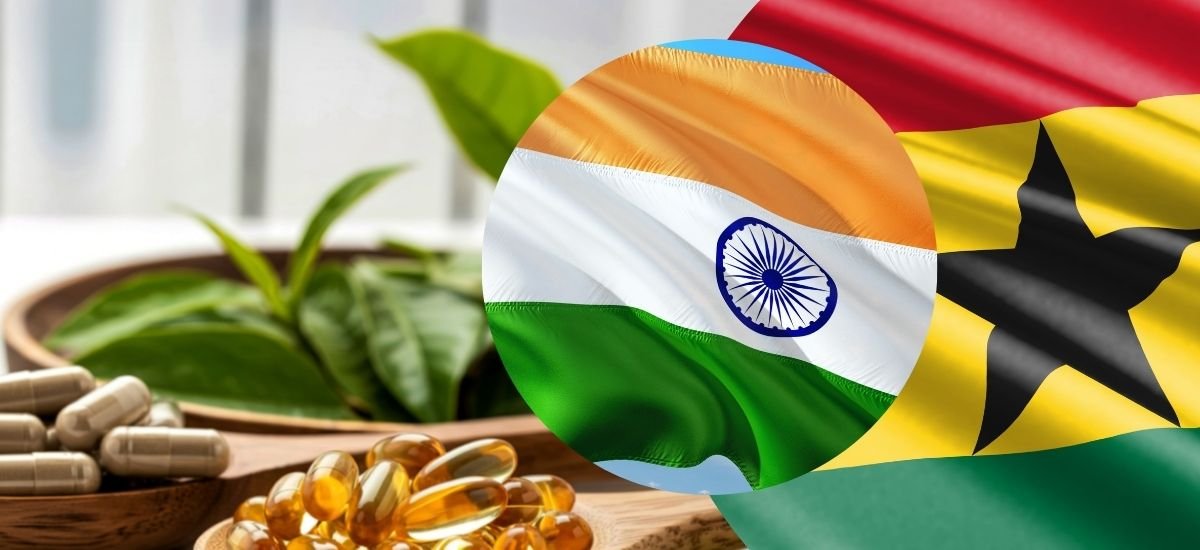
India and Ghana have signed four institutional agreements on traditional and integrative medicine following a two-day expo in Accra that drew 845 participants from across West Africa’s herbal and wellness sector. The deals open scholarship pipelines, clinical training placements, and joint research programmes between Indian and Ghanaian health institutions, and a formal AYUSH Chair is set to be established at a Ghanaian university.
- The West Africa Natural Health and Wellness Expo took place on February 26 and 27 at the Accra International Conference Centre, organised by Vipex Associates and attended by 845 targeted participants including hospital representatives, dealers, distributors, medical associations, doctors, and students from Ghana’s herbal and alternative medicine sector
- The inauguration was led by V.N. Parameswaran, Charge d’Affaires at the High Commission of India, joined by Dr. Anastasia Yirenkyi, Director for Traditional and Alternative Medicine at Ghana’s Ministry of Health, and Professor Kwame Benoit Banga, Director of the Institute of Traditional Medicine and Alternative Medicine
- Parameswaran announced the upcoming establishment of an AYUSH Chair at the University of Health and Allied Sciences in Ghana, the most concrete institutional commitment to emerge from the event, creating a permanent academic base for Ayurveda, Yoga, Unani, Siddha, and Homeopathy research and teaching within Ghana’s university system
- Four Memorandums of Understanding were signed: Deshavari Global Pharmaceuticals with Ghana’s Alternative Medical Practitioners Association covering GMP-compliant herbal supply, Ayurveda education, clinical training in India, and the GAMPA-Deshavari International Scholarship Scheme; Deshavari Global Pharmaceuticals with the Ghana Association of Medical Herbalists covering professional development and pharmaceutical knowledge sharing; IRA Chamber of Ayurveda with the Ghana Association of Medical Herbalists covering research commercialisation and institutional collaboration; and Arujiva Ayurveda and Naturopathy Hospital with the University of Nyarkotey of Holistic Medicine covering academic exchange, clinical training, faculty development, and research
- Ghana’s Deputy Minister for Health Dr. Grace Ayensu Danquah attended the afternoon exhibition session, commending Indian exhibitors for advanced packaging standards and calling for long-term partnerships in technology transfer, contract manufacturing, and packaging innovation
- With approximately 70% of Ghana’s population relying on traditional medicine, the Ministry of Health used the occasion to reaffirm support for structured product registration, regulatory compliance, and capacity-building to raise the sector’s export readiness, identifying regulation as the primary constraint on commercial scale
- India’s AYUSH ministry, established in 2014, oversees research, regulation, education, and global outreach across its traditional medicine systems, and Parameswaran framed the Ghana partnership as part of a broader Global South cooperation agenda to develop affordable, preventive wellness solutions for populations underserved by conventional pharmaceutical systems
- The Ministry of Health proposed making the Expo a biennial event, signalling an intent to institutionalise the trade and academic linkages opened in Accra rather than treat the gathering as a one-off
The four MoUs deserve reading in sequence because they form a deliberate ladder. The scholarship scheme with GAMPA creates a pathway for Ghanaian practitioners to train in India. The professional development agreement with GAMH builds knowledge-sharing infrastructure across both associations. The IRA Chamber deal adds a research commercialisation track. The Arujiva-Nyarkotey agreement at the university level formalises the academic architecture that gives the whole system institutional permanence. Together they cover supply, education, research, and clinical training, which is a more complete framework than most bilateral health partnerships achieve in their first phase. The AYUSH Chair at UHAS anchors it all within Ghana’s university system, meaning the knowledge transfer does not depend on individual relationships but gets embedded in curriculum and faculty capacity. Parameswaran’s call for Global South cooperation on preventive healthcare is also commercially significant: the global market for traditional and complementary medicine was valued at over $100 billion in 2023 and is growing rapidly, driven by rising chronic disease burdens and the cost of pharmaceutical healthcare. Ghana’s position as a potential West African hub for integrative medicine production and training is a market positioning play, not just a health policy one.
The Bigger Picture: Ghana’s traditional medicine sector is large, deeply embedded in daily healthcare practice, and almost entirely informal. Seventy percent of the population uses it but the products are largely unregistered, the practitioners are poorly credentialled by international standards, and the export potential is unrealised. India faced a structurally similar challenge before the AYUSH ministry created a systematic framework for research, standardisation, and global positioning of its traditional medicine systems. What the Accra expo accomplished, in a modest but real way, is the beginning of a knowledge transfer from a country that has solved that problem to one that has not yet done so. The scholarship scheme, the clinical placements, and the AYUSH Chair are all mechanisms for transplanting institutional knowledge rather than just selling products. For Ghana’s health sector, the commercial opportunity is genuine: West Africa has a regional market for validated, regulated traditional health products that no single country currently serves at scale. If Ghana can build the regulatory and academic infrastructure to produce GMP-compliant herbal products with internationally recognised quality certifications, it becomes the natural regional supplier. The India partnership provides the fastest credible path to that capability, because India has already built it and is now actively exporting the model.
Source: Ghanamma