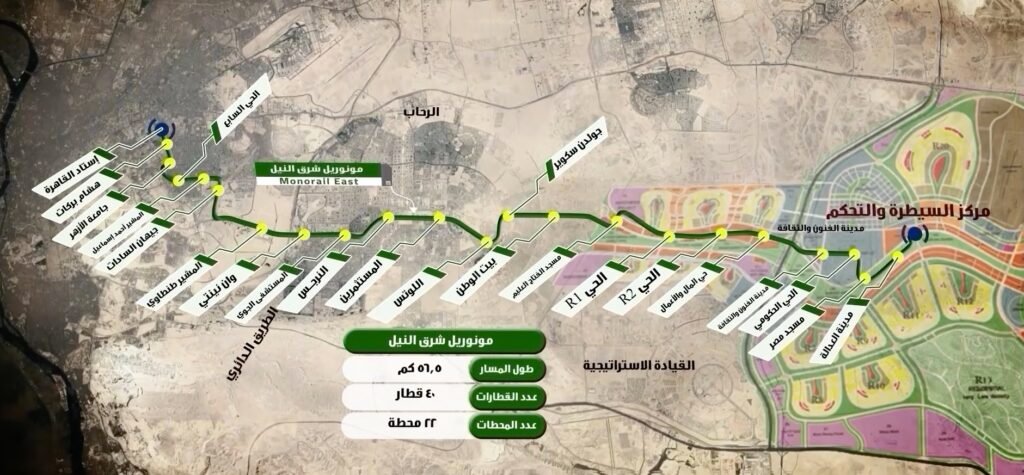

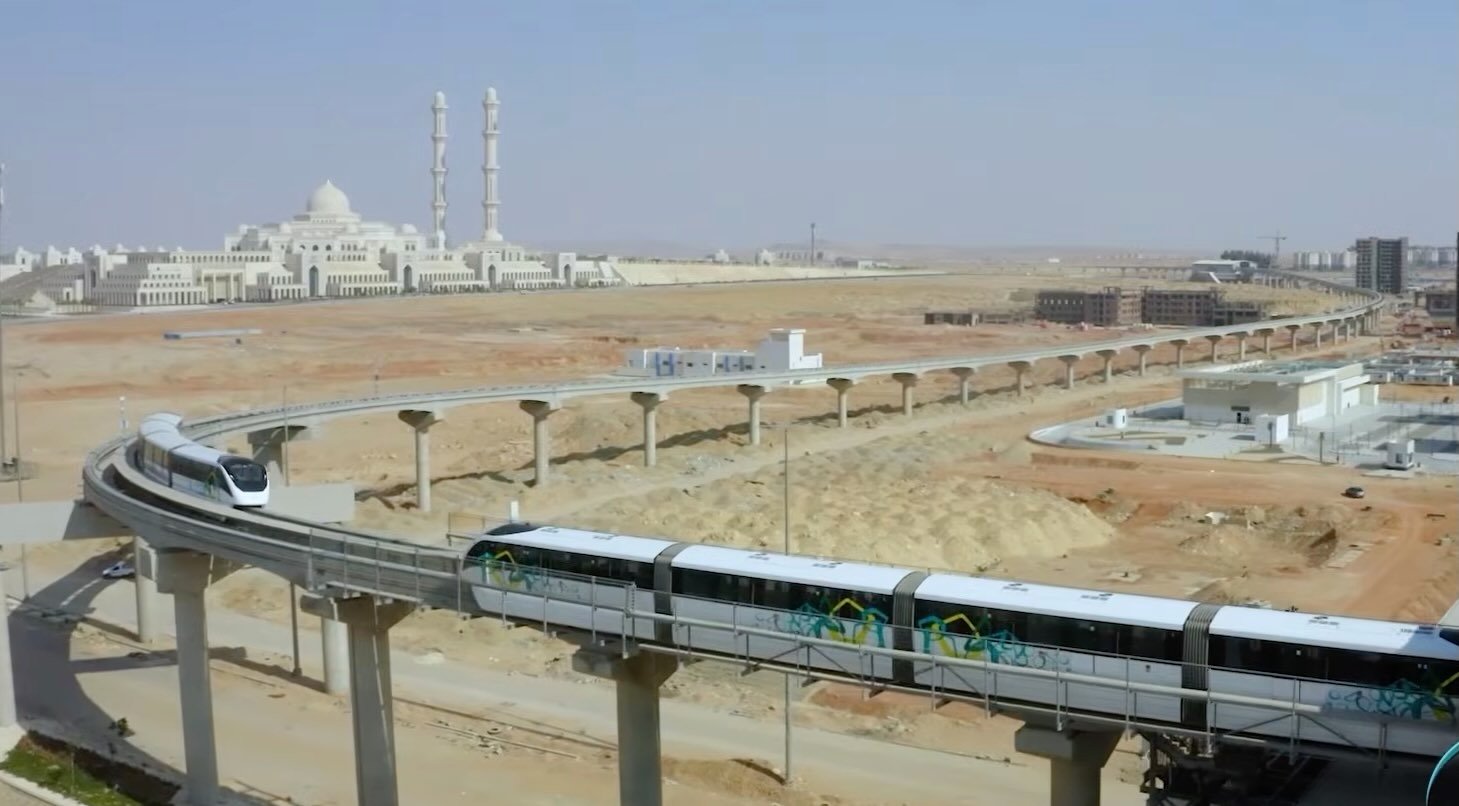
President Abdel Fattah el-Sisi inaugurated the East Nile Monorail on March 20, 2026, during Eid al-Fitr celebrations, opening Africa’s longest monorail line and Egypt’s first: a 56.5-kilometre fully driverless elevated railway connecting Cairo Stadium in Nasr City to the control centre of the New Administrative Capital. It is designed to carry 500,000 passengers per day, created approximately 15,000 direct and 10,000 indirect jobs, and is the first phase of a 100-kilometre two-line system that will become the world’s longest driverless monorail network when complete.
Sisi rode the train from Al-Fattah Al-Alim Mosque station to the Business and Financial District station alongside families of fallen soldiers, passing through the R1 and R2 residential districts of the New Capital. Prime Minister Mostafa Madbouly, Transport Minister Kamel al-Wazir and Chairman of the Administrative Capital for Urban Development Khaled Abbas accompanied the president. The inauguration was timed to coincide with the Eid holiday and the opening of the Green River zone, which includes what Egypt describes as the world’s largest central park.
The line runs from Cairo Stadium in Nasr City eastward through Nasr City, New Cairo and the Fifth Settlement, terminating at the control and operations hub in the New Administrative Capital. Its 22 stations serve Cairo International Stadium, Al-Azhar University, Dar Al Fouad Hospital, Al-Galaa Specialist Hospital, the Mosque of Field Marshal Tantawi, Al-Fattah Al-Alim Mosque and Misr Mosque, before reaching the government district, the financial and business district, and residential communities in the New Capital. The route integrates with Cairo Metro Line 3 at Cairo Stadium station, creating the city’s first intermodal connection between the metro and the new monorail network.
The system operates 40 trains, each composed of four carriages, running at speeds up to 80 kilometres per hour. End-to-end journey time is approximately 70 minutes. Headways currently run to three minutes, with plans to reduce to 90 seconds as ridership grows and operations mature. The trains are fully automated at Grade of Automation 4, meaning they operate without a driver and are managed remotely from the central control centre in the New Capital, which spans 85 feddans across 13 buildings. The system runs on rubber tyres to minimise noise and consumes 30 percent less energy than conventional electric rail. Stations are equipped with platform screen doors, elevators, escalators, wheelchair access routes, and internal passageways between carriages.
The project was developed by a consortium of Orascom Construction, Arab Contractors, and France’s Alstom, which supplied 70 Innovia 300 trains for both lines under a design-build-operate-and-maintain contract. The contract includes 30 years of operations and maintenance. Total project cost is approximately $4 billion, financed through a JP Morgan Europe facility backed by UK Export Finance, with additional contributions from the European Bank for Reconstruction and Development and the European Investment Bank. Construction on the East Nile line began in 2019. The original completion target was May 2022. Four years and multiple delays later, the line is open.
Transport Minister al-Wazir described the project as a civilisational leap and a fundamental shift in how Egypt moves its people. Commercially, the government has leased naming rights for selected stations to private sector companies to generate additional revenue, a model new to Egyptian public infrastructure.
The East Nile line is one of two planned. The West Nile line will run 42 kilometres from 6th October City to Giza, with 13 stations and a metro interchange at Nile Valley Station. Together the two lines will cover approximately 100 kilometres with 35 stations, making the completed Cairo Monorail system the longest driverless monorail network in the world, surpassing the existing record holder in Osaka. The West Nile line construction is ongoing.
Bigger Picture: The East Nile Monorail is the infrastructure spine of a bet Egypt has been making for a decade: that relocating the capital eastward into the desert will decentralise Cairo’s 22-million-person population, reduce congestion, and signal to global investors that Egypt can execute at scale. The monorail makes that bet tangible. Without mass transit connecting the New Capital to the city it is meant to complement, the government district and business hubs remain an expensive inconvenience. With it, commuters in Nasr City can reach the financial district in 70 minutes without a car. Whether that is enough to make the New Capital the economic hub its designers intended is still an open question. What is not in question is the engineering achievement: Africa has its longest monorail, Egypt has its first driverless rail system, and the project that was meant to open in 2022 is finally moving passengers.
Source: SIS Egypt / Al-Ahram / Egypt Today