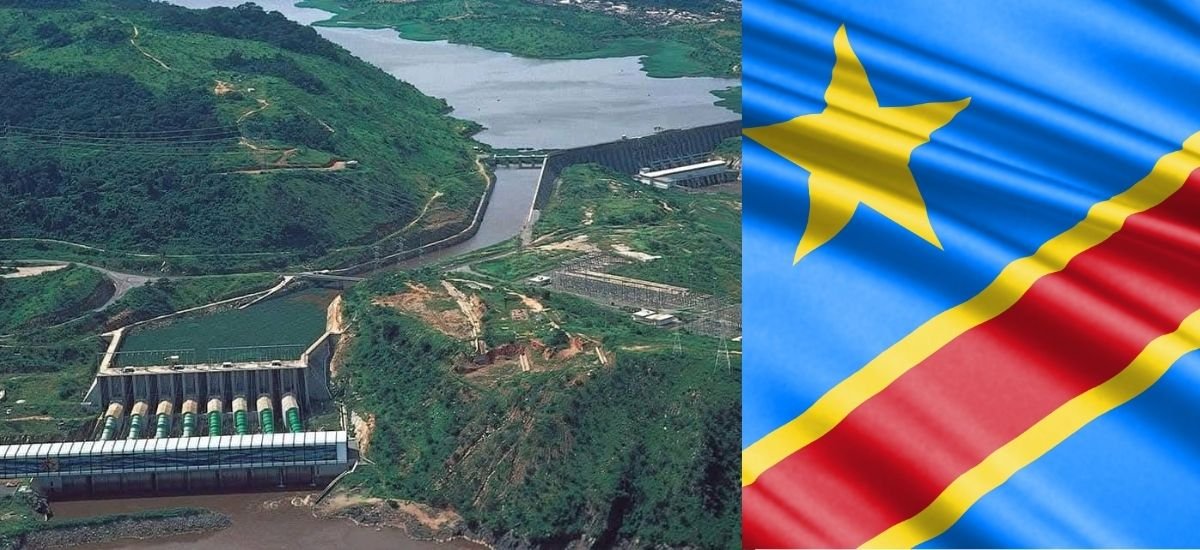
The Democratic Republic of Congo and South Africa have revived bilateral talks on the Inga 3 hydropower project, a $10 billion dam on the Congo River that, if built, would be the largest single power station in Africa and one of the most consequential energy infrastructure investments in the world. The latest engagement adds to growing momentum behind a project that has been discussed for decades without a concrete construction start.
Inga 3 is the third phase of the Grand Inga Dam complex at the Inga Falls on the Congo River, approximately 150 kilometres from the Atlantic coast in western DRC. The Congo River carries the second-largest volume of water of any river on earth, and the Inga site holds the largest untapped hydropower potential on the planet. Inga 1 and Inga 2 were built in 1972 and 1982 under Mobutu Sese Seko. Both now operate at roughly 40 percent of their original capacity after decades of underinvestment and poor maintenance. Only 21 percent of the DRC’s population has access to electricity.
The Inga 3 phase alone, in its current design, would generate between 4,800MW and 11,000MW depending on which variant is selected. Under the latest bilateral framing, South Africa has committed to purchasing approximately 2,500MW to 5,000MW of Inga 3’s output. The power would travel over 3,000 kilometres of high-voltage direct current transmission lines passing through Angola or Zambia and Zimbabwe before reaching South Africa’s Gauteng economic heartland. An additional 3,000MW has been earmarked for DRC’s Katanga mining district. Nigeria has previously indicated interest in 3,000MW through a separate Inga-Calabar transmission line.
Why the project keeps reviving
South Africa needs baseload power. Its grid has been through years of rolling blackouts driven by Eskom’s ageing coal fleet and chronic underinvestment. Inga 3 offers a large volume of clean, renewable hydropower from a single source. For the DRC, the project offers export revenue, political prestige, and the infrastructure rationale to upgrade transmission across the country.
The bilateral commitment has been restated multiple times over two decades without resulting in construction. President Ramaphosa and then-President Tshisekedi recommitted to it in Kinshasa in July 2023, with Ramaphosa describing the project as having been "lying dead." The World Bank cancelled its original involvement in 2016 citing strategic disagreements with the DRC government, then reversed course in June 2025, approving a $250 million credit from the International Development Association as the first tranche of a $1 billion Inga 3 Development Programme. In February 2026, the DRC’s Agency for the Development and Promotion of the Inga 3 Project signed a memorandum of understanding with the French Development Agency in Kinshasa, bringing French financing support into the project preparation phase. The March 2026 South Africa-DRC bilateral engagement is the latest political signal added to that financial stack.
The obstacles that have never gone away
The project’s history is a catalogue of near-starts. A Sino-Spanish consortium led by China Three Gorges Corporation and Sinohydro signed design contracts in 2018 for an $18 billion, 11,000MW design. The Spanish partner ACS Group pulled out in 2020. The consortium fragmented. Competing adviser groups backed different international partners. The DRC government kept the project agency inside the presidency, which the World Bank argued enabled corruption risk and prompted its 2016 withdrawal. The World Bank’s 2025 return came with a community-first development framework and a public-private partnership structure intended to ensure better governance and local benefit.
The economics remain disputed. An academic study published in Environmental Research Letters found that a mix of wind, solar and natural gas would be more cost-effective for South Africa than Inga 3, even without accounting for the project’s environmental and social risks. Critics point out that at least 35,000 people would be displaced by Inga 3, that less than a third of the electricity would serve DRC’s population, and that transmission losses of up to 15 percent before the power crosses into South Africa make the delivered cost higher than the headline figure. The World Bank responded that DRC’s energy deficit is so large that no single technology is sufficient, and that the critical minerals industry in Katanga, currently running on highly polluting diesel, would benefit substantially from clean hydropower.
Construction, if authorised, would take approximately a decade.
Bigger Picture: The Congo River runs through the DRC. The DRC holds 80 million people, 90 percent of whom live without reliable electricity. Inga 3’s power, if it is ever built, will go primarily to South African consumers and Congolese mining companies, not to the rural Congolese. That is the political economy of the project in a sentence. South Africa wants cheap green baseload. The DRC government wants export revenue and geopolitical significance. International lenders want a governance framework that makes the project bankable. The Congolese people want lights. Whether those four things can be made to align, and at what cost to whom, is the question that has kept this project in the planning stage for 30 years. The current momentum, with World Bank funding, a French MoU, and renewed South African bilateral commitment, is the most serious stack of support the project has had in a decade. It may still not be enough.
Source: Ghanamma / Daily Investor / World Bank / Financial Afrik