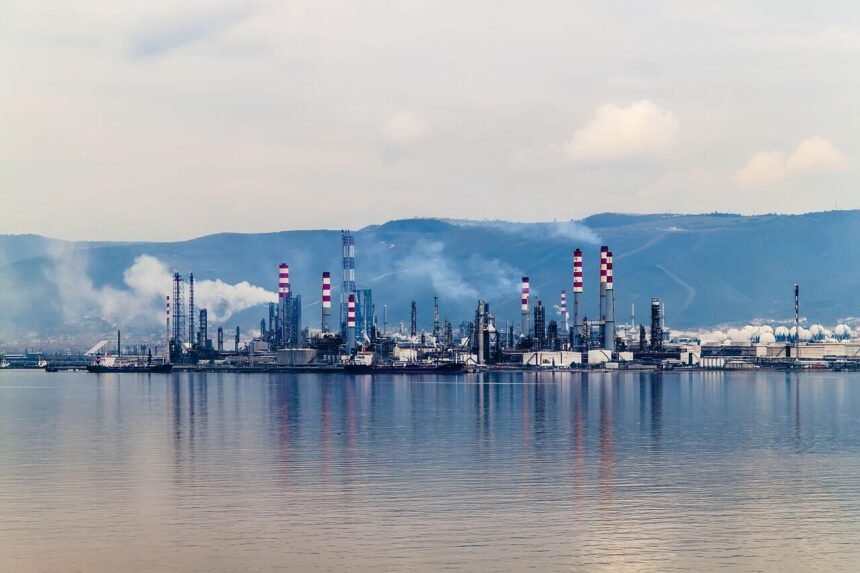

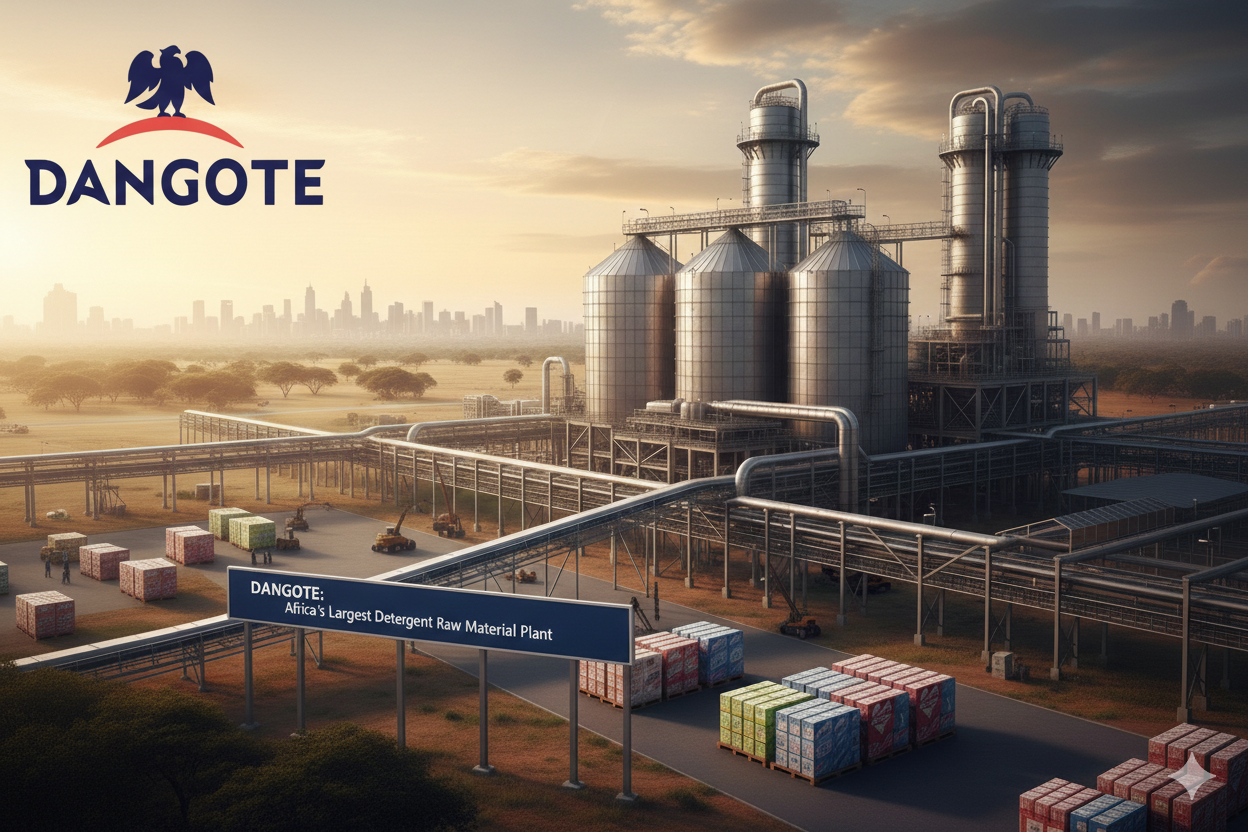
Aliko Dangote has announced plans to build Africa’s largest linear alkylbenzene plant within the Dangote Refinery complex in Lekki, Lagos, with annual production capacity of 400,000 tonnes that he says will be sufficient to supply the entire continent’s detergent raw material needs.
Key points
- The plant will produce linear alkylbenzene (LAB), the primary feedstock used in manufacturing surfactants, the active cleaning agents in detergents, positioning Dangote as a wholesale supplier to consumer goods manufacturers rather than a retail brand
- Dangote said the facility will outpace the combined output of Africa’s only two existing LAB plants: Algeria at 100,000 tonnes and Egypt at 50,000 tonnes
- Completion is targeted within 30 months, and the project forms part of a broader $12 billion expansion that will raise the refinery’s crude processing capacity from 650,000 barrels per day to 1.4 million barrels per day
- The expansion also includes 2.4 million tonnes of polypropylene production and new base oil capacity, deepening the complex’s transformation from fuel refinery into integrated petrochemical hub
- Dangote made the announcement on 21 February 2026 during a tour of the refinery by NNPC Group Chief Executive Officer Bayo Ojulari, describing the site as an industrial hub rather than simply a refinery
- NNPC holds a 7.25 per cent stake in the refinery on behalf of Nigerian citizens, with Dangote adding that individual Nigerians will be able to buy shares directly within the next four to five months
- The refinery reached its full nameplate capacity of 650,000 barrels per day on 11 February 2026, making it the first refinery globally to achieve full capacity at that scale in a single train
- Dangote Group has also signed a $400 million construction equipment deal with XCMG Construction Machinery to accelerate delivery of the expansion projects
Context
LAB is the dominant surfactant feedstock in global detergent manufacturing, used in household cleaning products, laundry detergents, and industrial cleaners. Africa currently imports the vast majority of its LAB supply, exposing manufacturers to currency risk and supply chain fragility. By producing 400,000 tonnes annually at the Lekki complex, Dangote would supply roughly four times the continent’s current domestic output in a single facility. The move is consistent with the group’s wider strategy of capturing value across the petrochemical chain rather than simply exporting crude derivatives. The refinery complex already produces fertiliser through Dangote Fertiliser, and the addition of LAB and polypropylene would extend that model into consumer goods manufacturing inputs, targeting multinationals such as Unilever and PZ Cussons as industrial customers.
Why it matters
The Dangote Refinery reaching full capacity at 650,000 barrels per day is itself a landmark: Nigeria spent decades importing refined petroleum despite sitting on some of Africa’s largest crude reserves, and the refinery’s ramp-up has already altered the domestic fuel supply picture. The LAB announcement signals that the commercial logic is now shifting further up the value chain. If delivered on schedule, a 400,000-tonne LAB plant would make Nigeria the dominant supplier of detergent inputs across Africa, reducing import bills continent-wide and creating a new category of industrial linkage between Nigerian energy and African manufacturing. For investors, it also reflects an increasingly confident Dangote Group that is compounding large-scale bets rather than consolidating around a single asset.
Source: Business Insider Africa