

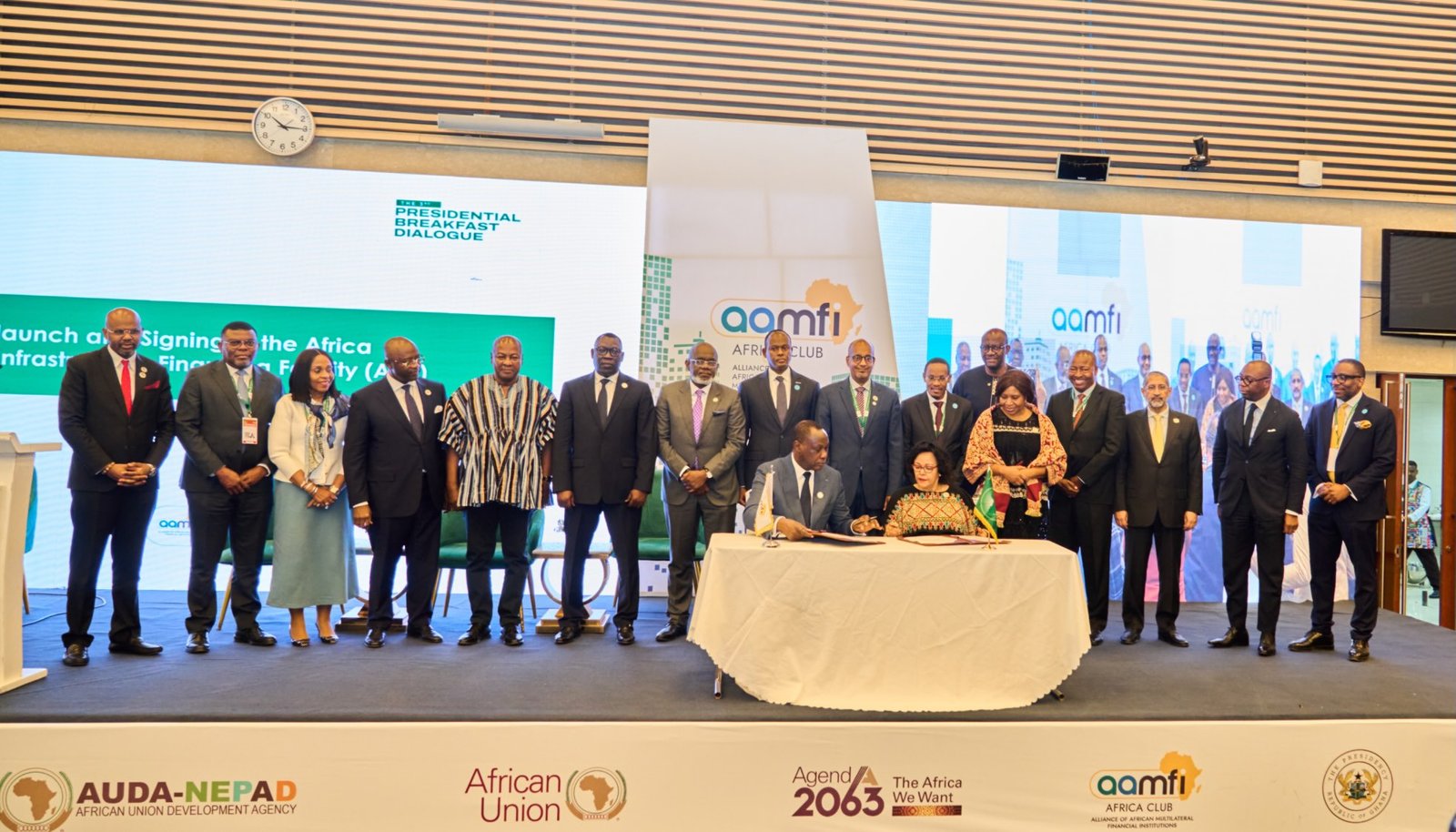
African heads of state have formally launched the Africa Infrastructure Financing Facility (AIFF), a coordinated, continent-led platform designed to channel Africa’s $2.5 trillion in domestic capital into priority cross-border infrastructure — marking a pivotal shift from dependency on external financing toward homegrown financial sovereignty.
The AIFF was unveiled on February 14, 2026, during the Third Presidential High-Level Dialogue of the Alliance of African Multilateral Financial Institutions (AAMFI), held on the sidelines of the 39th African Union Summit in Addis Ababa under the theme “Strengthening Africa’s Financial Architecture to Finance Agenda 2063.”
The Core Diagnosis: Capital Exists, Deployment Is the Problem
Ghana’s President John Dramani Mahama, who convened the Dialogue in his capacity as African Union Champion on AU Financial Institutions, framed the challenge with striking clarity: Africa does not lack capital — it lacks the institutional machinery to deploy it purposefully.
“Africa has domestic capital pools exceeding $2.5 trillion,” President Mahama stated. “The challenge is not the availability of capital, but how intentionally we deploy it into infrastructure, industrialization, and job creation to realize Agenda 2063 and the African Continental Free Trade Area.”
That $2.5 trillion sits across sovereign wealth funds, pension funds, and insurance assets — institutions that have historically directed the bulk of their portfolios into foreign markets. Redirecting even a modest share — analysts suggest 5 to 10 percent — toward domestic and cross-border infrastructure could unlock tens of billions of dollars annually for transformative projects.
The backdrop is a well-documented financing crisis. Africa faces an estimated $221 billion annual infrastructure gap between 2023 and 2030, driven by fragmented capital markets, elevated risk premiums that misrepresent Africa’s actual investment profile, limited long-term funding instruments, and structural over-reliance on external financing systems that do not reflect continental development realities.
What the AIFF Actually Does
Established under a Cooperation Framework Agreement between AUDA-NEPAD and AAMFI, the AIFF is not a new fund — it is a structured coordination mechanism. Its role is to accelerate project preparation and facilitate financing engagement for priority infrastructure aligned with Agenda 2063.
The persistent gap in African infrastructure delivery has not been political will or even available capital — it has been execution. As Afreximbank President Dr. George Elombi explained: “Too many projects stall not because they lack relevance, but because they are insufficiently prepared, inadequately structured, or misaligned with the requirements of long-term capital.”
The AIFF addresses this by pooling technical expertise across AAMFI’s twelve member institutions, standardising risk assessment frameworks, providing early-stage project preparation funding, mobilising domestic pension and insurance capital, and coordinating cross-border policy alignment. In short, it converts fragmented African finance into a coherent, deployable system.
Samaila Zubairu, President and CEO of Africa Finance Corporation and outgoing AAMFI Chair, underscored the collective firepower now on the table: “The Alliance of African Multilateral Financial Institutions represents over $70 billion in balance sheets, working together to close Africa’s trade, investment, and development financing gaps.”
A New Era of Financial Sovereignty
AU Commissioner for Economic Development Francisca Tatchouop Belobe captured the significance of the moment: “The launch of the AIFF is a powerful demonstration of what can be achieved when political will and institutional coordination converge. We are confident that this Facility will contribute meaningfully to closing Africa’s infrastructure financing gap.”
The Dialogue also produced a second milestone: Cameroon deposited its Instrument of Ratification of the Protocol and Statutes of the African Monetary Fund (AMF), advancing efforts to operationalise a continental institution capable of providing balance-of-payments support and promoting monetary cooperation among AU member states.
Incoming AAMFI Chair Dr. Corneille Karekezi, CEO of Africa Reinsurance Corporation, articulated the philosophy behind both moves: “Africa’s development finance must be anchored in collaboration and innovation. By strategically sharing risk, strengthening our institutions, and mobilizing both domestic and private capital, we can build a resilient financial ecosystem capable of delivering transformative infrastructure and industrial growth across the continent.”
Why It Matters
The AIFF launch signals that Africa’s financial architecture is entering a new phase — one defined not by aid dependency or single-nation bilateral deals, but by continent-wide institutional coordination. If the AIFF achieves even a fraction of its potential, it could raise annual GDP growth by up to two percentage points by closing the infrastructure gap that has long constrained productivity, intra-continental trade, and industrial development.
For the AfCFTA to function as envisioned — a single market of 1.4 billion people generating a $7 trillion continental economy by 2035 — the physical and financial infrastructure connecting those markets must be built. The AIFF is the mechanism Africa has chosen to make that happen on its own terms.
Source: Business Insider Africa / Afreximbank