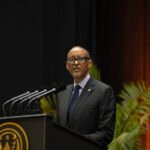

Afreximbank has raised its financing ceiling for the Caribbean Community from $3 billion to $5 billion, with President George Elombi telling CARICOM heads of government the bank intends to reach full utilisation within three to four years. With $750 million already disbursed and over $2 billion in active transactions, Africa’s foremost trade bank is no longer testing the Caribbean market — it is scaling into it.
- The announcement was made at the 50th Regular Meeting of the Conference of Heads of Government of CARICOM in Basseterre, St. Kitts and Nevis on February 25, 2026, where Elombi attended as a special guest under the summit theme “Beyond Words: Action Today for a Thriving, Sustainable CARICOM”
- Afreximbank has already disbursed more than $750 million across CARICOM member states and currently holds a pipeline exceeding $2 billion in transactions under active execution, before the new $5 billion ceiling takes effect
- Healthcare facility development is planned for Barbados, Guyana and Grenada; tourism project financing targets Barbados, Grenada, the Bahamas and Antigua and Barbuda
- Agro-processing and logistics projects will be financed in Barbados, Guyana, Antigua and Barbuda, and St. Kitts and Nevis; infrastructure including power generation, road projects and trade centres is targeted in Grenada, Jamaica, the Bahamas and Suriname
- SME-focused on-lending facilities will be extended to development banks in Suriname, St. Lucia, Grenada and Dominica; local content promotion in natural resource-rich countries is part of the mandate to retain value inside CARICOM economies
- Afreximbank is working with African corporates including Access Bank, Oando and Arise Integrated Industrial Platforms (Arise IIP) to establish a presence in the region; Arise IIP is already exploring special economic zones across multiple CARICOM countries
- The bank reaffirmed its commitment to the Afreximbank African Trade Centre in Bridgetown, Barbados, and is advancing work toward establishing a dedicated Caribbean Eximbank to make long-term structural investments in the region
- CARICOM Central Bank Governors agreed to adopt a regional payment and settlement system modelled on PAPSS, the Pan-African Payment and Settlement System Afreximbank pioneered in 2022, enabling low-cost, real-time cross-border payments in local currencies across Caribbean member states
- St. Kitts and Nevis will host ACTIF2026, the fifth Africa-Caribbean Trade and Investment Forum, in July 2026, featuring deal signings, business matchmaking and cultural showcases
The strategic logic behind Afreximbank’s Caribbean push runs deeper than bilateral goodwill. Africa and the Caribbean share a historical and demographic connection through the African diaspora, but the economic relationship has been thin relative to that history. CARICOM economies are largely commodity exporters and tourism-dependent service economies facing structural challenges that closely mirror those Afreximbank was built to address on the African continent: insufficient processing of raw outputs, limited intra-regional trade, fragmented payment systems and underfinanced SME sectors. The PAPSS alignment is particularly significant. CARICOM governors adopting a Caribbean payment system modelled on Afreximbank’s own architecture creates immediate infrastructure interoperability between two regional blocs, lowering the transaction cost of Africa-Caribbean trade before most of the $5 billion has even been committed. Elombi framed the bank’s overarching vision as changing the structure of economies rather than simply financing them, a distinction that separates Afreximbank’s posture from conventional development lending.
The Bigger Picture: This is one of the most ambitious expressions of South-South economic strategy currently being executed by any African institution. Afreximbank at end-2024 held total assets and contingencies of over $40.1 billion and shareholder funds of $7.2 billion, giving it balance sheet depth comparable to mid-tier multilateral development banks. Directing $5 billion of that capacity toward CARICOM is not charity or soft diplomacy — it is an investment thesis built on the premise that Caribbean economies are underfinanced relative to their fundamentals and that African capital, channelled through a bank with 30 years of emerging-market structuring experience, can earn returns while deepening integration. The PAPSS model adds a multiplier: if the Caribbean payment system scales the way the African one has, it creates permanent infrastructure for trade flows that make every subsequent Afreximbank transaction in the region cheaper and faster to execute. The Arise IIP special economic zone exploration is the sharpest leading indicator of what the $5 billion is really building toward. If African industrial platforms take root in CARICOM economies, the bank’s financing becomes the foundation for a manufacturing and export relationship that outlasts any individual loan facility. That is not development banking. That is economic architecture.
Source: Afreximbank