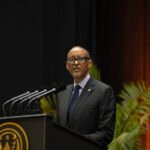


IN SHORT: The Central Bank of Nigeria was named Central Bank of the Year 2026 at the Central Banking Awards in London on June 10, the most prestigious institutional recognition in global central banking. CBN Governor Yemi Cardoso accepted the award on behalf of the board, management and staff of the bank. The citation recognised the CBN’s monetary policy reforms that overhauled past frameworks, cleared more than $7 billion in outstanding FX obligations, unified the foreign exchange market, brought inflation down significantly, rebuilt external reserves above $50 billion, strengthened the banking sector through recapitalisation, and secured Nigeria’s exit from the FATF grey list.
Nigeria’s Central Bank has achieved the highest recognition in global central banking, winning the Central Bank of the Year award from Central Banking, the authoritative institution-focused publication that has tracked and evaluated central bank performance globally for three decades, in an assessment that validates the CBN’s three-year reform programme as one of the most comprehensive institutional transformations in the history of African monetary policy. The June 10 ceremony in London marks a dramatic reversal from the CBN’s position in 2023, when it faced accusations of exchange rate distortion, a $7 billion backlog of unmet FX obligations, and monetary policy that market participants described as opaque and inconsistent.
- The Central Banking Awards citation specifically recognised several distinct achievements under Governor Cardoso: monetary policy reforms that overhauled past frameworks, with the CBN adopting an inflation-targeting regime with transparent policy rate decisions; implementation of disciplined monetary tightening while simultaneously pursuing FX market reform, a combination that required the central bank to accept short-term pain in output and credit growth to deliver medium-term stability; and clearance of more than $7 billion in outstanding FX obligations that had been accumulated under previous management and were deterring foreign investors from the Nigerian market.
- The external results of those reforms are measurable. Inflation has moderated to approximately 15% under the new framework, down from peaks above 34% in 2024. Foreign exchange reserves have risen above $50 billion, providing more than ten months of import cover. The spread between the official exchange rate and the parallel market rate has narrowed from approximately 60% at its widest to approximately 2%, meaning the foreign exchange market now functions as a genuinely unified market rather than a dual-track system that invited arbitrage and capital flight.
- Banking sector recapitalisation, one of Cardoso’s signature initiatives, has required all Nigerian commercial banks to meet significantly higher minimum capital requirements by specific deadlines, with non-compliant institutions facing merger or restructuring. This programme strengthens the sector’s resilience against the external shocks that have historically triggered banking crises in Nigeria during commodity price downturns.
- Nigeria’s removal from the Financial Action Task Force grey list is a governance achievement whose commercial implications extend beyond the banking sector. Grey list status creates correspondent banking difficulties, raises the cost of international transactions for Nigerian businesses and financial institutions, and signals governance deficiencies that deter institutional investors. Removal demonstrates that Nigeria’s anti-money laundering, counter-terrorism financing and financial intelligence frameworks have met international standards, reopening relationships with correspondent banks that had restricted services.
- The CBN’s reform programme has drawn recognition from multiple international organisations alongside the Central Banking Award. The IMF praised steps to build reserves and support market confidence. In 2025, Cardoso was named Central Banker of the Year at the African Banker Awards. The Centre for Economic Growth and Monetary Reforms described the reforms as evidence that monetary policy discipline produces measurable outcomes when applied consistently. Multiple credit rating agencies have cited improved monetary policy credibility in their assessments of Nigeria’s sovereign credit trajectory.
The award comes with a significant caveat that Cardoso himself acknowledged in his acceptance speech: the reform journey is not finished. On the day of the ceremony, the CBN released new draft guidelines for financial holding companies, aimed at strengthening governance, capital adequacy and operational ring-fencing across conglomerates. The ongoing work programme reflects the CBN’s recognition that institutional credibility must be continuously reinforced through action rather than maintained through past achievement. The Central Bank of the Year award is recognition of what has been done. The new HoldCo guidelines and the continued FX market transparency work signal what remains to be done.
The Bigger Picture: The CBN winning Central Bank of the Year is a validation that African central banks can undertake the kind of fundamental monetary policy reform that previous administrations avoided because of its short-term political costs. Inflation targeting, foreign exchange unification, FX obligation clearance and banking recapitalisation are each individually demanding. Executing all four simultaneously, while maintaining political support in Africa’s most populous country, is the institutional achievement that the award recognises. For other African central banks watching, the Nigeria example demonstrates that orthodox monetary policy reform, applied consistently and transparently, produces the external reserve rebuilding, exchange rate stability and investor confidence that is otherwise only available through IMF programmes with explicit conditionality. The CBN did it without an IMF programme. That is the more significant achievement.
Source: African Business, June 12 2026 / Central Banking Awards, June 10 2026