
IN SHORT: Eskom launched Eskom Green on June 10, a new separate renewable energy platform within the utility that will develop and supply large-scale renewable energy to mining and manufacturing companies through long-term power purchase agreements. The platform has an early pipeline of approximately 2GW of projects, forming part of a broader development pathway to 5.6GW by 2030, 21GW by 2035 and 32GW by 2040. Eskom Green will initially focus on utility-scale solar PV, battery storage, wind and pumped storage. Projects will use existing Eskom land and transmission infrastructure to reduce grid connection delays. Eskom Green is expected to be separated into a wholly owned subsidiary subject to regulatory approval.
Eskom, Africa’s largest electricity utility and historically the continent’s single largest emitter of greenhouse gases due to its coal-dependent generation fleet, launched Eskom Green on June 10 as a structurally separate renewable energy platform designed to accelerate South Africa’s industrial decarbonisation by supplying mining and manufacturing companies with utility-scale clean power under long-term agreements, deploying a 2GW initial pipeline toward a 32GW target by 2040. Group CEO Dan Marokane described the launch as not a thumb-sucking exercise but the product of international benchmarking across 20 utilities, and said Eskom Green reflects the successful adaptation to new technologies that South Africa’s national electricity system requires.
- Eskom Green’s initial commercial focus is large industrial customers, specifically the mining and manufacturing sectors, which are among South Africa’s largest electricity consumers and face the most acute decarbonisation pressure from global investors, supply chain partners and regulatory requirements. Mining sector emissions are largely electricity-linked: a cleaner electricity supply eliminates approximately 75% of mining’s scope 1 and 2 emissions without requiring the sector itself to change its production processes.
- The platform will operate through long-term power purchase agreements with take-or-pay structures designed to provide revenue certainty for project financing. This is the same contract structure used by independent power producers under South Africa’s REIPPP programme, adapted for Eskom’s balance sheet. In the early phase, Eskom will use its own balance sheet to anchor project finance; over time, private capital will be introduced alongside it.
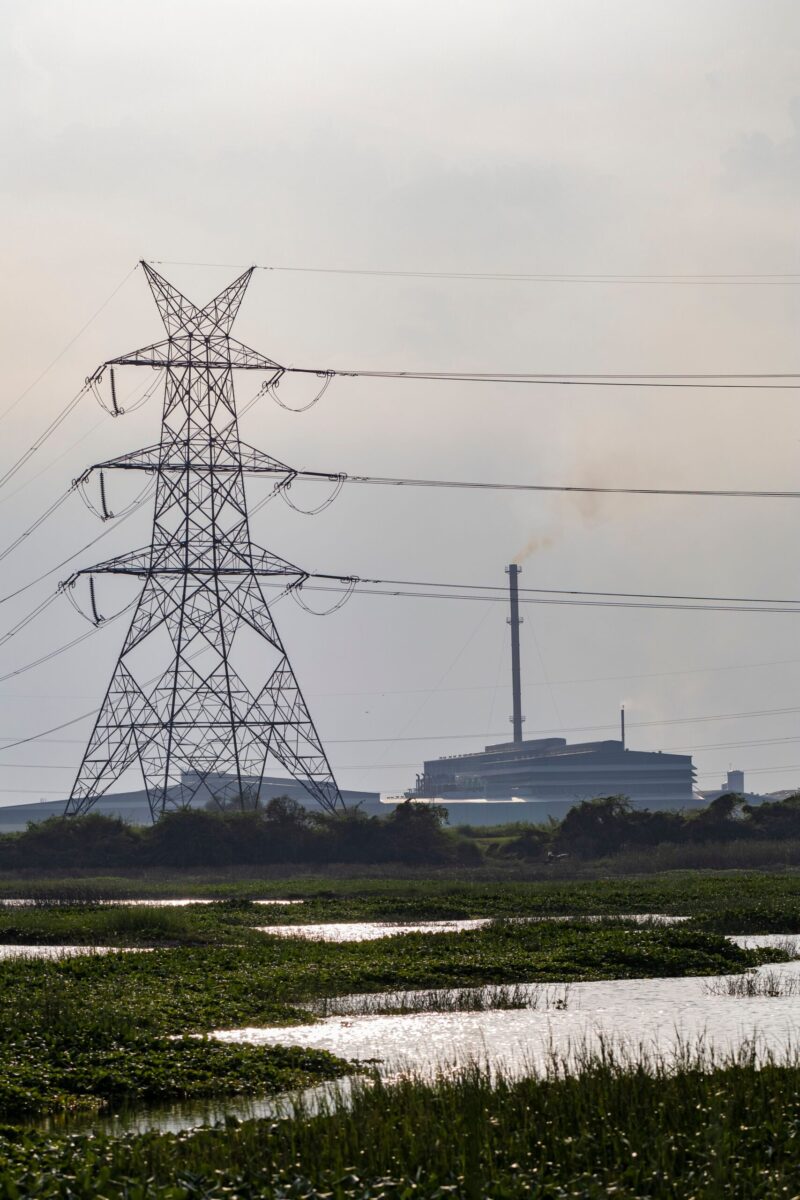
- A key strategic asset is Eskom’s land portfolio at existing power station sites. Coal stations occupy large land areas, often with strong solar and wind resources, grid connections and water access already in place. Using these sites for renewable development reduces the primary bottleneck in South Africa’s renewable rollout: the grid connection queue, which has delayed projects by years and added billions in waiting costs. Eskom Green’s use of legacy coal station sites could compress the development timeline for new renewable capacity by 18 to 24 months per project.
- The pipeline breakdown is: 2GW early pipeline (immediately developable), 5.6GW by 2030 (aligned with IRP 2025), 21GW by 2035 and 32GW by 2040. At 32GW, Eskom Green would represent a generation portfolio comparable to Eskom’s current total installed capacity, transforming the utility from primarily a coal generator into a primarily renewable one over 15 years.
- Eskom board chair Mteto Nyati explicitly addressed the concern that Eskom’s entry into the renewable market would crowd out independent power producers. He said the platform is designed to complement rather than displace IPPs, leveraging Eskom’s grid access, land portfolio and system integration capabilities that private developers cannot easily replicate. The Minister of Electricity and Energy Kgosientsho Ramokgopa framed the launch as addressing delivery execution constraints rather than policy targets, noting that procurement alone has failed to bring new capacity online at the required pace.
- Eskom Green will have its own governance structures and is expected to be separated into a wholly owned subsidiary in future, subject to regulatory and shareholder approvals. The separation enables Eskom Green to access commercial financing more directly, enter into off-take agreements without routing them through Eskom’s complex balance sheet, and attract private equity or institutional investment if the subsidiary’s track record justifies it.
The launch of Eskom Green on the same day that South Africa’s Q1 2026 GDP growth was confirmed at 0.5% for a sixth consecutive quarter is a coincidence of timing that nonetheless illustrates a structural dynamic: South Africa’s economy is growing, its electricity system has stabilised after years of load-shedding, and the next challenge is converting that stability into green industrial competitiveness. Mining companies selling platinum, manganese and rare earths to European battery manufacturers are increasingly required to demonstrate scope 2 emission reductions as conditions of supply contracts. Eskom Green’s mining-focused power purchase agreements directly address that supply chain requirement.
The Bigger Picture: Eskom launching a dedicated renewable arm targeting 32GW by 2040 is the most consequential strategic decision the utility has taken in a generation. South Africa’s Just Energy Transition requires Eskom to retire coal stations that power roughly 80% of the country’s electricity while simultaneously deploying renewable capacity that can fill the gap. Eskom Green is the institutional mechanism for the deployment side of that transition. Whether it delivers depends on execution: land site preparation, grid integration, project finance mobilisation and the regulatory approvals for the subsidiary separation. The mining sector’s demand for green power, driven by European supply chain ESG requirements, is the commercial engine that makes Eskom Green financially viable. The planet’s need for South African platinum group metals, which go into hydrogen fuel cells and catalytic converters, is the global demand signal that makes the decarbonisation economically rational. Eskom Green sits at exactly that intersection.
Source: Business Day, June 10 2026