

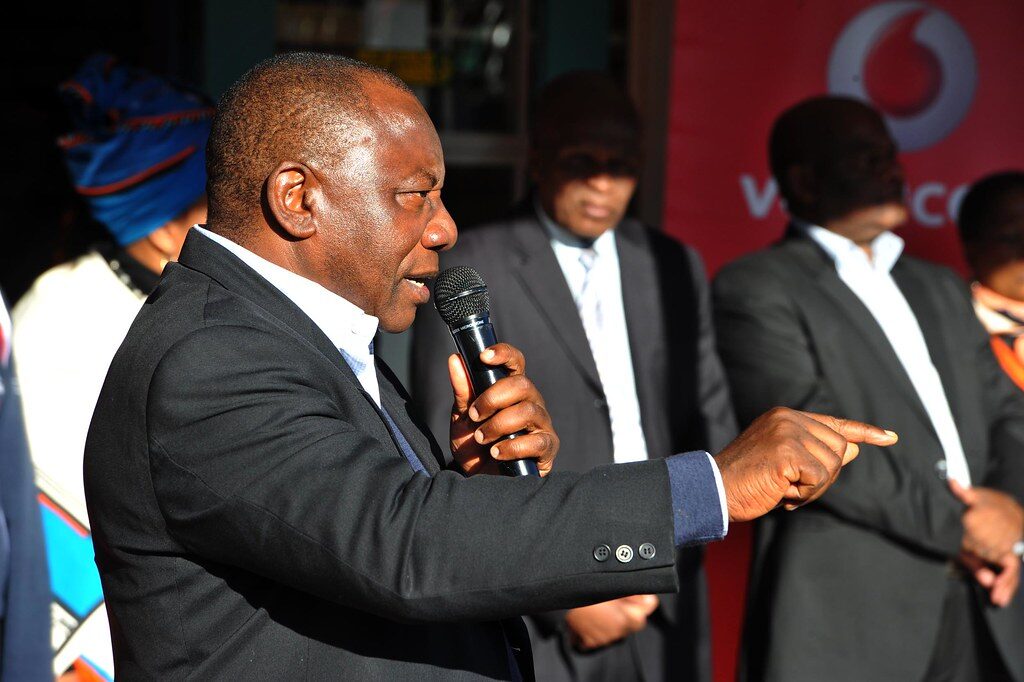
IN SHORT: President Cyril Ramaphosa addressed South Africans in a televised national address on June 7 to announce a sweeping crackdown on illegal immigration, committing to tighter border controls, faster deportations, penalisation of employers hiring undocumented workers and action against corruption in the immigration system. The announcement follows months of anti-migrant protests by the March and March movement, which has set a June 30 deadline for all illegal immigrants to leave South Africa or it will “shut down” the country. Human Rights Watch has warned of a new wave of xenophobic violence, including vigilante attacks on foreign-owned businesses in Durban, Johannesburg and Pretoria. South Africa’s foreign policy consequences are already visible: Ghana’s Ibrahim Mahama offered 100 jobs to Ghanaians displaced by the attacks.
South Africa is facing its most serious anti-immigration crisis since 2008 as the March and March movement escalates pressure on Ramaphosa’s government with a June 30 ultimatum, forcing the President into a nationally televised address that committed to immigration enforcement while explicitly condemning vigilante violence, a balance that reflects the fundamental tension between South Africa’s constitutional obligations to migrants and the political reality of deepening public frustration over jobs, services and security. The June 7 address was the clearest signal yet that Ramaphosa’s government recognises the crisis as politically destabilising, not merely a law enforcement challenge.
- The government’s announced immigration enforcement measures include stricter border controls to reduce irregular crossings, faster deportation processes for undocumented migrants, financial penalties for businesses employing undocumented workers, and crackdowns on corruption within the home affairs and border management systems that facilitate irregular migration. Ramaphosa was explicit that citizens taking immigration enforcement into their own hands is unlawful, a direct reference to March and March’s document-checking operations in city centres that have triggered violent confrontations.
- March and March, the anti-immigration movement that organised April and May protests across Pretoria, Johannesburg and Durban, has set June 30, 2026 as its deadline for all illegal immigrants to leave South Africa. The movement’s leader Sandile Dube and founder Jacinta Ngobese-Zuma met with a government high-level security cluster at the Union Buildings, but Dube said afterward he had little confidence in the outcome. The movement is threatening to “shut down” South Africa if its demands are not met, language that echoes the July 2021 riots that caused an estimated R50 billion in economic damage.
- Human Rights Watch documented a wave of xenophobic attacks in April and May 2026, including a Cameroonian shop owner in Durban whose premises were broken into by a group of ten men affiliated with March and March. HRW reported that police response was insufficient in many cases, with authorities slow to intervene as vigilantes targeted foreign-owned businesses. Bloomberg data cited in multiple reports shows xenophobic discrimination incidents reached their highest level since 2008 last year.
- The economic and diplomatic consequences are spreading. Billionaire Ibrahim Mahama announced 100 job offers to Ghanaians displaced by xenophobic attacks, a public gesture of solidarity that also signals Ghana’s government awareness of the crisis affecting its diaspora in South Africa. Nigeria, Zimbabwe, Cameroon and Mozambique all have significant communities in South Africa. The bilateral diplomatic consequences of sustained anti-migrant violence include potential trade retaliation, restrictions on South African goods in regional markets and damage to South Africa’s standing in AfCFTA negotiations where it needs goodwill from its neighbours.
- South Africa’s 32.7% unemployment rate, unchanged in Q1 2026, is the structural driver of anti-migrant sentiment. The March and March movement explicitly frames undocumented migration as a cause of South African unemployment, a narrative that finds resonance among young South Africans without formal employment. The government’s response acknowledges the economic frustration while refusing to validate the causal link between migration and unemployment that economists contest.
- The June 30 deadline creates a specific calendar risk. The movement has vowed to shut down the country if its demands are not met by that date, a threat that South Africa’s business community is watching with acute concern. A repeat of July 2021 disruption during the 2026 World Cup period, with the tournament kicking off on June 11, would compound economic damage with reputational consequences that South Africa cannot afford in its current investment recovery phase.
The immigration crisis sits at the intersection of South Africa’s most persistent structural tensions: unemployment, inequality, urban migration and post-apartheid incomplete transformation. Foreign nationals have become a lightning rod for frustration that is fundamentally about South Africa’s failure to generate enough jobs and services for its own citizens, not about the actual economic impact of migration, which economists consistently find to be broadly neutral or modestly positive. The policy challenge for Ramaphosa is that enforcing immigration law more strictly does not create jobs. But not responding to the political pressure risks the kind of mass disruption that does the most damage to the investment climate his government has been working to restore.
The Bigger Picture: South Africa’s immigration crisis has three dimensions that matter for investors. First, any large-scale disruption in June or July would damage the investment recovery story that has attracted R889.8 billion in SAIC 2026 commitments and earned the Fitch credit rating upgrade. Second, sustained anti-migrant violence creates bilateral trade and diplomatic risks with the Southern African neighbours whose markets South Africa needs for its manufacturing exports and AfCFTA integration. Third, the failure to resolve the structural unemployment crisis that drives anti-immigrant sentiment is itself the most serious medium-term economic risk, regardless of what happens in June. The June 30 deadline is the immediate catalyst. The underlying structural conditions are the story that will persist well beyond it.
Source: Bloomberg, June 7 2026 / Business Standard, June 8 2026 / Human Rights Watch, May 20 2026