
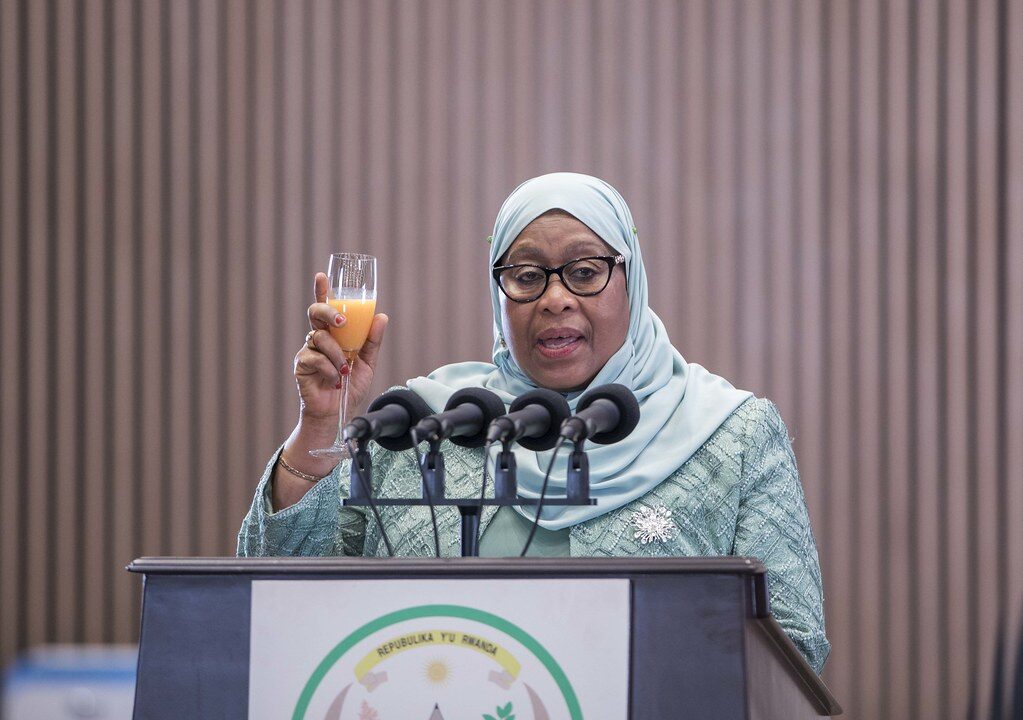
IN SHORT: Tanzania’s President Samia Suluhu Hassan arrived in Moscow on June 2 for a three-day state visit, becoming the first Tanzanian head of state to set foot in Russia since founding father Julius Nyerere’s historic trip in October 1969, a gap of 57 years. She met President Vladimir Putin at the Kremlin on June 3. Five memoranda of understanding are expected to be signed. Business leaders on the sidelines of the St. Petersburg International Economic Forum are targeting $1 billion in new investment commitments. The visit comes as Tanzania faces Western isolation following a disputed 2025 election and is part of Russia’s broad Africa re-engagement strategy.
Tanzania has made its most significant diplomatic pivot in decades, with President Samia Suluhu Hassan choosing Russia as the destination of her first state visit since her re-inauguration, ending a 57-year absence from Moscow that began when Julius Nyerere walked through the Kremlin doors in 1969 and placing Tanzania firmly in the group of African nations deepening ties with Russia amid a fracturing global order. Putin received Samia at the Grand Kremlin Palace on June 3 and described her choice of Russia as the first foreign destination after inauguration as “a very good sign.” She becomes the first Tanzanian president to visit Russia since Nyerere’s Cold War-era trip during Tanganyika’s early post-independence years.
- Bilateral trade between Tanzania and Russia grew from $178.8 million in 2020 to approximately $307.5 million in 2025, a 72% increase over five years, according to figures cited at the Kremlin meeting. Putin said trade grew 20 to 25% in 2025 alone across sectors including energy, geological exploration, transport, logistics, healthcare and education. Tanzania’s exports to Russia have nearly quadrupled over the same period.
- Five memoranda of understanding are expected to be signed during the visit. The areas covered were not fully disclosed ahead of the signings, but Tanzania’s delegation included the Minister for Foreign Affairs, the Minister for Planning and Investment and the Minister of Mining, signalling that energy, minerals and infrastructure investment are among the priorities.
- Samia is attending the St. Petersburg International Economic Forum alongside the state visit. Business leaders from both countries meeting on the sidelines are targeting new investment commitments worth approximately $1 billion. Tanzania is presenting itself as an investment destination with a particular focus on its natural gas reserves, critical minerals, agricultural potential and infrastructure investment pipeline.
- The visit carries a specific diplomatic subtext. Tanzania held a presidential election in October 2025 in which Samia won 97 to 98% of the official vote, a result that triggered large-scale protests and what multiple sources describe as the killing of hundreds of people. Western governments have condemned the violence and imposed limited sanctions, producing the international isolation that has contributed to Tanzania’s pivot toward Moscow.
- Russia became the first country to send a high-level delegation to Tanzania after the 2025 election. Putin sent Samia a congratulatory message praising her political authority. The pattern mirrors Russia’s broader Africa strategy of engaging countries navigating political crises or under Western pressure, from Mali to Sudan to Guinea, extending influence at moments when traditional Western relationships are strained.
- Tanzania’s non-alignment tradition, established by Nyerere during the Cold War as a founding principle of the Organisation of African Unity, gives the Moscow visit an ideological grounding: Tanzania can argue the visit is consistent with balanced engagement across global powers rather than a departure from non-alignment toward Moscow. Whether Western partners accept that framing is a separate question.
The Tanzania-Russia realignment should be read through two lenses simultaneously. The economic lens shows a genuine opportunity: Russia has significant capacity in energy, fertilisers, nuclear power and heavy industry that Tanzania needs for its Vision 2050 development agenda. The geopolitical lens shows a pattern: Russia is filling diplomatic space created by Western criticism of African governments’ electoral and governance records. Tanzania is not the first and will not be the last African country to have this conversation with Moscow when Washington and Brussels become more demanding than welcoming.
The Bigger Picture: Samia’s Moscow visit is the most visible single expression of an African diplomatic rebalancing that has been building for several years. As Western development financing conditionalities tighten, aid budgets decline and human rights conditionality becomes more assertive, African governments with political vulnerabilities are finding that Russia, China and Gulf states offer engagement without the governance requirements. Tanzania’s $307.5 million in bilateral trade with Russia is small against its trade with the EU, US and China, but the symbolic weight of a Moscow state visit is not measured in trade volumes. It signals to domestic constituencies, regional peers and global investors that Tanzania is prepared to define its own relationships on its own terms. Whether that independence produces better development outcomes or deeper political isolation depends on what Samia returns from Moscow with in hand.
Source: The Citizen Tanzania, June 3 2026 / The Chanzo, June 4 2026