
IN SHORT: The IFC and Citi have signed a R1.6 billion ($98 million) borrowing facility that expands IFC’s ability to lend in South African rand, its first local currency facility in the country. The deal immediately supported IFC’s anchor investment in a Cape Water outcome bond issued by FirstRand Bank, the first outcome bond issued by a commercial bank anywhere in the world.
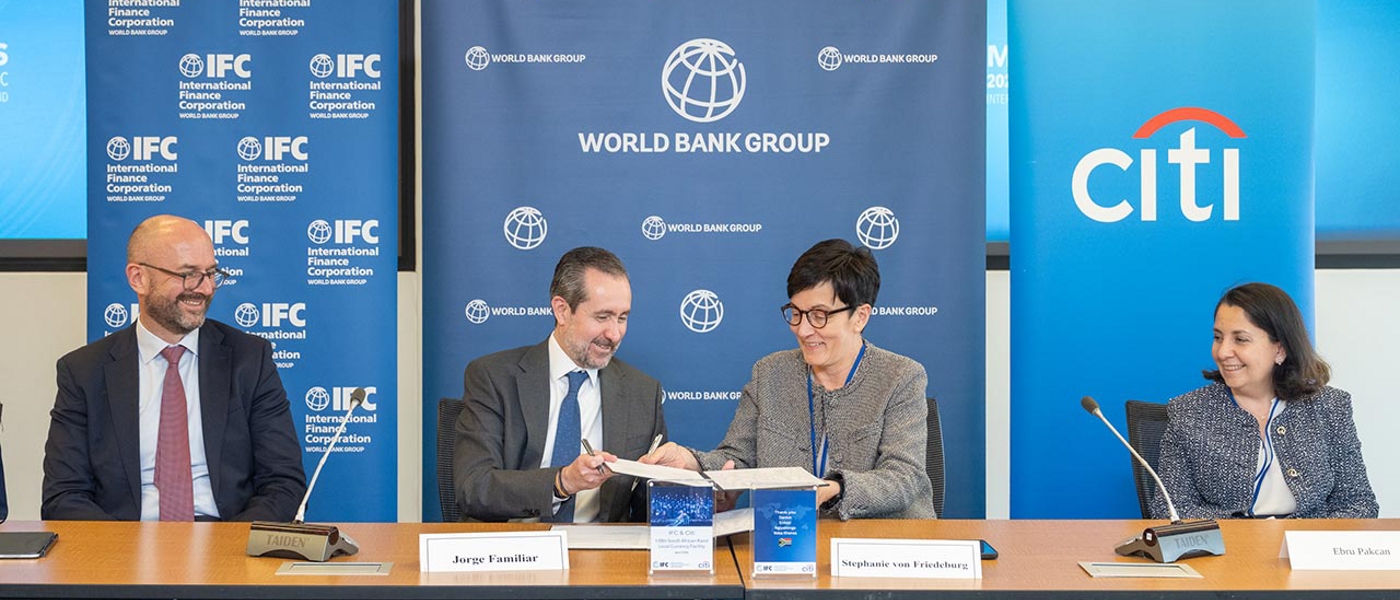
The IFC and Citi signed a R1.6 billion ($98 million) rand facility on April 14, giving the World Bank Group’s private-sector arm the ability to lend in local currency to South African businesses for the first time. The deal is a structural tool, not a single transaction: it sits in the IFC’s financing toolkit and allows it to provide rand-denominated capital to private sector borrowers who earn revenue in rands and need to avoid carrying foreign exchange risk. The announcement came from Washington on the sidelines of the IMF and World Bank Spring Meetings.
- The R1.6 billion facility is structured as a borrowing arrangement between IFC and Citi, enabling IFC to raise local currency funds and on-lend them in South Africa rather than requiring borrowers to take on dollar or euro exposure.
- First deployment: the facility backed IFC’s anchor investment in a Cape Water outcome bond issued by FirstRand Bank, the first such bond ever issued by a commercial bank globally. Outcome bonds tie returns to measurable development results.
- The structure mirrors a Kenyan shilling facility IFC and Citi signed in 2024 and is explicitly framed as a replicable model for other African markets.
- IFC has committed more than $33 billion in local currency financing across 71 currencies over the past decade, but until this deal had no rand instrument in place.
- Currency mismatch has long constrained private investment in South Africa: businesses earn in rands but available development finance has historically come in dollars or euros, creating exchange rate exposure that increases project risk and cost of capital.
The rand facility arrives at a pointed moment. South Africa secured a record R889.8 billion in investment pledges at the 6th Investment Conference in March 2026, covered by Africaspoint: South Africa pulls record $53bn in one day. Converting pledges into disbursed capital requires financing mechanisms that work in the local currency, and the IFC’s new instrument directly addresses that need. The Cape Water bond connection is notable: climate adaptation infrastructure is exactly where local currency financing is most needed, since water and energy assets generate rand-denominated revenues and cannot absorb dollar debt service without significant hedging costs.
The Bigger Picture: Local currency financing is one of the most stubborn constraints on private sector investment in African markets. For every major project that pencils out in dollar terms, the rand-denominated financing stack is the bottleneck. IFC’s move follows the playbook from Kenya, suggesting a continental rollout is the strategic direction: build the instrument in one market, prove it, then replicate. If the Kenyan shilling template holds, similar facilities in Nigerian naira, Ghanaian cedi and Kenyan shilling will follow. South Africa’s deep capital markets make it the logical proving ground, and FirstRand’s outcome bond is precisely the kind of innovative instrument that benefits most from development finance participation.
Source: IFC, April 14 2026 / CNBC Africa, April 15 2026