

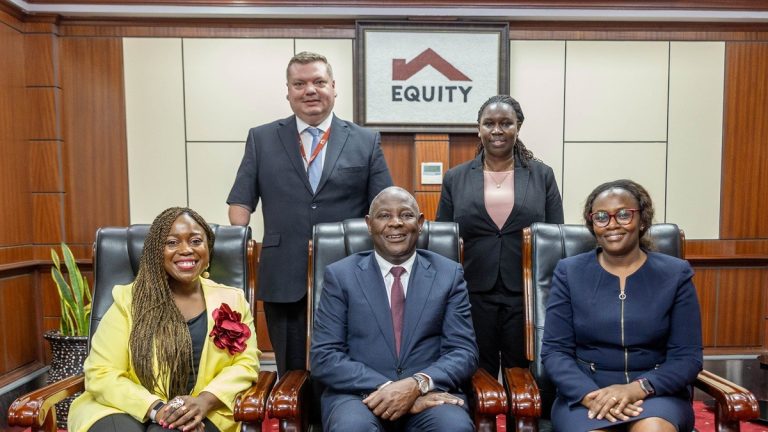
IN SHORT: Equity Bank swept ten categories at the 2026 Think Business Banking Awards in Kenya, with CEO James Mwangi named Overall CEO of the Year. The recognition caps a year in which Equity navigated Kenya’s macroeconomic stress from the Hormuz oil shock while delivering double-digit profit growth. Equity now serves over 21 million customers across seven African countries, having transformed from a small building society in 1994 into East Africa’s largest bank by customer base under Mwangi’s three-decade leadership.
Equity Bank’s sweep of ten categories at Kenya’s most prestigious banking awards and James Mwangi’s naming as Overall CEO of the Year is recognition for an institution that has done what few African banks have managed: build genuine pan-continental scale while maintaining the customer-centric model that made it dominant at home.
The 2026 Think Business Banking Awards were held this week, drawing Kenya’s financial sector leadership for an annual assessment of performance, innovation and leadership across the industry.
- Equity Bank won ten of the award categories, a clean sweep that reflects the bank’s dominance across multiple dimensions of the Kenyan banking landscape. The categories covered include performance metrics, customer service, digital banking innovation and sustainability, demonstrating that Equity’s leadership extends beyond pure financial performance to the operational and reputational dimensions that the Think Business judges assess.
- Mwangi has led Equity for more than two decades, having joined what was then Equity Building Society in the early 1990s when it was a small, struggling building society with a handful of branches. Under his leadership, the institution transformed its model to focus on the unbanked, deploying agency banking, mobile money and affordable account structures that brought millions of Kenyans into the formal financial system for the first time.
- Equity now operates across Kenya, Uganda, Tanzania, Rwanda, South Sudan, Ethiopia and the DRC, with over 21 million customers, making it the largest African bank by customer numbers outside South Africa and Nigeria. The DRC subsidiary is among the most operationally complex African banking expansions, serving a country with chronically weak infrastructure and a largely cash-based economy at scale.
- The bank navigated 2025 and early 2026 under genuine macroeconomic stress. Kenya’s CBK ended its 10-cut easing cycle in April 2026 as the Iran war drove oil prices above $90 and inflation began rising. Equity’s double-digit profit growth during this period reflects both the bank’s underlying earnings power and the benefits of regional diversification: operations in Uganda, DRC and Rwanda continued to grow even as the Kenyan macroeconomic environment tightened.
- Equity’s digital infrastructure is central to its competitive position. The bank processed hundreds of billions of shillings in mobile transactions in 2025 through its Equitel MVNO and EazzyBanking app. Its agency banking network, one of Africa’s largest, extends Equity’s reach into rural and peri-urban Kenya where traditional branch infrastructure is uneconomic.
- Mwangi has been among Africa’s most vocal advocates for what he calls the “transformative capitalism” model: using business to generate social impact at scale rather than treating the two as separate activities. His public positioning has given Equity institutional credibility that goes beyond banking, allowing the bank to attract development finance institution partnerships and co-financing arrangements that lower its cost of capital for lending programmes.
The award follows recognition of Equity’s regional expansion model as a template for African banking across the continent, with the DRC acquisition and the Ethiopian banking licence both cited as strategic landmarks in Equity’s pan-African buildout.
The Bigger Picture: Equity Bank’s awards sweep is not just about one bank or one CEO. It reflects a broader maturation of the East African banking sector, where institutions that began as inclusion-focused domestic lenders are now genuinely continental competitors with the scale, technology and capital to challenge for business that once went to international banks. Mwangi’s three decades of leadership at Equity have produced one of Africa’s most studied business transformation stories. The challenge for the next chapter is whether the model that worked in Kenya can be replicated with the same fidelity in Ethiopia, the DRC and the markets beyond, where the conditions are harder and the competitors are watching closely.
Source: Billionaires.Africa / Think Business Banking Awards 2026, May 5, 2026