

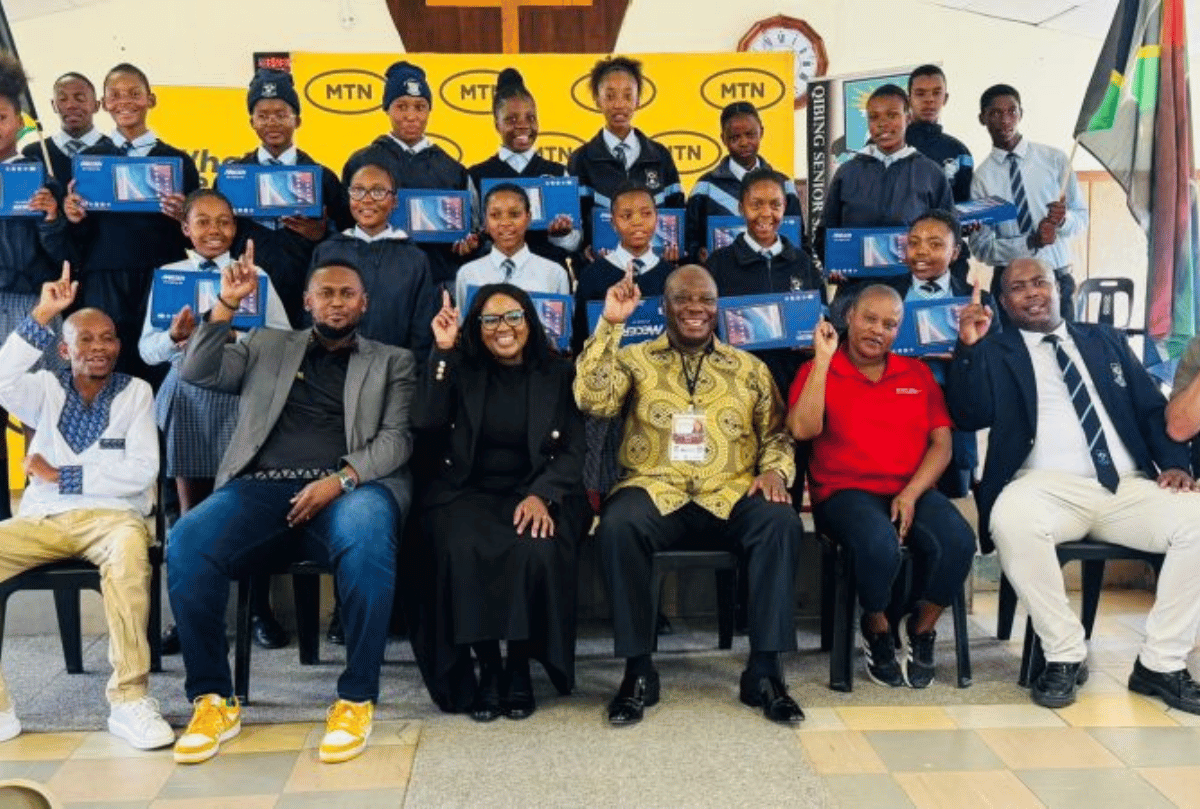
IN SHORT: MTN South Africa has donated digital devices to Qibing Secondary School in the Free State, which recorded a 100% matric pass rate in 2025, the first in its 46-year history. The donation is part of MTN’s Back2School campaign, which has placed nearly 1,200 devices in schools nationally.
MTN South Africa has donated digital learning devices to Qibing Secondary School in Wepener, Free State, through its foundation’s Back2School campaign. The school, a Quintile 1 institution serving one of the province’s most disadvantaged communities, made history in 2025 by recording a 100% matric pass rate for the first time in its 46-year history. The device handover is designed to sustain that momentum by equipping students with tools for digital learning and research.
Quintile 1 schools are the most under-resourced in South Africa’s state education system, receiving the highest government subsidy precisely because they serve communities with no capacity for school fees or private supplementation. Qibing’s 100% pass rate in 2025 was achieved against that backdrop, making it a nationally significant result rather than a routine milestone.
The donation forms part of MTN’s broader national education programme. The company has delivered nearly 1,200 devices to schools across South Africa, established over 400 multimedia centres, and made learning platforms available on a zero-rated basis to hundreds of thousands of learners. The programme runs in collaboration with district officials, local government, and strategic partners, and is framed by MTN as part of its contribution to bridging the digital divide and reducing inequality in access to quality education.
South Africa’s digital skills gap is a documented constraint on economic mobility. The 2024 General Household Survey found that fewer than a third of learners in rural and township schools had regular access to digital devices for schoolwork. Programmes like MTN’s Back2School campaign address this directly at the school level, though systemic scale remains a challenge: South Africa has roughly 26,000 public schools, and 1,200 devices across that base is a starting point rather than a solution.
Bigger Picture: The Qibing story illustrates what is possible in under-resourced South African schools when students, teachers, and communities commit to results. A 100% matric pass rate at a Quintile 1 school after 46 years of trying is not a lucky outcome; it reflects deliberate effort. MTN’s intervention arrives at the right moment: the school has proved it can deliver academic results, and the devices create a platform to build on that. The larger question for South Africa’s education system is whether corporate CSI programmes can be scaled and coordinated into something structurally transformative, or whether they remain well-intentioned but fragmented contributions to a gap that only systemic government investment can close.
Source: TechAfrica News