

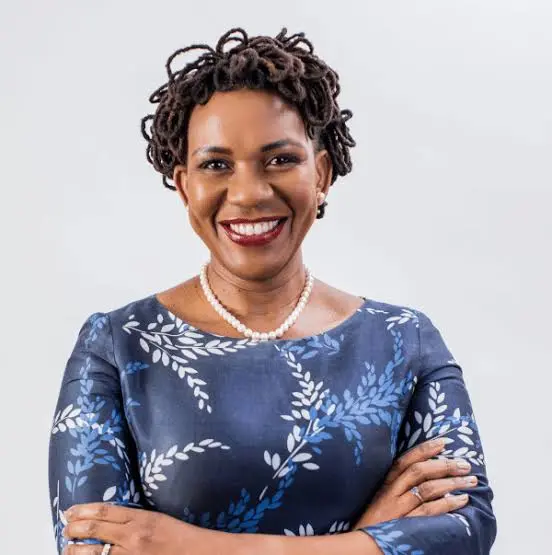
Mary Vilakazi became CEO of FirstRand Group in April 2024, making her the first woman to lead Africa’s largest bank by market capitalisation, the second Black CEO in the group’s history, and the most senior woman in sub-Saharan African banking since Maria Ramos left Absa. She grew up in Alexandra township outside Johannesburg, sold sweets on the street for pocket money, and financed every stage of her education through scholarships and bursaries. None of it was given.
The origin story matters because it is not decorative. Vilakazi has described her path explicitly as a product of opportunity, not exceptional talent. "There were children that were a lot smarter than me. They never benefited from tertiary education, while I got lucky and got exposure to some education programmes," she told CFO South Africa in 2016. The programmes she credits are specific: a Gifted Child Programme that included Saturday school at Redhill School in Morningside, a Rotary Fund scholarship that got her to St Enda’s Secondary School in Braamfontein, and a PwC bursary that funded her BCom at the University of the Witwatersrand, which she completed in 1999. She gave birth during her final year of high school. She enrolled at Wits anyway.
Her career trajectory from there is disciplined and fast. She completed her chartered accountancy articles at PwC, qualifying in 2002, and made partner at 27 in the Cape Town office in 2005, one of the youngest globally at that point. She specialised in financial services auditing, built deep sector knowledge from the outside, and then crossed to the operating side in 2008 as CFO of Mineral Services Group. By 2014 she was at MMI Holdings, rising from CFO to Deputy CEO by 2017. When FirstRand brought her in as Chief Operating Officer in 2018, she was running the group’s diversification strategy across insurance, investment management and broader Africa. When Alan Pullinger announced his departure in October 2023, Vilakazi was the named successor. She took the chair on April 1, 2024.
FirstRand is not a small assignment. The group encompasses First National Bank, Rand Merchant Bank, WesBank and Ashburton Investments, employs approximately 50,000 people globally, and holds a market capitalisation of around $22 billion (R400 billion). Its operations span South Africa, sub-Saharan Africa, the UK and India. In the six months to December 2025, under Vilakazi’s leadership, normalised earnings rose 11 percent to $1.27 billion (R23.2 billion), non-interest revenue climbed 12 percent, and net interest income grew 7.7 percent across a lending book that is expanding in South Africa, East Africa and the UK simultaneously.
Her strategic priorities as CEO are increasingly continental. FirstRand acquired Standard Chartered’s Zambia wealth and retail banking business in 2025 and is actively exploring entry into Kenya, where a tenfold increase in minimum capital requirements is forcing consolidation across the banking sector. Vilakazi told Bloomberg she wants to go to Kenya. She is also building in Ghana and Nigeria. The domestic South Africa business, which accounts for 81 percent of group earnings, is improving, with the central bank’s rate-cutting cycle from late 2024 supporting credit demand and household balance sheets. But Vilakazi is explicit that South Africa alone cannot deliver the growth the group requires. East Africa, growing above 5 percent annually, is where the incremental opportunity sits.
She was named a World Economic Forum Young Global Leader in 2016. She received the Greg Boyd Award at the 2024 Association of Black Securities and Investment Professionals Awards. She is married to Zeblon Vilakazi, who became Vice Chancellor of the University of the Witwatersrand in 2021 — the same institution where Mary Vilakazi completed her degree on a bursary a generation earlier. They have three children.
Bigger Picture: The significance of Mary Vilakazi’s appointment is structural, not symbolic. FirstRand is the most profitable banking group in Africa. It is run by a woman who grew up in a township, sold sweets for income, and earned every qualification through access to programmes that most of her peers never received. In a continent where the pipeline of Black women into senior financial leadership remains constrained by capital, geography and institutional access, her trajectory is relevant beyond South Africa. The argument she makes is not that she is exceptional. The argument is that she got access. Africa’s banking sector employs millions and intermediates trillions of dollars of capital. The composition of its leadership has consequences for who that capital serves. Vilakazi understands this. It is why she says her role model responsibility is something she takes seriously, especially toward young Black women.
Source: BusinessTech