
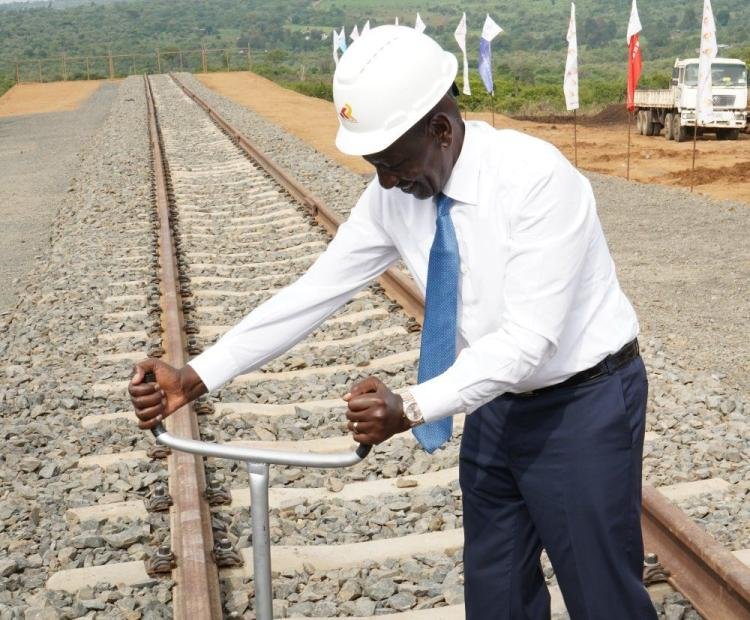
President William Ruto broke ground on the Naivasha-Kisumu-Malaba Standard Gauge Railway extension at Suswa, Narok County, on March 19, officially launching a 371-kilometre railway that will link western Kenya and the Ugandan border to the Port of Mombasa. The contractor is China Communications Construction Company, whose chairman Song Hailiang met Ruto at State House the day before. The project is the most consequential infrastructure commitment Kenya has made since the original SGR was completed in 2017.
The extension runs in two phases. Phase one covers approximately 264 kilometres from Emurtoto in Narok County through Narok, Bomet, Kericho, Nyamira and Kisumu counties to Kisumu, with an 8.69-kilometre branch line connecting to the proposed new Kisumu Port. Phase two covers approximately 107 kilometres from Kisumu through Siaya, Vihiga, Kakamega and Busia counties to Malaba on the Ugandan border. Together the two phases form the western leg of the Northern Corridor, Kenya’s primary trade route connecting the Indian Ocean port at Mombasa to Uganda, Rwanda, Burundi, South Sudan and the DRC.
The railway is designed to carry up to 22 million tonnes of freight annually. Each freight train will haul 4,000 tonnes and passenger trains will carry up to 1,096 people at speeds up to 120 kilometres per hour. The Naivasha-Kisumu section includes six intermediate stations at Narok, Mulot, Bomet, Sotik, Sondu and Ahero, plus crossing stations and a major freight station at Kisumu linked to the port. The Kisumu-Malaba section includes stations at Yala and Mumias and a major freight station at Malaba. The project requires 13 tunnels, 23 bridges and 376 culverts.
Ruto described the extension as completing a national vision: connecting Kenya more efficiently, lowering the cost of doing business, and positioning the country as the entry point to the Great Lakes region. Currently thousands of trucks use the Nairobi-Kisumu highway daily, generating heavy road wear, accidents and high transport costs. The SGR extension is projected to shift bulk cargo from road to rail and reduce freight transit times significantly.
The financing model for this extension breaks sharply from the debt-driven approach that built the original Mombasa-Nairobi line. Kenya is not borrowing from Beijing this time. The capital structure relies on the National Infrastructure Fund, which mobilises domestic asset monetisation proceeds and crowds in private capital. That distinction matters for a country that spent years trapped by the terms of the Chinese loans that built the first phase.
Ruto is scheduled to launch the Kisumu-Malaba section separately at Kibos in Kisumu County, with Uganda’s President Museveni attending to underscore the regional significance of the connection.
Bigger Picture: The Naivasha-Kisumu-Malaba SGR is not just a railway. It is the infrastructure argument for why landlocked East and Central African economies should route their trade through Mombasa rather than through Dar es Salaam or Djibouti. Every kilometre of track laid westward from Naivasha extends Kenya’s commercial gravity and deepens the integration logic of the Northern Corridor. If completed on schedule and budget, which no major African infrastructure project should be assumed to do, it positions Kenya as the indispensable logistics spine of a region whose combined GDP is approaching $600 billion.
Source: Capital FM Kenya