
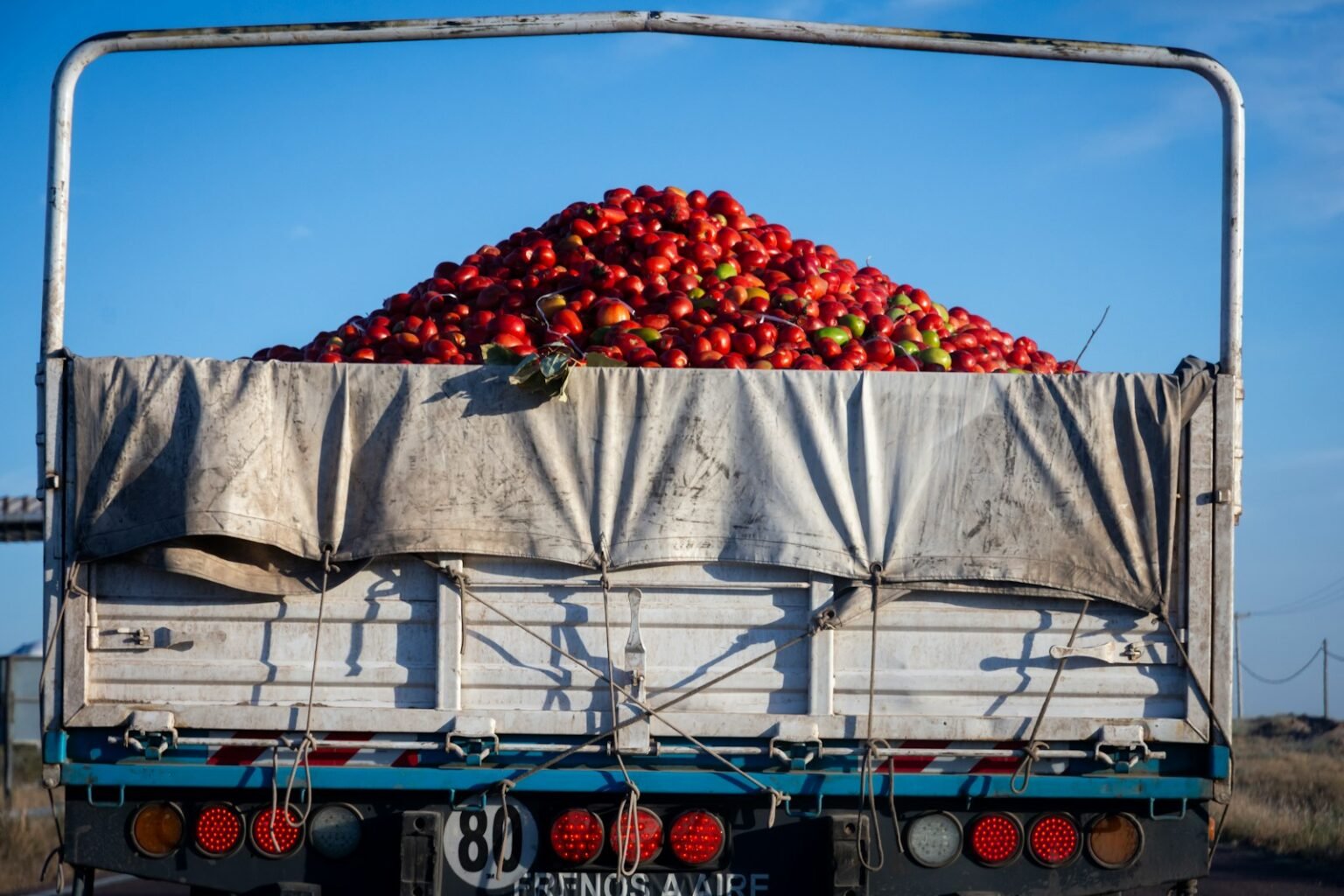
Burkina Faso has banned fresh tomato exports with immediate effect, effective March 16, 2026, in a move that has disrupted supply to Ghana, Côte d’Ivoire, Togo and Benin, and that represents the sharpest expression yet of a deliberate industrial policy that Captain Ibrahim Traoré has been building since he took office in October 2022. The ban is not a crisis response. It is the enforcement mechanism for a strategy that has been years in the making.
The background matters to understand what this week’s export ban actually means. Burkina Faso has always been a significant tomato producer. In 2021, the country produced 290,000 tonnes of fresh tomatoes, almost all of it grown by smallholder farmers. The structural problem was that without domestic processing capacity, a large share of that harvest either rotted in the field or crossed the border into Ghana and Côte d’Ivoire as raw produce, generating minimal value for Burkina Faso’s economy. Traders in Ghana’s northern markets came to depend on Burkinabè tomatoes, particularly during Ghana’s dry season when local supply is thin. The tomatoes were preferred for their shelf life and quality. Burkina Faso was effectively subsidising food security in neighbouring countries while its own farmers saw their perishable crops expire.
What Traoré built before the ban
When Traoré took power and launched the Presidential Initiative for Agricultural Production in 2023, followed by the broader Agropastoral and Fisheries Offensive covering 2023 to 2025, the tomato sector was a specific priority. The logic was explicit: before you can stop exporting raw tomatoes, you have to give your farmers somewhere else to sell them. Two processing plants were inaugurated in rapid succession in late 2024. The first, the Société Burkinabè de Tomates (SOBTO) in Bobo-Dioulasso, was launched on November 30, 2024, with a processing capacity of 6 tonnes per hour, 20 percent state participation and 80 percent community capital through the Agency for the Promotion of Community Entrepreneurship (APEC). Total investment was approximately $8 million. The second, the Société Faso Tomates (SOFATO) in Yako in the northern region, was inaugurated in December 2024, with a $8.9 million investment and a capacity of 5 tonnes per hour. Together the two plants process 11 tonnes of tomatoes per hour, converting raw produce into paste, puree and sauces. A third facility in Tenkodogo was announced in early 2025. The combined infrastructure was budgeted at approximately $2.4 million for the third plant, bringing total sector investment to over $19 million in eighteen months.
The results against production numbers are significant. Tomato output rose from 290,000 tonnes in 2021 and 315,000 tonnes in 2022 to 360,000 tonnes in 2024, a 14 percent increase over two years, driven by access to improved hybrid seedlings, subsidised inputs, and the distribution of over 400 tractors. Agriculture’s contribution to Burkina Faso’s GDP growth was 1.6 percentage points of overall 4 percent growth in 2024. The country achieved grain surpluses for two consecutive years. By the government’s own accounting, the Agricultural Offensive has created conditions for food sovereignty that simply did not exist before 2023.
Why the ban now
The ban, signed jointly by Minister of Industry, Commerce and Crafts Serge Gnaniodem Poda and Minister of State for Agriculture Commandant Ismaël Sombié on March 16, 2026, is the logical enforcement step. Processing plants built to run at capacity need raw material. If tomatoes continue flowing freely across the border into Ghana, the factories in Bobo-Dioulasso and Yako cannot achieve the throughput that justifies their investment. The ban effectively forces the supply chain to route domestically. Traders with existing Special Export Authorisations have a two-week grace window to complete transactions already in progress, after which all permits are revoked. Confiscated tomatoes will be redirected to processing facilities at no cost to the factories.
This is a version of the same logic that drove Indonesia’s nickel export ban: you cannot build a processing industry if the raw material keeps leaving. Uganda’s iron ore export ban follows the same principle. Burkina Faso, operating under a military transitional government with explicit sovereign economic ambitions, is applying it to its most productive perishable crop.
The regional disruption
For Ghana, the timing is uncomfortable. The ban took effect during the dry season, precisely when Ghanaian market supply is thinnest and dependence on cross-border imports is highest. Traders at the Racecourse Market in Kumasi were among the first to raise concerns about impending price increases. Northern Ghana is the most exposed: this is the primary corridor through which Burkinabè produce enters the Ghanaian supply chain, both through formal channels and informal cross-border flows. Ghana’s Ministry of Trade, Agribusiness and Industry has announced diplomatic engagement with Ouagadougou and urged traders to remain calm, while simultaneously directing Deputy Minister John Dumelo to push farmers in the Upper East Region, specifically in Garu and Talensi, to intensify dry-season harvesting. The government has invoked its Feed Ghana and Feed the Industry programmes as medium-term responses, but these take seasons to produce.
Côte d’Ivoire, Togo and Benin face similar supply adjustments. The broader regional reality is that Burkina Faso’s tomato export, historically handled informally through West Africa’s cross-border produce networks, did not flow through formal AfCFTA channels or bilateral agricultural agreements that would provide any enforceable remedy. The ban is legal under WTO frameworks as a measure to supply domestic industry, and Burkina Faso’s transitional government has shown limited interest in multilateral trade obligations it views as relics of the Western-dominated order it is explicitly rejecting.
What this tells the investor about Burkina Faso’s direction
The tomato story is a data point in a larger pattern. Traoré has banned raw iron ore exports, imposed requirements on cotton processing, broken from ECOWAS, established the Alliance of Sahel States with Mali and Niger, and expelled French military forces. The Agricultural Offensive, while producing genuine output gains, is simultaneously the vehicle for a sovereignty agenda that has little interest in the kind of foreign investment frameworks that Western development finance institutions favour. The APEC model, with its emphasis on community shareholding rather than foreign equity, is deliberate.
For the CEO audience, the specific investment signal is clear: the Burkina Faso tomato processing sector is actively seeking supply. The two operating plants and the third in development represent investable agro-industrial infrastructure if approached on terms compatible with Ouagadougou’s political priorities. Packaging, logistics, and distribution for domestically processed tomato products are the obvious adjacent opportunities. Raw commodity export plays are, by design, being closed.
For Ghana specifically, the ban is a structural reminder that food import dependency is a policy choice that accumulates risk with every season. Ghana has the agricultural land, the irrigation potential in the Upper East and Volta regions, and the processing gap that mirrors where Burkina Faso was in 2022. The question the ban forces Accra to ask is whether the current disruption will catalyse the same kind of domestic investment response that Ouagadougou has now enforced at its borders.
Bigger Picture: Burkina Faso’s tomato export ban is the enforcement mechanism of a three-year industrial policy, not a spontaneous protectionist reaction. Traoré built the processing plants first, grew the production numbers, and is now directing the supply to fill the factories. The ghost of Thomas Sankara, who argued in the 1980s that Burkina Faso must produce what it consumes and consume what it produces, is present in every line of the March 16 communiqué. Whether the agro-industrial model delivers lasting prosperity or becomes another African resource-sovereignty story that enriches a small domestic class while leaving farmers poor will depend on governance quality that is genuinely uncertain in a country still operating under a military transitional administration. What is not uncertain is the direction of travel. Burkina Faso is building factories, protecting their supply, and pricing in sovereignty. Its neighbours that export food north are going to need to decide whether to compete or depend.
Source: GBC Ghana / Radio Tamale / GBC Ghana / Food Business Africa