
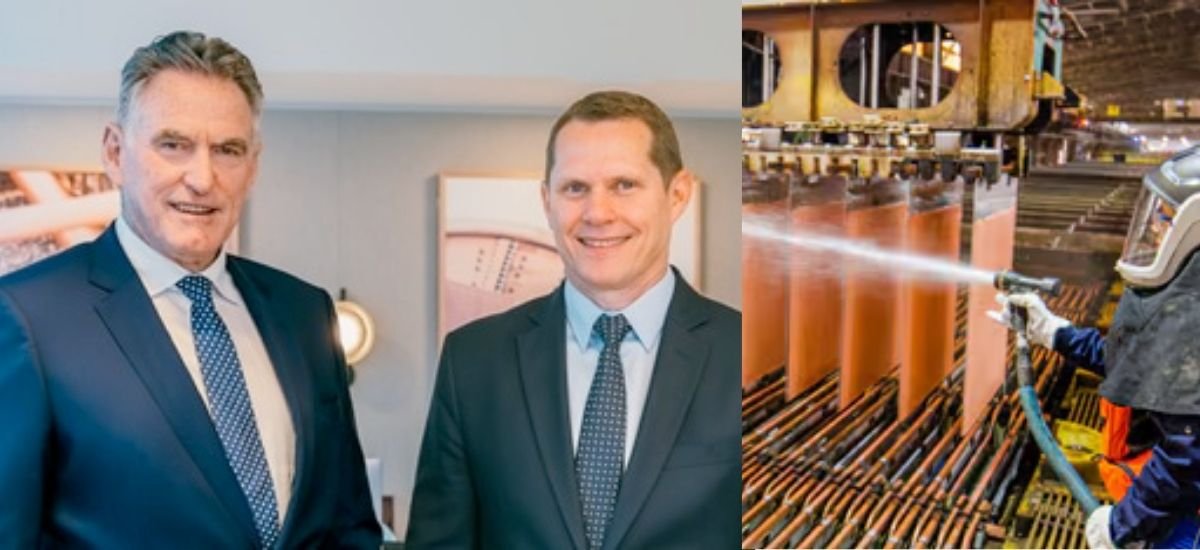
BHP, the world’s largest listed mining company with a market capitalisation of approximately $246 billion, has appointed Brandon Craig as its next chief executive. Craig, 53, is KwaZulu-Natal born, trained as an engineer at the University of KwaZulu-Natal where he graduated summa cum laude, and has spent 25 years at BHP. He takes over from Canadian-born Mike Henry on July 1, 2026. The appointment signals continuity over disruption at a company that is simultaneously navigating a pricing war with China, a historic shift toward copper, and a geopolitical environment in which critical minerals have become instruments of national strategy.
Craig is the latest in a growing roster of South Africans running some of the world’s largest mining companies. Natascha Viljoen recently took over as CEO of Newmont, the world’s largest gold miner, becoming the first woman to lead it in its 104-year history. Anglo American, worth approximately $56 billion, is led by South African Duncan Wanblad, who fended off three takeover attempts by BHP under Henry and is now finalising a transformative merger with Canada’s Teck Resources that will create a $53 billion copper-focused group. Craig, Viljoen and Wanblad collectively run companies that between them produce a significant share of the world’s copper, iron ore, gold, potash and coal.
Who Craig is and how he got here
Craig joined BHP in the late 1990s after training as an engineer in South Africa. He spent over two decades in operational and leadership roles across the company’s global assets, rising to lead BHP’s Western Australia Iron Ore division, the world’s lowest-cost major iron ore operation, through the years of pandemic disruption. In 2024 he was appointed President Americas, taking charge of BHP’s growth strategy across the United States, Chile, Argentina and Canada, a region the company has identified as central to its copper and potash ambitions. His name only emerged publicly as a CEO candidate relatively recently, with Australia boss Geraldine Slattery having been the widely assumed frontrunner. Craig’s rapid rise through the Americas role convinced the board otherwise.
BHP chair Ross McEwan said Craig’s extensive operational experience, discipline and focus would continue to drive the company’s high-performance culture. RBC Capital Markets analyst Kaan Peker described the transition as “more evolutionary than transformational.” Barrenjoey analyst Glyn Lawcock put it plainly: “He knows the business very well and he’s got an empire to lead.”
What he inherits
Henry leaves Craig a company in the strongest strategic position it has occupied in years, but facing acute short-term pressures. The key numbers:
- Copper accounted for more than 50 percent of BHP’s earnings in the six months to December 2025, the first time in the company’s history. BHP is now the world’s largest copper producer.
- Iron ore, still 44.7 percent of net sales, remains hugely profitable but geopolitically exposed. China accounts for 62.6 percent of BHP’s revenue distribution. BHP is currently locked in a protracted pricing dispute with China’s Mineral Resources Group, which has banned its mills from buying several BHP products during annual supply negotiations.
- The Jansen potash project in Canada, one of the largest greenfield mining investments on earth, is in its final construction phase and approaching first production. Potash is a key fertiliser ingredient and a major future revenue stream.
- Henry attempted three times to acquire Anglo American and its copper portfolio. All three approaches were rejected. Craig has said he will not rule out acquisitions but that any deal “would have to be incredibly compelling” to compete with BHP’s existing organic growth options.
- BHP’s Australian shares rose 1.2 percent on the day of the announcement.
What this means for Africa
BHP has historically operated in South Africa but has progressively reduced its direct footprint there. The African relevance of Craig’s appointment is primarily symbolic and structural. Symbolically, the appointment of a South African to lead the world’s biggest miner, alongside Viljoen at Newmont and Wanblad at Anglo American, is a statement about where global mining expertise is concentrated. South Africa’s mining universities, particularly Wits and the University of KwaZulu-Natal, continue to produce engineers who rise to the top of the global industry despite the domestic sector’s well-documented structural challenges.
Structurally, Craig inherits BHP’s position at the centre of a Western government-led push to secure critical mineral supply chains outside Chinese dominance. Copper is the most important metal in that push, essential for electric vehicles, grid infrastructure, AI data centres and defence manufacturing. BHP controls major copper assets in Chile and is a partner in the Resolution Copper project in Arizona, one of the largest undeveloped copper deposits in the United States, which gained key land access in March 2026 after two decades of opposition from Native American groups.
The African continent holds a disproportionate share of the world’s critical mineral reserves, including copper, cobalt, lithium and manganese. Craig’s stated priority of building strong government and customer relationships, and his observation that the geopolitical importance of mining has never been better understood, positions BHP as an institution that may deepen African engagement as competition for critical mineral assets intensifies between Western democracies and China.
Bigger Picture: A KwaZulu-Natal engineer now runs the world’s biggest mining company. The three largest publicly traded mining groups on earth are led by South Africans. That is not coincidence. It reflects decades of technical training, operational culture and global career mobility built on the back of an industry that shaped South Africa’s economy for over a century. The irony is that the domestic mining sector those engineers trained in remains under profound pressure. Craig takes charge of a company whose primary growth focus is copper in the Americas, not Africa. The continent that produced him holds most of the minerals his company needs. Whether BHP, under his leadership, treats Africa as a supply chain to be managed or a partner to be invested in is a question that will matter for decades.
Source: Daily Investor / Reuters via Mining Weekly / Business Day / Moneyweb