

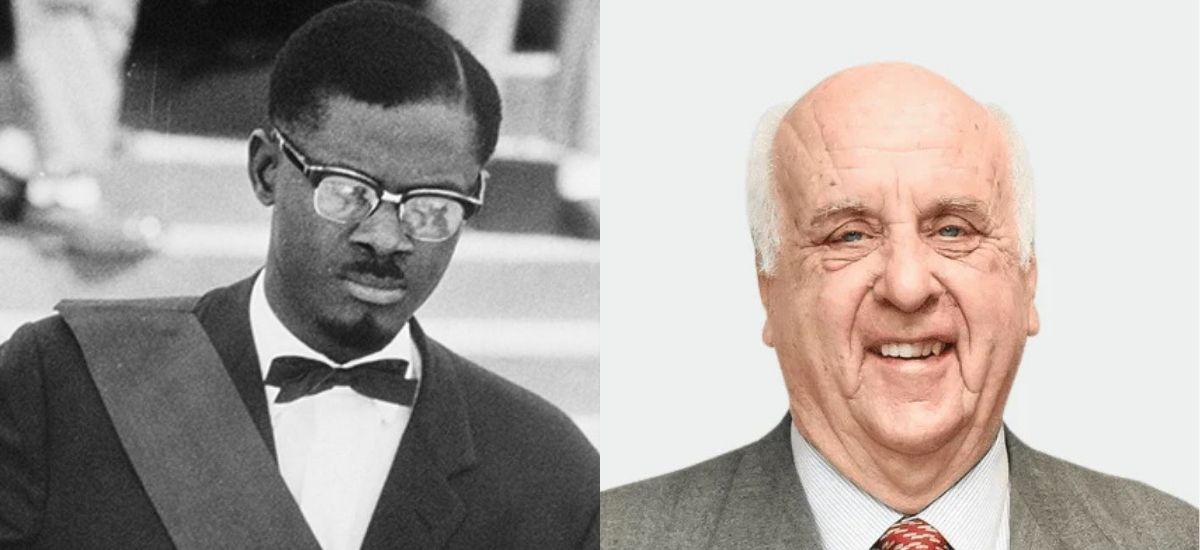
A Brussels court has ordered 93-year-old former diplomat Étienne Davignon to stand trial for war crimes connected to the 1961 assassination of Patrice Lumumba, the first prime minister of the Democratic Republic of Congo. Sixty-five years after the killing, this is the first time any Belgian has been ordered to face a criminal court over Lumumba’s murder. Davignon is the last surviving suspect.
- Davignon served as a junior diplomatic attaché in Congo in 1960 and 1961. At 28, he was part of the Belgian diplomatic mission during the Congo crisis that followed independence.
- Charges: participation in war crimes, specifically unlawful detention and transfer of Lumumba, denial of a fair trial, and humiliating and degrading treatment. He is also charged in connection with the murders of Lumumba’s political allies Maurice Mpolo and Joseph Okito, who were executed alongside him.
- Ten Belgians were originally accused by the Lumumba family. Nine have since died. Davignon alone remains.
- The ruling by the Council Chamber of the Brussels Court of First Instance on March 17 is subject to appeal. Davignon was not present in court. His lawyer has declined to comment.
- The court went beyond the federal prosecutor’s submissions by extending the scope to include Mpolo and Okito, adding weight to a decision already described by the family’s lawyer as a "gigantic victory."
Patrice Lumumba became Congo’s first prime minister when Belgium granted independence on June 30, 1960. His tenure lasted 77 days. He was a firebrand orator, a pan-Africanist, and a politician whose central demand, that Congo’s mineral wealth belong to its people, made him immediately dangerous to two sets of powerful interests: the Belgian state, which had built its industrial wealth on Congolese copper, cobalt, uranium and rubber, and the United States government, which feared his willingness to accept Soviet support during the Cold War.
In September 1960, Lumumba was deposed in a coup led by army colonel Joseph-Désiré Mobutu, backed by the CIA and Belgian intelligence. US National Security Council records, declassified decades later, confirm that American officials explicitly authorised action against Lumumba. He was placed under house arrest in Kinshasa. In December he escaped, was recaptured, and in January 1961, was flown to Katanga province, the mineral-rich region then under Belgian-backed secessionist control led by Moïse Tshombe. The flight itself, which placed Lumumba in the hands of people certain to kill him, was organised with Belgian official involvement. Davignon is accused of being part of that chain.
On January 17, 1961, Lumumba, Mpolo and Okito were driven into the bush and shot by a firing squad. A Belgian officer, Gerard Soete, later admitted dissolving the bodies in acid and keeping a tooth as a trophy. That tooth, gold-capped, was returned to Lumumba’s family in a formal ceremony in Brussels and Kinshasa in June 2022, accompanied by an official Belgian government apology. The apology acknowledged what a 2002 parliamentary investigation had already found: that Belgium bore "moral responsibility" for the assassination. But moral responsibility is not criminal liability. The 2026 trial is the attempt to close that gap.
Davignon’s career after Congo illustrates the impunity that surrounded the killing for six decades. He rose to become vice president of the European Commission from 1977 to 1985, head of the International Energy Agency, chairman of Société Générale de Belgique, and a board member of numerous listed companies. In 2018, Belgium’s King Philippe elevated him to the rank of Count. The man prosecutors now say organised part of the machinery of a political assassination was, for most of his life, one of Europe’s most decorated establishment figures.
The case was filed by Lumumba’s family in 2011. For fifteen years it advanced slowly, stalled by institutional reluctance and legal complexity over whether the 1961 events could be prosecuted under the Geneva Conventions, which require an armed conflict. The court determined that Congo was in a state of armed conflict in 1961, enabling the war crimes charges. The Belgian Federal Prosecutor’s Office formally requested referral to trial in June 2025. In January 2026, ten of Lumumba’s grandchildren joined the proceedings as civil parties. In March, the court ordered trial.
Lumumba’s granddaughter Yema Lumumba called the ruling "a step in the right direction," adding that the family’s goal is "to search for truth and establish different responsibilities." His grandson Mehdi Lumumba called it "historic." Family lawyer Christophe Marchand described Davignon as "a link in the chain" of what he termed a "disastrous state-sponsored criminal enterprise."
The precedent matters beyond this case. For the first time, a criminal court will examine, under formal criminal law, the individual responsibilities of a representative of a former colonial power in the assassination of an African head of government. The principle established, that six decades of impunity do not erase criminal liability for colonial-era war crimes, has implications that extend well beyond Belgium and Congo. France, Britain, Portugal, and other former colonial powers have been shielded by similar assumptions of historical distance. A conviction in Brussels would challenge that assumption directly. Even a full trial, whatever its outcome, puts the evidentiary record before a criminal court in a way no parliamentary inquiry or government apology has done.
Bigger Picture: Lumumba was 35 years old when he was shot in the dark outside Elisabethville. The country he briefly led has spent the 65 years since living out the consequences: Mobutu’s three-decade kleptocracy, successive armed conflicts, the looting of the mineral resources Lumumba said belonged to the Congolese people, and a humanitarian crisis that remains among the worst on earth. Davignon’s trial will not undo any of that. But it will, for the first time, force a criminal court to look directly at how it began, who made the decisions, and what the legal consequences of those decisions should be. Africa has been waiting 65 years for this question to be asked in that setting. The answer, whatever it is, will be heard across the continent.
Source: RFI / Reuters via US News / Al Jazeera / France 24 / ECCHR