

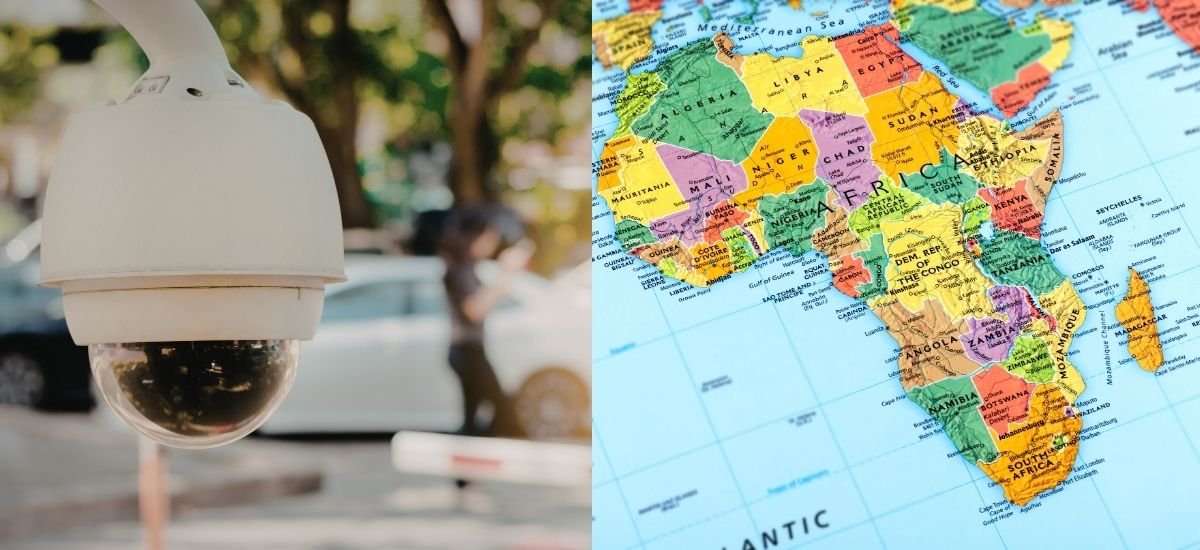
Eleven African governments have spent at least $2 billion on AI-enabled surveillance cameras, facial recognition systems, and command centre technology supplied overwhelmingly by Chinese companies, with no compelling evidence the spending has reduced terrorism or serious crime, according to a new report by the Institute of Development Studies published this week. The research, authored by the African Digital Rights Network, documents a surveillance expansion across Algeria, Egypt, Kenya, Mauritius, Mozambique, Nigeria, Rwanda, Senegal, Uganda, Zambia and Zimbabwe that has in multiple cases been used not for public safety but for political control.
The country-level spending figures are stark. Nigeria is Africa’s largest buyer of Chinese mass surveillance technology, having spent over $470 million on facial recognition and automatic number plate recognition systems. Mauritius, a small island nation of 1.3 million people, is the second largest spender at $456 million. Kenya ranks third at $219 million. Across the 11 countries studied, average per-country spending reaches approximately $240 million. Most have had mass public space surveillance infrastructure in place for between five and ten years. Not one has enacted a legal framework capable of balancing legitimate security needs against constitutional privacy rights.
The research traces the surveillance architecture from initial procurement through deployment and finds a consistent pattern. Governments justify the investment as counter-terrorism or crime prevention infrastructure. The contracts are negotiated with limited or no public participation, and the terms are frequently classified. The cameras, control centres and data management systems are supplied and often financed by Chinese companies operating under China’s Belt and Road Initiative and Global Security Initiative frameworks. Once operational, the systems are used for purposes that extend beyond the stated security rationale.
The country-specific findings are the most damaging part of the report. In Zimbabwe, specific groups including government critics and opposition figures report that facial recognition technology is being used to track and target them. In Mozambique, the deployment of smart CCTV cameras correlates geographically with areas of concentrated political opposition. In Zambia and Senegal, mass surveillance infrastructure has been installed in environments the researchers describe as having no meaningful terrorist threat or serious crime challenge that would justify the scale of deployment.
Tony Roberts, independent digital rights researcher and co-author of the report, frames the distinction clearly: targeted digital surveillance of terrorists and serious criminals can be justified in the public interest, but installing thousands of CCTV cameras for the mass monitoring of entire urban populations, in the absence of any individual suspicion, crosses a different line. The absence of legal regulation does not merely create a risk of abuse. It creates a chilling effect on protest, journalism, and political dissent that functions as suppression even when no individual is ever arrested. People who know they are being watched, without legal limits on how that data is used or by whom, change their behaviour. That is the mechanism of control.
The investment model embedded in most of the contracts deepens the governance concern. Chinese financing packages for smart city technology frequently bundle the infrastructure loan with the technology supply, the installation, and the operational integration, creating long-term technical dependency on Chinese vendors for system maintenance, software updates, and data infrastructure. African governments that sign these contracts are not merely purchasing hardware. They are integrating Chinese technological standards and data architectures into their national security systems for a generation.
The report’s findings arrive in a wider context of growing African engagement with digital governance. Ghana announced new Data Protection and Emerging Technologies Bills in March 2026, covering AI regulation and cross-border data. Kenya has built dedicated data infrastructure at Konza Technopolis, including disaster recovery systems for critical national platforms. These are encouraging steps. But legislation governing how governments collect and use data on their own citizens, and what constraints apply to surveillance infrastructure procured from foreign vendors, remains absent or inadequate across most of the 11 countries studied.
The researchers are explicit about what is needed: full transparency in procurement and deployment, mandatory human rights impact assessments before any surveillance rollout, and enforceable legal frameworks that subject surveillance operations to judicial oversight. None of the 11 governments studied have implemented all three. Most have implemented none.
Bigger Picture: Africa is buying a surveillance infrastructure from China that its own legal systems cannot yet regulate, cannot audit in real time, and in some cases cannot even fully access or understand. The $2 billion already spent is the floor, not the ceiling: the contracts identified represent only the disclosed portion of a procurement landscape where secrecy is the default. For investors and executives, this matters beyond the governance dimension. A continent whose governments are surveilling their own citizens at scale, without legal constraint, is a continent building the institutional architecture of authoritarian control at exactly the moment it is also building the digital infrastructure of economic growth. Those two trajectories are not compatible over time. The African Digital Rights Network’s report is not primarily an argument about Chinese technology. It is an argument about whether African governments are building states that their citizens and investors can trust.
Source: IPS News / Institute of Development Studies