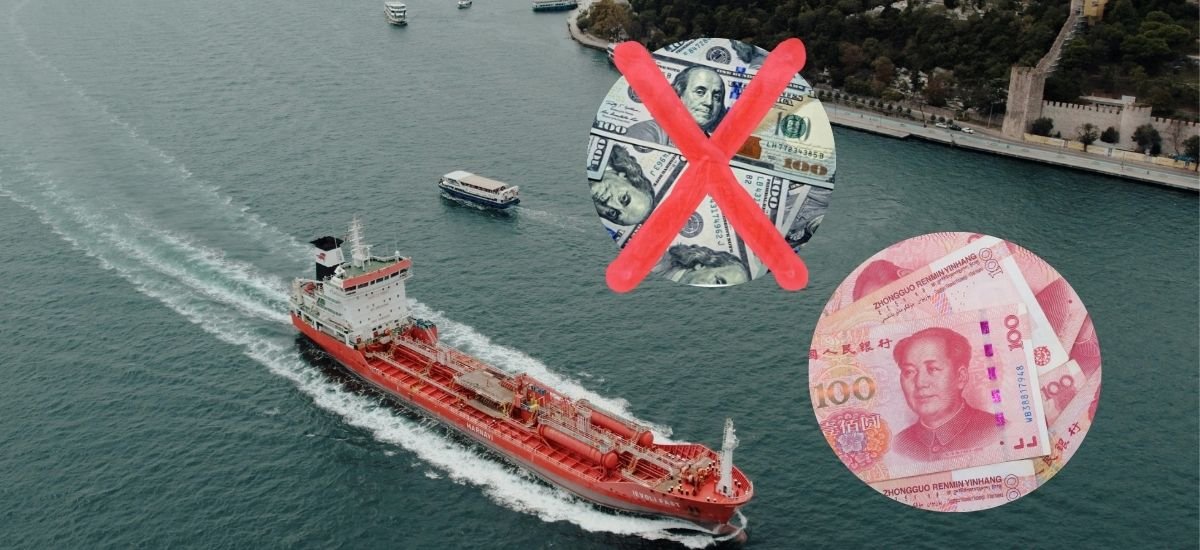
On March 14, 2026, a senior Iranian official told CNN that Tehran would allow a limited number of oil tankers through the Strait of Hormuz on a single condition: payment must be made in Chinese yuan, not US dollars. In a war that began with American and Israeli airstrikes on Iran on February 28, that one sentence may prove more consequential than any missile fired. It directly attacks the financial architecture that has underwritten American global power since 1974. And for Africa, the continent most exposed to dollar dependency and most positioned to benefit from a multipolar currency order, the consequences are structural, not peripheral.
The Strait of Hormuz is the single most important chokepoint in global energy. Approximately 20 percent of the world’s oil supply transits it daily. Since March 4, 2026, Iranian forces have effectively closed it to vessels linked to the United States, Israel, and their Western allies, following the joint US-Israeli military campaign that included the killing of Iran’s supreme leader. Oil prices moved from around $70 per barrel to above $110 within days of the closure. QatarEnergy declared force majeure. European energy markets went into crisis. The pipeline alternatives, including Saudi Arabia’s East-West pipeline to Yanbu and the Fujairah bypass in the UAE, carry a combined capacity that falls approximately 12 million barrels per day short of what previously transited Hormuz. There is no volume solution. Iran holds the physical leverage.
What changed on March 14 is that Iran converted physical leverage into financial leverage. The yuan condition is not a commercial preference. It is a direct attempt to use military control of a shipping lane to force a currency shift in global energy trade, specifically to dismantle the structural global demand for US dollars that the petrodollar system has generated since 1974.
What the petrodollar actually is and why it matters
The petrodollar system is not a treaty, a law, or a formal agreement in the conventional sense. It is an arrangement that originated in 1974 when the United States and Saudi Arabia agreed that Saudi oil would be priced and traded exclusively in US dollars. Every other OPEC nation followed. The structural consequence is that any country anywhere in the world that wants to buy oil must first acquire US dollars. This created permanent, structural global demand for the dollar regardless of trade balances, inflation rates, or the underlying health of the American economy. The US could borrow cheaply, fund its military, and deploy dollar-based sanctions as economic weapons because the world had no alternative settlement system for energy.
That arrangement formally expired in June 2024 when Saudi Arabia chose not to renew the 50-year petrodollar agreement and announced it would accept yuan, euros, and digital currencies for oil. Saudi Arabia has since signed a $7 billion currency swap agreement with China and joined the mBridge platform, a blockchain-based multi-central bank digital currency system that allows cross-border settlement outside SWIFT entirely. By November 2025, mBridge had processed over $55 billion in transactions, with the digital yuan accounting for 95 percent of volume. The infrastructure for a post-dollar oil settlement system already exists. What Iran did on March 14 was fire a weapon using that infrastructure as the barrel.
Separating fact from speculation
Several claims circulating about the Iran-yuan proposal require calibration before any analysis of consequences.
What is confirmed: CNN, citing a senior Iranian official, reported on March 14 that Iran is considering allowing limited tanker passage through Hormuz if cargo is settled in yuan. Multiple outlets including IranWire and the Financial Times subsequently reported that Asian trading houses have begun exploring yuan-denominated crude contracts for Persian Gulf cargoes. Three major commodity traders told Reuters they had received inquiries from Gulf-based charterers about structuring voyage charters with yuan settlement options.
What is not confirmed: Iran has not formally implemented a yuan-only passage policy. No public decree has been issued. The proposal remains, as of this writing, a condition being discussed in Tehran and signalled through diplomatic channels, not an operational enforcement mechanism. Chinese analysts cited by the South China Morning Post have reacted with explicit caution, noting operational feasibility limits and the risk of straining China-US relations if Beijing is seen as the financial enforcer of an Iranian blockade.
What is structurally real regardless of implementation: the dollar’s share of global foreign exchange reserves has declined from 71 percent in 2000 to approximately 56 percent today. China’s Cross-Border Interbank Payment System (CIPS) now processes the equivalent of trillions of yuan daily, growing over 65 percent year on year since 2022. Russia has reduced its dollar holdings from 41 percent of reserves in February 2022 to between 13 and 18 percent by late 2024, demonstrating that forced de-dollarisation can compress transition timelines dramatically. Iran’s proposal, even if only partially implemented, accelerates a structural shift already underway.
What this means for Africa: the specific exposures
Africa is not a spectator in this story. The continent has three direct and distinct exposures.
The first is the oil import bill. Most African nations import oil priced in dollars. When the dollar strengthens under a supply shock as it has during the Hormuz disruption, the real cost of oil imports rises for every African government holding local currency reserves. Nigeria, Kenya, Ghana, and Egypt have all experienced severe currency pressures in recent years, in part because of exactly this structural exposure. A world in which oil can be purchased in yuan would reduce that exposure for African nations with existing yuan trade relationships, which is most of them given China’s position as the continent’s largest trading partner.
The second exposure is reserve management. African central banks currently hold the majority of their foreign exchange reserves in US dollars. If the dollar’s structural demand weakens because fewer nations need it to buy oil, those reserves lose value in real purchasing power terms. This is not a theoretical risk. It is the same dynamic that has eroded dollar reserve share globally over two decades. For smaller African economies with limited reserve buffers, the adjustment could be sharp.
The third is the trade opportunity. Africa has already positioned itself as a critical mineral supplier for China, a major recipient of Belt and Road infrastructure financing denominated in yuan, and an active participant in BRICS financial architecture, which now includes Egypt, Ethiopia, South Africa, and most recently several other African economies. Africa also has the largest oil and gas export position relative to its financial system of any region in the world, which means African energy exporters who can price in yuan face a credible new settlement option for their largest customer.
Existing coverage on this platform has documented Africa’s $360 billion infrastructure pipeline, its position as Europe’s emergency gas backstop, and the paradox of a continent sitting on 125 billion barrels of oil reserves while paying world prices for fuel. The Iran yuan condition inserts a new variable into every one of those calculations.
Three scenarios for what comes next
The analytical work here is not prediction. It is probability-weighting. Three scenarios bracket the realistic range of outcomes.
Scenario one: the proposal collapses. China refuses to formally back the yuan-for-passage arrangement because the risk of escalating tensions with the United States outweighs the geopolitical benefit. Iran lacks the enforcement capacity to sustain a bifurcated tanker regime under sustained US naval pressure. The Hormuz disruption resolves through diplomatic negotiation, oil prices retreat, and the dollar reasserts its dominant position. For Africa, this means a return to the pre-conflict status quo: dollar dependency, high import costs during future supply shocks, and continued slow-motion reserve diversification. This scenario is possible but becomes less likely with every week that the Hormuz disruption persists.
Scenario two: partial institutionalisation. Iran allows passage for Chinese, Indian, and Turkish-flagged or Chinese-destination cargoes settled in yuan, while Western-linked vessels remain targeted. This creates what analysts are already calling a bifurcated oil market: two pricing tiers, a dollar lane and a yuan lane, operating simultaneously. Saudi Arabia, under sustained economic pressure and facing China as its largest customer, accelerates its existing currency swap and mBridge participation into a formal yuan pricing arrangement for Chinese-bound cargoes. This does not kill the petrodollar. It creates a parallel system. For Africa, this is the scenario with the most complexity. African oil exporters gain a new settlement option for Chinese buyers. African oil importers gain a potential cost reduction if they can access yuan settlement channels. But African central banks face a more complicated reserve management challenge as two dominant settlement currencies compete.
Scenario three: accelerated transition. The combination of the Hormuz yuan condition, Saudi Arabia’s existing multi-currency infrastructure, and the demonstrated functionality of mBridge creates a critical mass of non-dollar oil settlement that tips market convention. More Asian buyers demand yuan pricing not just for logistical reasons but for the safety discount it confers in the current conflict environment. The yuan’s share of global oil settlement rises from its current marginal position toward 20 to 30 percent within three to five years, mirroring the trajectory that analysts studying the OAPEC data have modelled. This is not the end of the dollar. The yuan remains incompletely convertible, China’s capital markets remain opaque by global standards, and no single currency is positioned to replace the dollar’s institutional depth. But it is the end of the dollar’s monopoly over energy settlement. For Africa, this is the scenario in which the continent’s existing yuan trade infrastructure, built over two decades of Belt and Road engagement, becomes a competitive advantage rather than a political liability.
The limits of the yuan alternative
Any credible analysis must include the structural constraints on the yuan’s rise. The yuan is not freely convertible. China’s capital controls mean that countries receiving yuan for oil exports cannot freely invest those yuan in global financial markets the way petrodollar recycling worked. The depth and liquidity of US capital markets, with daily foreign exchange trading volume exceeding $7.5 trillion and the dollar involved in 88 percent of all currency transactions, represent barriers that no alternative has yet overcome. The yuan’s current share of global foreign exchange reserves is approximately 2.6 percent, up from zero in 2000 but a fraction of the dollar’s 56 percent.
The more realistic near-term outcome is not yuan dominance but currency multipolarity: a world in which oil is routinely settled in dollars, yuan, euros, and potentially gold-backed digital currencies depending on buyer, seller, and routing. mBridge is already building that infrastructure. What Iran’s Hormuz gambit has done is compress the timeline for that transition by making the cost of dollar dependency visible to every energy importer simultaneously.
The Africa dimension that is not being covered
The international financial commentary on this story has focused almost entirely on the US-China dynamic. What is being missed is the Africa layer. Twenty-two of the world’s 54 African nations are oil importers with no domestic production. For all of them, the Hormuz disruption has already raised import costs, strained foreign exchange reserves, and complicated fiscal planning. Africa’s gas export surge is well documented. What is less visible is that the same disruption creating European demand for African gas is simultaneously creating the conditions for African energy exporters to demand yuan settlement from their largest buyers. Nigeria, Angola, and Libya all export significant volumes to China. They all hold yuan trade relationships through existing swap agreements and Belt and Road finance. The Hormuz yuan condition is, for these exporters, not a crisis but an opportunity to formalise what informal channels have been doing for years.
And there is a deeper historical echo. Muammar Gaddafi spent the years before 2011 advocating for a pan-African gold-backed dinar for oil trade. The proposal was never implemented. What Iran’s yuan condition has done in 2026 is demonstrate, at scale, that an alternative to dollar oil settlement is operationally feasible, financially backed, and militarily enforced. The question for African policymakers and executives is not whether to have a view on this transition. It is whether they have the institutional infrastructure and strategic clarity to benefit from it rather than simply absorb the volatility it generates.
Bigger Picture: The petrodollar system was not killed by Iran on March 14, 2026. It was already dying, slowly, of the very weapon it created: the dollar-denominated sanction regime that pushed Russia, Iran, and increasingly large parts of the Global South to build the exits that are now wide open. What Iran did was kick the door. The mBridge infrastructure, the China-Saudi currency swap, the CIPS payment rails, and the yuan futures contracts launched in 2018 are the exits behind it. For Africa, the transition from a unipolar dollar system to a multipolar currency order is not a threat to be managed. It is a structural shift to be positioned for. The continent’s Chinese trade volumes, yuan swap lines, BRICS membership, and energy export surplus all position it better for a petroyuan world than almost any other major emerging market region. The executives and policymakers who understand that now will be several moves ahead of those who wait for the outcome to become consensus.
Source: CNN / South China Morning Post / Financial Times / Reuters