
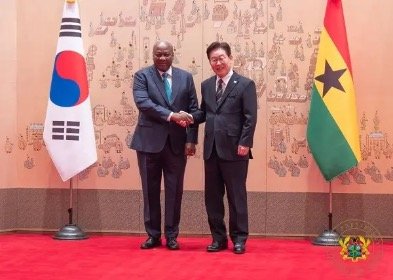
Ghana’s President John Mahama held bilateral talks with South Korean President Lee Jae Myung on March 11, positioning Ghana as Korea’s commercial gateway into Africa’s 1.4 billion-person single market under the AfCFTA.
The meeting, held during Mahama’s visit to Seoul, centred on expanding a partnership that already spans maritime security, agriculture, and trade. Mahama pointed to the AfCFTA secretariat’s Accra base as a structural advantage: Korean firms manufacturing in Ghana gain preferential access to all 54 African markets without additional tariffs.
- Ghana and South Korea share a diplomatic relationship dating back decades. President Lee noted a cultural thread that has run through it for over 50 years: the "Ghana" chocolate brand, made from Ghanaian cocoa, has been a household name in Korea since the 1970s, a rare example of an African commodity embedded in Asian consumer identity.
- Both presidents identified technology transfer as a priority. Mahama framed Ghana’s natural resource base and workforce as complementary to Korea’s manufacturing and innovation strengths, a pairing that could produce Korean-invested industrial capacity for continental export.
- Lee took office in June 2025 following the impeachment of his predecessor Yoon Suk Yeol and has since pursued an active diplomatic agenda across Asia and now Africa. His administration has prioritised broadening economic partnerships as South Korea manages trade pressure from the United States.
- Korea is not a major FDI source for Ghana today, but Korean conglomerates have significant Africa exposure in infrastructure, electronics, and automotive sectors across the continent. The bilateral conversation signals intent to deepen that footprint through Ghana specifically.
Ghana’s pitch to Korea is structurally sound. The AfCFTA secretariat in Accra gives Ghana a legitimate claim to continental gateway status that few African capitals can match. Korea, navigating a complex trade environment with both the US and China, has strategic reasons to diversify its manufacturing and investment partnerships. For Korean firms weighing African market entry, a Ghana base offers a stable democratic environment, an English-speaking professional workforce, Atlantic port access at Tema, and tariff-free reach across the continent.
Bigger picture: The Mahama-Lee meeting reflects a broader pattern: African leaders are actively courting Asian economies outside China as alternative technology and investment partners. South Korea brings something distinct: world-class manufacturing in shipbuilding, semiconductors, automotive, and consumer electronics, sectors where Africa has deep import dependency and little domestic production. For Ghana, converting diplomatic goodwill into signed investment agreements is the hard part. The AfCFTA gateway pitch is compelling on paper. Execution requires industrial zone infrastructure, power reliability, and logistics connectivity that Ghana is still building. But the conversation is the right one, and the timing, with Korea actively seeking to diversify beyond its traditional partners, is better than it has been in years.
Source: Ghanaian Times