
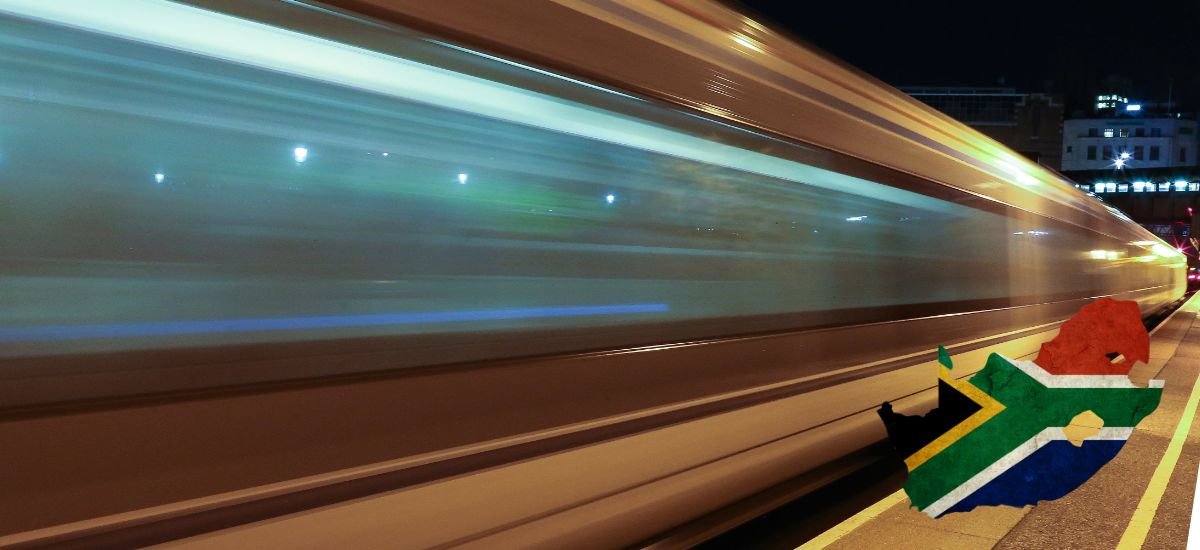
President Cyril Ramaphosa used his 2026 State of the Nation Address to recommit South Africa to its $34 billion bullet train programme, revealing that nearly 30 companies have formally expressed interest in the project and that the government is preparing to issue a request for proposals after years of feasibility work. The flagship route is the Limpopo-Gauteng Speed Train, a 500km corridor linking Pretoria to Polokwane and on to Musina at the Zimbabwe border, with a second strategic line planned from Johannesburg to Durban. Construction is targeted for late 2026; first trains by 2030. Parliament responded with jeers from opposition benches, a reminder that South Africa has been promising high-speed rail since 2010.
- The Pretoria to Polokwane route spans roughly 500km and will operate at an average speed of 177 km/h, exceeding 200 km/h on specific segments. That cuts the current five-to-six-hour car journey to 90 minutes. Planned stations include Hammanskraal, Bela-Bela, Mokopane, Louis Trichardt, and Musina. Phase 1 covers Pretoria to Polokwane; Phase 2 extends north to the other stops.
- Ramaphosa confirmed that the Department of Transport issued a request for information last year and that the response from almost 30 companies, spanning engineering, rolling stock, construction, and finance, validated commercial appetite. The next formal step is a request for proposals, which the government says will open competitive procurement. No timeline for RFP issuance was given beyond the SONA commitment.
- Feasibility studies and environmental impact assessments have been underway since mid-2025. Land acquisition along the corridor remains a significant risk: negotiations with landowners have historically delayed South African infrastructure projects by years. Construction cannot begin until those assessments conclude and land is secured.
- The Johannesburg to Durban line, identified as the most commercially viable route given its potential to compete with air travel on that corridor, carries an estimated price tag of around $30 billion on its own. China has been cited as a potential foreign partner for that line. Gauteng province has separately pledged R120 billion to expand the Gautrain network from 80km to 230km, which would integrate with the bullet train at Pretoria.
- The political history is long and the credibility gap is real. High-speed rail was first proposed by then-Transport Minister Sibusiso Ndebele in 2010. Ramaphosa first promised bullet trains in his 2019 SONA. Cabinet approved a high-speed rail framework in November 2023. The 2024 SONA confirmed feasibility studies. The 2026 SONA has advanced the narrative to “nearly 30 companies interested” and “RFP being prepared,” a meaningful step but not a shovel in the ground.
South Africa’s bullet train ambition now sits in the narrow window between credible momentum and a credibility problem. The interest from 30 companies is genuine signal: private capital does not file formal expressions of interest without commercial rationale. The feasibility work, the environmental assessments, and Gauteng’s R120 billion Gautrain expansion are all real infrastructure activity that would feed into a functioning high-speed corridor. What the project still lacks is a confirmed funding structure for the $34 billion total cost, given that South Africa’s public debt is near 78% of GDP and the government has been explicit that fiscal space is constrained. Ramaphosa’s R1 trillion infrastructure pledge, made in his end-of-year address and reinforced at SONA, provides the political framework, but the bullet train will require private capital and likely foreign partners to actually move. The RFP, when it lands, will be the real test of whether demand at information-stage translates into binding commitments.
The Bigger Picture: South Africa’s rail network has been in structural decline for over a decade. Transnet’s freight rail carries 149 million tonnes annually against a target of 250 million. The Gautrain, operating 80km in Gauteng, is the only functioning modern passenger rail in the country. A 500km bullet train at 177 km/h would be a generational infrastructure leap, not an incremental improvement. The economic case is strong: the Johannesburg to Durban corridor moves roughly 20 million passengers a year by road and air; shifting even a fraction to rail would change South Africa’s logistics economics fundamentally. But South Africa has a fifteen-year history of announcing this project and not building it. The RFP is the next gate. If it goes out this year, attracts binding bids, and a financially structured consortium emerges, 2030 is achievable. If the RFP slips, the 2010 pattern repeats. Ramaphosa knows this. So does Parliament.
Source: BusinessTech / IOL