

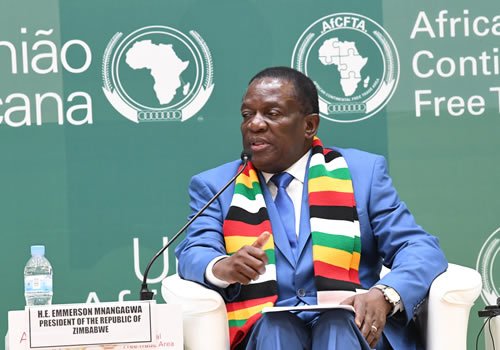
President Emmerson Mnangagwa told diplomatic missions and international organisations in Harare on March 5 that Zimbabwe is actively working to clear the $23 billion it owes multilateral creditors, calling credibility and predictability essential to restoring investor confidence and unlocking new credit lines. The statement is backed by a concrete recent development: Zimbabwe secured a 10-month IMF staff-monitored programme in February 2026, the first formal IMF engagement the country has had in over two decades.
- The IMF’s own Article IV consultation puts Zimbabwe’s total public and publicly guaranteed debt at $23.3 billion, equivalent to 72.9% of GDP, a figure that exceeds the $21 billion the government had officially acknowledged, with the gap attributed to accounting discrepancies identified by the Fund.
- External arrears stand at $7.4 billion, representing 23.2% of GDP, accumulated over more than two decades of non-payment to multilateral development banks including the World Bank, IMF, and African Development Bank.
- The IMF staff-monitored programme, secured in February 2026, is designed to establish a track record of reform credibility and lay the groundwork for formal arrears clearance and debt restructuring, including eventual access to concessional financing.
- The arrears clearance process has been running since 2022 through the Structured Dialogue Platform, co-championed by the African Development Bank and facilitated by former Mozambican President Joaquim Chissano, with three reform pillars: economic stability, governance, and land tenure compensation.
Zimbabwe’s debt crisis has its roots in the land reform programme of the early 2000s, which triggered sanctions, capital flight, and the collapse of the formal economy. Since then, the country has been locked out of international capital markets and concessional lending windows. The SDP process has made measurable progress on economic and land reforms but governance reforms remain the weakest pillar, a point creditors have consistently flagged. The February IMF deal changes the calculus: it gives Zimbabwe a formal monitoring framework for the first time since 2016, which is a prerequisite for the bridge financing of $2.6 billion the government says it needs to clear multilateral arrears and trigger comprehensive restructuring.
The Bigger Picture: Zimbabwe holds some of the continent’s most significant mineral endowment: platinum, lithium, gold, chrome, and diamonds, resources that are strategically valuable in the global energy transition. The country’s inability to access international capital markets has suppressed investment in those assets for over two decades. A credible debt clearance process backed by an IMF programme directly unlocks that bottleneck. For mining companies, development finance institutions, and infrastructure investors watching Southern Africa, the combination of Mnangagwa’s public commitment, the IMF deal, and the SDP process represents the clearest path Zimbabwe has had to financial normalisation since the Mugabe era ended. Execution risk remains high. But the architecture is now in place.
Source: Bloomberg