
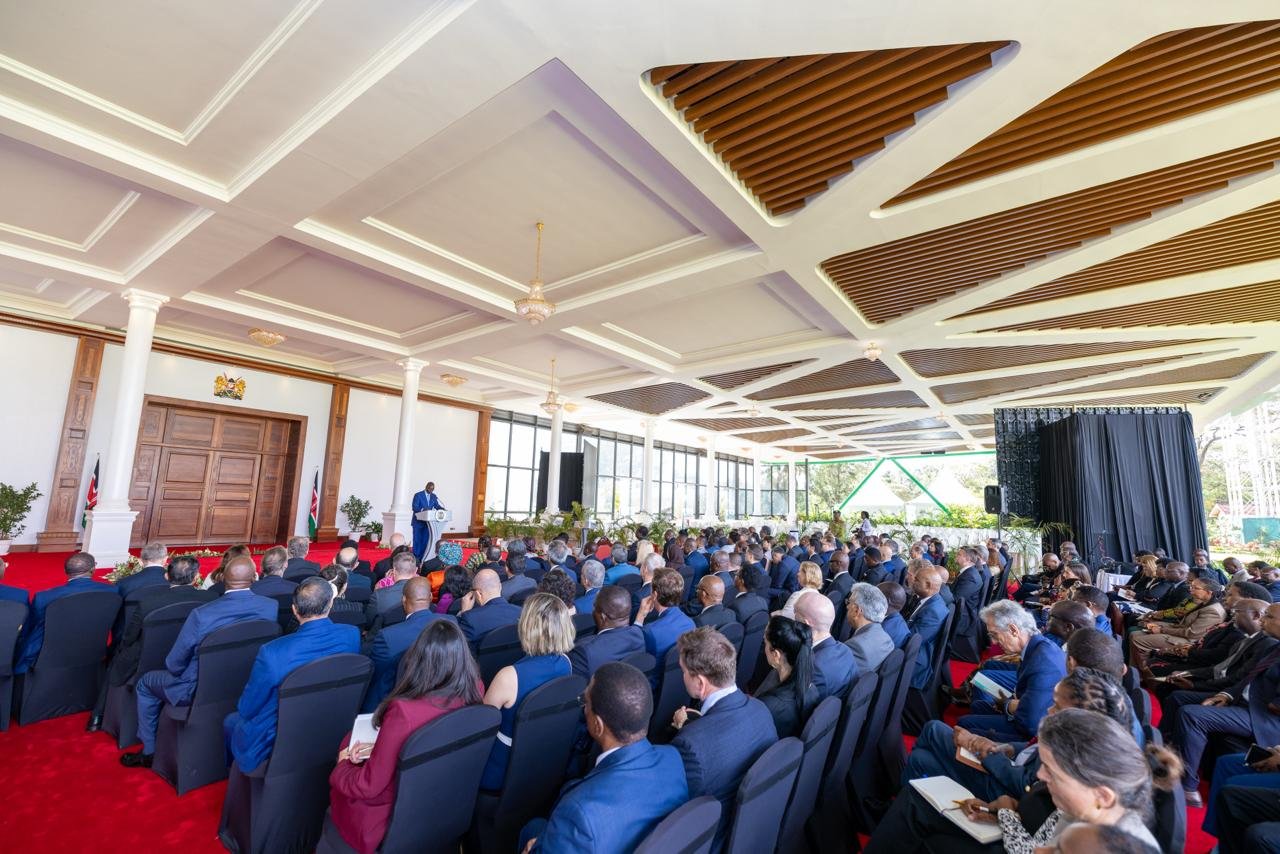
President William Ruto has made a direct pitch to global investors, development banks and pension funds to back Kenya’s newly established National Infrastructure Fund, a KSh 5 trillion ($38 billion) vehicle designed to finance a decade-long transformation programme without relying on sovereign borrowing or tax increases.
Speaking at the annual New Year Diplomatic Briefing at State House on February 9, Ruto appealed specifically to international development finance institutions, pension funds and private capital to invest in the Fund, describing it as a vehicle for long-term returns rather than charity or aid. The Fund’s priority areas are roads (28,000 km of new tarmac plus 2,500 km of dualled highways), energy (scaling generation capacity to 10,000 MW), water and irrigation (an additional 2.5 million acres under cultivation), and education and R&D spending rising from 0.8% to 2% of GDP over the decade.
A parallel Sovereign Wealth Fund, operationalised in January 2026, will accumulate revenues from natural resources, state enterprise dividends and privatisation proceeds. Legislation ring-fences all privatisation revenues exclusively for infrastructure, preventing their use on recurrent spending or debt repayment. Ruto has been working with the IFC to identify global best practices for the Fund’s structure. Kenya’s model is a hybrid combining public anchor capital with private and institutional investment, modelled partly on Singapore’s sovereign fund framework.
Not everyone is convinced. Governance experts at home have raised concerns that Kenya’s national debt is approaching KSh 13 trillion and warned that structuring the Fund as a limited liability company risks weak accountability over public assets. On the global stage, Ruto called for stronger UN funding, warned that defunding multilateral agencies undermines global capacity to respond to crises, and announced Kenya will host the Africa-France Summit in May 2026.
Context
Kenya carries one of Africa’s highest debt-service-to-revenue ratios following a decade of infrastructure-led borrowing, much of it from China. The Infrastructure Fund represents Ruto’s attempt to pivot away from concessional debt toward a capital markets and asset monetisation model. The government plans to use proceeds from selected state asset sales, including stakes in enterprises like Safaricom and Kenya Pipeline, to capitalise the fund and unlock long-term investment without adding to the sovereign balance sheet. Whether the structure can attract the scale of institutional capital required at a time when Kenya faces fiscal pressure and an IMF bailout negotiation remains the central question.
Why It Matters
If Kenya succeeds in building a credible blended finance vehicle that attracts global pension and development capital at scale, it could offer a replicable model for other African countries trying to escape the debt trap. The continent collectively faces a multi-trillion-dollar infrastructure gap, and donor aid or Chinese loans alone will not close it. A well-governed, independently managed infrastructure fund backed by real asset flows could change the financing architecture available to African governments. The Africa-France Summit in May and ongoing IFC engagement suggest Kenya is actively building the multilateral credibility needed to make the pitch stick.